John Foster Dulles: The devil’s (not) in the details
-
I did not like John Foster Dulles when I first met him.
Of course, I have never actually met him; he died 10 years before I was born. But I have been studying him and writing about him for seven years now. And I first encountered him almost 30 years ago, while I was a student majoring in history at Furman University.
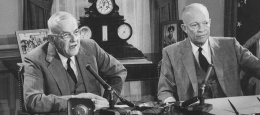
Back then, I was taking a course on “U.S. history since 1945” with one of my academic heroes, Dr. Marian Strobel, who still teaches at Furman. Dulles came up a lot in that course. John Foster Dulles was instrumental in the formation of the United Nations, served on the postwar Council of Foreign Ministers, led the negotiations which produced the Treaty of San Francisco in 1951 that formally ended hostilities with Japan, and held the position of United States Secretary of State from 1953 to 1959 in the Eisenhower administration. When Dulles died in 1959, he was nearly universally regarded as a titan of sagacity, a paragon of the statesman, and the embodiment of American prestige. His state funeral was the largest in the history of the nation’s capital to that date, surpassed just four-and-a-half years later by...
-
Should the government regulate social media content?
-
Some conservatives believe that the left-wing or progressive bias of social media giants like Facebook is so egregious that the only solution is to have the federal government regulate the content. In 2019 Mark Zuckerberg himself, founder and CEO of Facebook, called for more government regulation of the internet. This raises the question: Can the government do this in an unbiased fashion which properly respects the freedom of speech?
To ask for the government to be the arbiter of internet content assumes that the government has the knowledge to do this, the understanding of what content is “bad” and requires removal or reform, and that it can do all of these things in an unbiased manner. Essentially, it requires the state itself to be unbiased, which it is not. The two key problems in asking for the state to regulate content come down to knowing what to do and doing it in an even-handed manner. States are incapable of either. This is true whether we are talking about the central allocation of scarce resources or whether it can control politicized or harmful information.
Nobel Laureate economist F.A. Hayek, in his ground-breaking article “The Use of Knowledge in Society...

-
The solution to ‘cancel culture’ is true community
-
I remember well the first time someone told me about the existence of the world wide web and the possibility of electronic mail. It was the spring of 1992, and I was in my second year of graduate school. I was thrilled with the possibility of sending mail without paying for U.S. postage and, as a rather hardcore libertarian, I felt this was the best way to circumvent the government monopoly on the postal service. However, I soon noticed that the new technology brought changes into my life.
Prior to this, I had prided myself on writing seven-, eight-, or even nine-page handwritten letters. My family and friends had filled our letters with news, with details of great adventures, with reviews of the latest books we had read and music we had heard. We filled the entire page with snippets of poems or lyrics, with some rather inexpert doodles; sometimes, I’d paste photos into the letter or squiggle in some band name such as Rush, Talk Talk, or Yes. There was an individualistic art to long-form letter correspondence.
I still have boxes and files full of these letters received from friends, and I cherish them as some of my finest...

-
Cardinal Stefan Wyszyński
-
Cardinal Stefan Wyszyński was born in 1901 in eastern Poland, then part of Russia. In 1924, he was ordained a priest. He earned a Ph.D. in canon law and, during World War II, served as a chaplain with the Home Army, a Polish resistance organization. In 1946, he was ordained the bishop of Lublin and, in 1948, became the Primate of Poland. In 1953, the year of Stalin’s death, the Vatican elevated him to cardinal.
Wyszyński initiated an agreement with the Communist government of Poland to guarantee the basic rights of Catholics. Contrary to his critics, this came from his sober analysis of the socio-political circumstances, rather than his sympathy to Communist ideology. When it became evident the state would not keep its promises, the bishops issued a new document known as “Non possumus,” highlighting the persecution of the church in Poland, especially state attempts to control the appointment of bishops. “If external factors would prevent us from appointing competent people to spiritual positions, we are determined to leave them unfilled, rather than to give the religious rule of souls to unworthy hands,” the Polish bishops wrote.
The letter was the last straw for Communist officials, who arrested...

-
Social media censorship: Regulation or innovation?
-
In the past, when some wild-bearded rebel emerged from the jungle to cry “Revolution!” and tried to topple the generalissimo of some humid non-democracy, among the first things on his to-do list was to take over the radio and television stations and newspapers. This was because controlling the news was extremely important. If the rebels could convince the nation that the revolution was desirable, or unstoppable, the generalissimo’s soldiers might drop their rifles, as his cronies scamper for the border and tap into their Swiss bank accounts. El Jefe could then be introduced to a firing squad while the populace blinked up at a new flag and fingered currency bearing unfamiliar faces.
Today, we have more than radio, television, and newspapers as news sources for the power-hungry to covet. Websites, search engines, and social media are the new instruments of political power.
A majority of Americans get their news from news websites (33 percent) or social media (20 percent), according to a Pew Research Center survey from August 2018. Young people were nearly twice as likely to rely on social media (36 percent). These numbers suggest that, in time, news websites will remain strong and social media’s influence will...

-
Lower taxes, higher giving
-
“Conservative voters tend to be more selfish,” a socialist friend recently told me. In broad terms the allegation is that fiscal conservatives, those who support lower taxes and less government intervention and redistribution, do so for their own benefit. The hard-hearted caricature of someone who has no personal need for welfare spending, and so wants to pay as little as possible towards it, is a popular stereotype on the Left. But is that true? I wanted to test the hypothesis against verifiable data.
Of course, there are many reasons besides avarice for opposing government welfare. It is inefficient – not just because it is administered by an often-dysfunctional bureaucracy, but also because politicians regularly fail to direct money where it is most needed. Government spending programmes can create perverse incentives, discouraging people from working, encouraging family break-up, and propelling themselves forward by their own inertia.
But stereotypes are not proved or disproved by economics or philosophy. What I wanted to see was how people actually behave. Does a belief in lower taxes and smaller government stem from greed, or does it encourage people to take private action to help others, rather than relying on the government? Do supporters of low...

-
Socialists to confiscate church property in Montenegro
-
Events in Montenegro underscore how property rights, parental rights, and religious liberty go together. That nation’s socialist leadership passed a law allowing the government to seize religious property, declare a monopoly over the education of the youngest children, and limit parents’ ability to raise their children in their faith.
On December 27, 2019, despite popular opposition, the Parliament of Montenegro passed the law on “freedom of religion or beliefs and legal status of religious communities.” Before the members of the ruling Democratic Party of Socialists and their coalition partners voted on the law, 18 Members of Parliament – who belong to the opposition Democratic Front – were arrested. The law passed in the dead of night and without a proper dialogue with the largest and oldest church in the country, the Serbian Orthodox Church, nor with other religious communities. Furthermore, it passed without popular support. This law and the process by which it was adopted speaks volumes about the government of Montenegro and about socialism’s disregard for religious and parental rights.
Since 1991, Montenegro has been ruled by Milo Đukanović, the president of the Democratic Party of Socialists. Previously, Đukanović served four terms as prime minister. President Đukanović is a...

-
Acton Briefs: Winter 2020
-
A collection of short essays by Acton writers, click a link to jump to that article:
- Prosperity and the ‘Four Horsemen of the Optimist’ by Patrick Oetting
- Big government and corruption correlate: Study by Joshua Gregor
- The uneasy conscience of a fair trade fundamentalist by Jordan J. Ballor
Prosperity and the ‘Four Horsemen of the Optimist’
Patrick Oetting, Acton Institute
Currently, less than 10 percent of the global population lives in extreme poverty. Yet a study from the Barna Group recently found that 67 percent of Americans believe the global poverty rate is increasing. The good news is broader and more expansive than poverty measures. Globally, people are living longer, eating more calories, drinking cleaner water, becoming more educated, experiencing less violence, and suffering lower maternal death rates during childbirth.
In his latest book, More From Less, Andrew McAfee attributes this unprecedented global progress to the “Four Horsemen of the Optimist”: technological progress, capitalism, responsive governments, and political awareness. These advances have come at the same time that we are experiencing what McAfee calls “dematerialization.” Since the beginning of the Industrial Revolution, exponential economic growth has meant that we were increasingly hard on our planet – using more...

-
Editor's Note: Winter 2020
-
“Almighty God hath created the mind free,” wrote Thomas Jefferson. Others believe that leaves too much to chance. The desire to shape news coverage, and the proper response, frames this issue.
When “the owners of these platforms suppress or delete content they deem objectionable,” writes Acton Institute co-founder Rev. Robert Sirico, this should not properly be called censorship but “censureship.” This insight should guide all discussions on this topic.
Ed Morrow notes how search engines disadvantage right-of-center news and websites – and the laws that would rectify or formalize this behavior.
Anne Rathbone Bradley reminds us that the same decentralized information flow that establishes prices is at work in the spontaneous fact-checking of news on social media. Regulating either can grievously distort reality. The solution to the dehumanizing tendency of social media, writes Bradley J. Birzer of Hillsdale College, is the humanizing presence of true community.
First Things editor Rusty Reno engaged in two debates with Rev. Sirico over the Christian approach to state regulation. Reno expounds on his views in his latest book, Return of the Strong Gods, which is reviewed in this issue by Kai Weiss of the Austrian Economics Center in Vienna.
Education forms the leitmotif...

-
Renewing the face of the Earth
-
The most reported remarks from September’s United Nations Climate Action Summit in New York were not from a scientist, an economist, or any of the world leaders present. They were the words of 16-year-old Greta Thunberg: “People are dying. Entire ecosystems are collapsing. We are in the beginning of a mass extinction.” Her remarks were passionate, full of anger, frustration, and fear. They were not grounded in any sound science, economic analysis, or political realism. They announced a sort of secular apocalypse.
Apocalyptic thinking precedes our debate over climate change and environmental stewardship by several millennia. There is, of course, a kernel of truth to this thinking. The prophets teach us that an apocalypse is an “unveiling,” that there will be both an end to life as well as a last judgment. This tends to order the mind. The cause of that end, however, will not be merely material but providential, and “the day and the hour knoweth no man.” Moreover, it is unavoidable and, as such, creates a sense of urgency in those who believe in its coming. We learn to judge ourselves and our own actions against its looming backdrop.
Note, however, the difference with the apocalyptic thinking...

-
The faith of the secularist
-
This Life: Secular Faith and Spiritual Freedom
Martin Hägglund | Pantheon Books | 2019 | 450 pgs
In his newest book, Martin Hägglund turns religious faith upside down. This Life constitutes a full-scale denial of the transcendent – on any level of human perception – and a declaration that religion is “unnecessary, ”“boring,” and worst of all, obsessed with “eternity.” Hägglund finds this last feature particularly odious, because religious faith calls people’s attention away from the values that he believes really matter – namely, the needs of the present life – in favor of an “other-worldly” consciousness that prevents them (and society at large) from experiencing true “freedom.” The necessary substitute for this misplaced faith in religious dogma, the author insists, is a “secular faith,” a “new” perspective on the value and extent of our finiteness. In this, he notes, his thought is indebted to the insights of the much “misunderstood” Karl Marx.
This Life is divided into six chapters intended to elucidate the nature of “secular faith” (Part One) and “spiritual freedom” (Part Two). The contents of Part One are organized under the intriguing titles “Faith,” “Love,” and “Responsibility,” which convey the author’s desire to mimic the Christian virtues...

-
Founding a Republic of Letters
-
Beyond Tenebrae: Christian Humanism in the Twilight of the West
Bradley Birzer | Angelico Press | 2019 | 258 pgs
Bradley Birzer’s Beyond Tenebrae: Christian Humanism in the Twilight of the West recounts the narratives of the men and women of the previous century who dared to embrace the “permanent things.” In an age where confusion reigns about the most basic of human assumptions, Birzer writes of those who sought permanence. Beyond Tenebrae follows the pattern of Russell Kirk’s The Conservative Mind: It lays out no rubric or policy. Instead, through the lives of Christian humanists, Birzer enchants the mind and draws the reader into a living dialogue of letters.
Tenebrae refers to the time of spiritual darkness between the Crucifixion and the Resurrection, when the Light of Life seemed gone from the world. The title’s metaphor establishes the present as a time of darkness, and Christian humanism as a candle burning in that darkness. Though the forces of progressivism seek to extinguish the flame, biographer Birzer shows a chain of humanists who kept alight enduring truths through their humanistic studies.
The book is divided into two parts. In the initial “Conserving Christian Humanism, ” Birzer spends six chapters...
-
Page 28 of 112