Dr. Josh Herring is professor of classical education and humanities at Thales College in Wake Forest, N.C., where he teaches liberal arts courses and directs the Certificate in Classical Education Philosophy program. He also hosts The Optimistic Curmudgeon podcast and tweets @TheOptimisticC3. 

Recent Articles by Josh Herring

  • Why this socialist sympathizer embraced free-market capitalism

    In 2011, I graduated from Hillsdale College as a mild socialist sympathizer. My studies of history had convinced me that capitalism caused as much harm as good, and that the socialistic drive to distribute economic goods to care for the weak of society resonated with Christian compassion. Between 2011 and 2016, my view changed as I discovered a deeper understanding of the biblical view of economics.

    My journey from being a soft socialistic sympathizer to finding in capitalism an economic system which best aligns with biblical Christianity began when I learned a deeper, more true story. Let me be clear: Christianity is not synonymous with any particular economics system. It is instead the story of God’s redemptive work reconciling fallen humanity to Himself. That redemption, however, tells us the true nature of the world and how we as creatures live best within God’s world. As such, I argue free market capitalism best aligns with the way God has made the world. Far from Bernie Sanders’ assertions that capitalism is grounded in human greed, capitalism is instead grounded in a strong vision of human dignity, the divine creation of reality, and the command for humans to take dominion of all...

  • Why we need virtue education

    Since time immemorial, the Western tradition has considered true education to encompass not just instruction in a given subject matter but the cultivation of students’ virtue. Aristotle considered the acquisition of virtue to be a life’s goal which, if achieved, would result in the greatest happiness. The virtuous man, he wrote, “is his own best friend … whereas the man of no virtue or ability is his own worst enemy.”

    The biblical tradition instructs parents to “train up a child in the way that he should go, and when he is old he will not depart from it.” Even American pragmatic educational philosopher John Dewey had room for some level of virtue; since the factory worker must obey, students must learn the virtue of obedience.

    The wider culture needs virtue education, because a free society relies on certain bedrock moral principles being inculcated and incarnated. We need business men, doctors, lawyers, plumbers, electricians, and grocers who act with the honesty which allows the free market to thrive. Virtue, character, ethics - these things matter profoundly, and it is one of the tasks of education to transfer the system of values from one generation to the next.


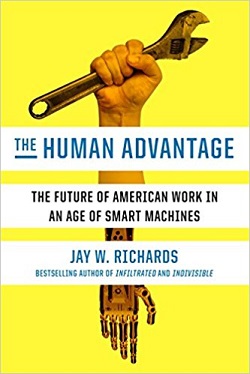
  • Book review, 'The Human Advantage' by Jay W. Richards

    The Human Advantage: The Future of American Work in an Age of Smart Machines. Jay W. Richards.
    Crown Forum, 2018. 261 pages.

    Catholic University of America business professor Jay Richards has written a humane, economically sound account of the current technological landscape, and argues that coming technological change is no threat to human labor. Labor, Richards argues, will change but not vanish. In contrast to the technophobic discourse becoming increasingly common amongst futurists and financial forecasters, Richards reminds us that the best ways to prepare for the future lie in remembering what makes human beings unique, and then developing the virtues which have sustained civilization for centuries.

    The Human Advantage begins with a brief survey of economic history, situating 2018 in a context stretching back to the hunter-gatherers of the Stone Age. He then addresses “the real challenge of our time: the rapid disruption of jobs, firms, ways of life, and whole industries.” In such a world, will “smart machines eat all the jobs?” Richards takes the fear behind this question seriously, but ultimately answers that jobs will not disappear; instead, they will transform. His economic narrative is one of continual disruption. Richards’ explains that ours is the most...

  • Edmund Burke: Philosopher for classical education

    In 1791, Edmund Burke published his Reflections on the Revolution in France. In the process of condemning the French Revolution, Burke articulated a defense of traditional life which can equip classical educators with a vocabulary to philosophically ground their educational endeavors. While classical education has exploded in recent decades, this movement of diverse schools lacks a philosophical figure who centers the goals of classical education; Edmund Burke could fill that need. Burke was a minority figure in his own day, speaking truth in opposition to those who praised the revolution. Classical education is also a minority movement in the Western world today. While writing about his own world at the turn towards modernity in France, Burke suggests three principles which are relevant to the task of classical education in the twenty-first century.

    Principle 1: Our way of life is worth preserving

    The century before the French Revolution, many philosophes (French intellectuals) argued that French civilization was so irrational and choked with superstitions that the only solution was to destroy it. Such destruction would create a tabula rasa, a blank slate, upon which the philosophes could create a new rational society. Burke watched as the National Assembly attempted to...

  • Book review: ‘Every Good Thing: An Introduction to the Material World and the Common Good for Christians’ by David Jones

    Every Good Thing: An Introduction to the Material World and the Common Good for Christians. David Jones.
    (Bellingham, WA: Lexham Press, 2016), 144 pages.

    As a professional ethicist teaching at a Southern Baptist seminary, David Jones inhabits at least three cultures. He is an academic with publications in various journals and books; he is a student of the evangelical church and its many quirks; perhaps most significantly, he is adept at walking students through complex ethical principles. As a teacher, Jones knows that people need general principles that lend themselves to clear application. That understanding lies at the heart of Every Good Thing: An Introduction to the Material World and the Common Good for Christians.

    Rather than a dense work of economic theory, Jones provides a framework that enables Christians to live in the world as material beings. He contends that, since human beings are embodied souls, economics must matter to the Christian. He traces economics back to the Greek word oikonomia, (“house-law”), defining it as both individual housekeeping and global “housekeeping.” Economics need not be a terrifying discipline populated with infinite graphs, statistics, and theories. Jones presents an economic framework accessible to all Christians, and explains...