
The Gospel of humanitarianism
-
In The Idol of Our Age: How the Religion of Humanity Subverts Christianity (Encounter Books, 2018), Daniel J. Mahoney confronts a central heresy of our age, the “remarkably truncated view of human beings” that permeates our culture. This shortsighted approach fails to “acknowledge the hierarchy of goods and values that characterize the moral order and the life of the soul.”
Mahoney traces the genealogy of contemporary humanitarianism and its critics from Auguste Comte through Pope Benedict XVI. Happily, he includes among the critics of humanism two Russian Orthodox thinkers: the nineteenth-century philosopher Vladimir Soloviev and the twentieth-century Soviet dissident and social critic Aleksandr Solzhenitsyn.
While critical of its secular proponents, Mahoney’s primary concern is with Christians who have uncritically adopted this new creed. Chief among these, he writes, is Pope Francis, “a pontiff at the intersection of authentic Christianity and a misplaced contemporary humanitarianism.” For Mahoney, humanitarian thinking leads Pope Francis to deviate from Catholic tradition on war and peace, e.g., when the pope declares “that ‘no war is just’ and that one ‘always wins with peace.’” In the economic realm, this causes the pope to offer a critique of the free market rooted in a “crude and reductive economism.”...
-
No room for debate: academia’s one-sided conversation
-
Oberlin University is paying the price of political correctness. The university complied with a court order to post a $36 million bond after an Ohio court ruled against the university in a defamation lawsuit brought by Gibson’s Bakery. The case arose from an incident in 2016 when the owner, who is a frequent target of student shoplifters, tackled an African-American male, who was subsequently arrested. The community accused the owner, who is white, of racial profiling, and the university sided with the protesters. This aspect – that university administrators would actively seek to perpetuate and support an unfounded claim – is what led to the defamation ruling initially amounting to $44 million.
During a visit to the Wall Street Journal’s editorial board, Oberlin University President Carmen Twillie Ambar said, “You can have two different lived experiences, and both those things can be true.” This sentiment has pervaded academia, where such things as personal narrative and the theory of intersectionality have become the impetus for modern activism. Lived experience has ousted reason. Empiricism has given way to the concept that one’s experience and identity solely inform truth. If truth, then, is based on your exclusive perspective, what sense does it make...

-
Marie Poussepin
-
I often notice that whenever we talk about faith and business, the discussion is mostly about businessmen and their faith. But what about women who seek to live a life of holiness in business? It’s not an exaggeration to say that they receive much less attention.
I recently read an article published on the French-language version of the Catholic website Aleteia which provides a welcome corrective to this tendency. Entitled “Businesswoman et bienheureuse, c’est possible!” and authored by Agnès Pinard Legry, it summarizes the life of a seventeenth- century Frenchwoman, Marie Poussepin. She combined the pursuit of sanctity with an active life as an entrepreneur. As Pinard Legry writes, “Her story, whether it is her business acumen or her piety, has something to inspire many busy businesswomen in search of holiness.”
Born in 1653 into a middle-class family, Marie was the daughter of a landowner who owned a silk needle mill. From an early age, she was very devout. After her mother died, Marie’s father went heavily into debt in an effort to maintain his social status. On the edge of bankruptcy, he abandoned his family.
It was at this point that Marie rose to the occasion. She...
-
The Christian Revolution
-
Figures like the Jewish scholar Philo of Alexandria (25 B.C.–A.D. 50) moved comfortably between the Hellenic and Jewish worlds. A member of a priestly family, Philo was also a Roman citizen and deeply involved in Roman politics. His brothers and nephews served as Roman officials. But Philo categorically understood himself to be a Jew and visited Jerusalem at least once.
Logos and dabhar: parallel concepts
Throughout his writings, Philo employs Greek concepts to elucidate aspects of Jewish belief. The word logos signifies at least eleven ideas in Philo’s reflections. It is one of his ways to describe the Word of God, linking it to the Jewish understanding of a personal and rational Creator who remains active in his creation, giving it meaning and order. Philo also uses logos to explain how human reason reflects God’s reason as the all-pervading Divine Logos. This unique gift of God, Philo writes, enables men to “comprehend the nature of all bodies and of all things” and, unlike other created life forms, to enjoy the power of free volition. Philo’s effort to bridge the Jewish and Greek worlds was aided by a Hebrew concept that in certain ways paralleled logos.
The Hebrew word...

-
Western Civilization: force for good or source of evil?
-
In 2016, students at Yale University called on the university to “decolonize” a reading list of canonical poets – people such as Shakespeare, Milton, Wordsworth, and so on – saying the course “actively harms students” and creates a “hostile” academic culture. The same year, students at Stanford University overwhelmingly voted down a proposal to restore a Western Civilization course requirement. This January, the University of Notre Dame announced that it will cover up a dozen “problematic” murals of Christopher Columbus’ exploits in the New World. And this summer, the San Francisco Board of Education voted to paint over an 83-year-old mural of George Washington – which was critical of his treatment of American Indians – at a district high school, calling the destruction a form of reparations.
My goal here is not to pass judgment on any particular one of these events but to comment on a prevailing attitude that promotes a one-sided focus on Western culture’s faults and failures. This method presents every affront to (highly selective) sensibilities as emblematic of broad, insidious currents that have been built into our civilization. It is ironic that, in an era in which self-esteem is touted as paramount, our cultural self-esteem has...

-
The moral hazard of ‘erasing’ student debt
-
In June 2019, Democratic presidential candidate and current Vermont Senator Bernie Sanders introduced a plan for eliminating $1.6 trillion dollars in student loans currently held by about 45 million Americans. This was more radical even than a similarly ambitious plan presented by his Democratic rival and Senate colleague Elizabeth Warren. With the election cycle for 2020 looming in the near future, this is one of several issues that will remain at the forefront of the discussion. This is especially true as candidates attempt to appeal to younger Americans, who are more likely to be impacted by the burden of student loan debt and who stand to benefit from such a plan.
But even with the debt burden being so great, and resting on the shoulders of so many Americans, is forgiveness of these loans the best path forward? Or does the system need a more fundamental overhaul?
Federal student aid comes in a few basic forms. Direct aid comes in the form of grants and loans. There are also select programs that allow for loan forgiveness for engaging in certain professions. It was not until 2013 that more than 50 percent of all undergraduate students received some sort of federal...
-
Untangling the college loan crisis
-
The current student loan crisis is a perfect, yet dismal example of policy gone wrong. It is right and good to desire the best life for our children, and for some that includes a traditional four-year undergraduate degree. But in recent years this has been upheld as the essential golden ticket for a prosperous and successful life, deemed necessary to the American Dream. Policies built on myths and fallacies can destroy an economy and, in the process, harm the very people they intend to help.
College attendance rates have skyrocketed in the U.S. since 1965, from just under six million students to just under 20 million. The biggest growth in attendance is at public universities, which account for almost three-quarters of all college students. In that same time period, the number of students who graduate with four-year degrees has increased significantly.
On their face, these data are encouraging: More people desire a college degree, and more are receiving it. However, 57 percent of college graduates leave college with an average debt load of $29,000. The average cost of attending an in-state university, including room and board, has increased by almost 50 percent since the year 2000. According to data from...

-
Acton Briefs: Spring 2019
-
A collection of short essays by Acton writers, click a link to jump to that article:
- Importing drugs from Canada won’t reduce U.S. drug prices by Joe Carter
- Walmart: Corruption’s causes and consequences by Sarah Schwartz
- No, millions of Americans are not living on less than $2 a day by Joe Carter
Importing drugs from Canada won’t reduce U.S. drug prices
Joe Carter, Acton Institute
If you suffer from acid reflux, your doctor may prescribe Nexium. But at $9 a pill, the price is enough to give you a worse case of heartburn. If you live in Canada, though, you can get the drug for less than a $1 a pill.
This price disparity leads many politicians to think the solution is obvious: Americans should just import drugs from Canada or other countries where they are cheaper.
This is a plan supported by politicians ranging from President Donald Trump to Senator Bernie Sanders. Sens. Amy Klobuchar (D-MN) and John McCain (RAZ) twice introduced legislation to allow Americans to order up to a 90-day supply of medicines from a licensed Canadian pharmacy. The Democratic Party even made it a plank in its 2016 platform.
But the reason for the drugs’...
-
Editor's Note: Spring 2019
-
This issue of Religion & Liberty focuses on higher education in all its fulness.
Two statistics throw the college tuition crisis into stark relief: Since 1978 – the year the federal government offered subsidized loans to all students – the cost of college tuition has risen by 1,375 percent. And another 1,400 students default on those loans every day.
The cover story by Anne Rathbone Bradley unravels the crisis of student debt. “The essential problem of student loan debt and high tuition fees is not the loans themselves,” Bradley writes, “but the skyrocketing costs that are due to heavy government interference in higher education.” She explains the process that created our modern-day predicament and points the way to a solution.
Trey Dimsdale complements her essay with an article describing why proposals to “erase” student loan debt will only create additional moral hazards. His academic and legal background adds authority to his clear-eyed argumentation.
At that point, this issue dives deeper, asking not just how to pay for an education but what subject matter constitutes a proper education. Samuel Gregg, the Acton Institute’s Director of Research, addresses the unique strands of religion and philosophy that gave birth to liberty in this...
-
'The Godfather,' Acton, and the price of liberty
-
As far as I am concerned, the classic Godfather saga remains incomplete with only two installments. The alleged third one is remarkable only in how unremarkable it is, and when my boxed set arrived from Amazon, I immediately removed a third disk that went by the title Godfather III and threw it into the trash. It is completely unmemorable, except for one line. It is the lament of Michael Corleone: “Just when I thought I was out, they pull me back in.”
This should be a daily mantra for all who are working against any abrogation of ordered liberty throughout the world. Our work is never done. It seems the lesson is never learned. In fact, in many ways our efforts are more important in 2019 than they were 30 years ago.
Thirty years: The Acton Institute began its mission as the Berlin Wall was falling, which reunified East and West Germany and precipitated the collapse of the Soviet Union. (I still have the front page of the New York Times with the headline.) However, less than 30 years later members of the latest generation find themselves, you should pardon the expression, in solidarity with politicians in their seventies, a coalition...

-
Till we have faces
-
An Introduction to Personalism | Juan Manuel Burgos (translated by R.T. Allen) The Catholic University of America Press | 2018 | 233 pages
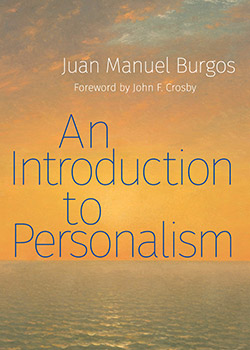
If it is true that “nature abhors a vacuum, ” then we ought to expect new ideas to arise in place of those which have proven false. Juan Manuel Burgos contends that personalism is the philosophical framework to revitalize Western thinking in the aftermath of the twentieth century, and his Introduction to Personalism is a readable introduction to a fruitful philosophical conversation.
Burgos defines personalism between two extremes. On the one hand, there are “collectivisms” like socialism and Communism that reduce humans to infinitesimally small players within a system. Materialist determinism fits on this end of the spectrum, reducing the significance of human actions by denying individual agency. This philosophy, best articulated by Hegel and applied by Marx, gave rise to various twentieth-century Communist regimes responsible for much suffering. On the opposite end of the spectrum, Burgos shows that other philosophies articulate an extreme individualism, proclaiming the absolute autonomy of each individual. Figures such as Jean-Paul Sartre and Ayn Rand developed such a radical view of individualism that relational connections become difficult; postmodernity inherited this radically...
-
9 big questions about democratic socialism
-
Democratic socialism is hot in the United States right now. Both the American media and young people seem to be enamored of the thought of steeply progressive, redistributive tax rates designed to achieve some vision of justice.
As with most public policy ideas, we tend to get pretty far down the road before we ask basic questions related to the project. In other words, we imagine a result that appeals to us before we’ve really considered whether other effects are likely and whether the proposal is morally right in the first place.
Accordingly, I encourage anyone thinking about democratic socialism to ask the following questions:
1. What is the moral basis for taxing some incomes at higher rates than others?
2. Do we imagine that incomes are entirely the result of some random process?
While John Rawls makes an argument along those lines – essentially, that no one really deserves their money because they didn’t control the family they were born into, their genes, etc. – there is a reasonable argument to be made that many people with such advantages seem to fail, while others who lack those advantages seem to succeed. In other words, attributes such as determination, hard...

-
Page 31 of 112