
Acton Briefs: Summer 2018
-
A collection of short essays by Acton writers, click a link to jump to that article:
- AU and building the free society by Jenna Suchyta
- Westminster Abbey praises God for the NHS by Noah Gould
- President Trump nominates Judge Brett Kavanaugh by Joe Carter
AU and building the free society
Jenna Suchyta, Acton Institute Intern
Over 1,000 people flocked to Grand Rapids June 18-21 to listen to more than 80 inspiring faculty members lecture on a wide variety of topics touching on liberty, faith and free-market economics. This was the 13th renewal of Acton University, Acton’s yearly four-day conference exploring the intellectual foundations of a free society. AU is all about “building the foundations of freedom” by bringing together leaders in business, ministry and development, as well as students, professors, entrepreneurs and members of the media.
Alejandro Chafuen, one of Acton’s current managing directors, was at Grove City College in October to accept the Grove City College Alumni Association’s Jack Kennedy Memorial Alumni Achievement Award for his substantial work in advancing the cause and research of liberty. As the GēDUNK put it, Chafuen and other GCC alumni seek to “build the political and intellectual infrastructure that [makes] it possible...
-
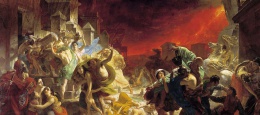
Nature, technology, and Pompeii
-
The primary mission of the Acton Institute since its inception has been identifying and revealing both traditional and innovative tonics to ward off Lord Acton’s dictum: “Power tends to corrupt, and absolute power corrupts absolutely.” In fact, the manner in which we wield our power over one another, our environment and God’s other creatures defines our humanity, or, in other words, who we are as individuals and social creatures.
Our combined tradition teaches us that humanity was not created by God to live in chains forged by other humans. Nor were we left without instructions on the care of our planet and its nonhuman denizens. Our Creator from the beginning had much better aspirations for us all.
However, one doesn’t have to be a grizzled rock guitarist and polarizing raconteur to recognize it’s one thing to respect and nurture God’s creations and another, totally different, thing to worship Earth’s flora and fauna. The former is Judeo-Christian principles practiced prudentially while the veneration of nature is mere paganism. We are called to be stewards of the environment, which entails conscientiousness of our planet’s vulnerabilities and concomitant realization of Earth’s resilience and sometimes cruelty.
Having recently returned from an archaeological dig in...
-
Power, people and things in 'Westworld'
-
Since I was a child I’ve always loved a good story. I believed that stories helped us to ennoble ourselves, to fix what was broken in us, and to help us become the people we dreamed of being.”
So begins Anthony Hopkin’s character, Robert Ford, in his speech marking the finale of the first season of HBO’s mind-bending, techno-philosophical series “Westworld.” Ford is the brilliant co-creator of Westworld, a theme park set several decades in the future in which wealthy customers can live out their fantasies, whatever they may be, with no apparent cost or consequence. The genius of Ford’s creation is not the theme park itself, though the sets and landscapes perfectly capture the nostalgic details of the vintage 1880s-era Western. What really sets Westworld apart is the “hosts” that populate the park, robots who inhabit various roles and inspire plots and who are entirely indistinguishable from the all-too-human guests who pay upwards of $40,000 a day to interact with them. And the guests do interact as they please, some choosing heroic and noble roles to play and others indulging in baser appetites by killing, raping and abusing the non-human hosts who were created for that very purpose.

-
The return of nature worship
-
We live in decadent times. Universal human rights have not been fully attained, yet radical environmentalists insist that flora, fauna and even geological features and structures should be deemed legal persons, a meme known as “nature rights.”
The drive to grant rights to the entirety of the natural world has already achieved stunning victories. In 2008, Ecuador granted human-type rights to “nature” in its constitution back, while Bolivia recently passed a law to the same effect. More than 30 United States cities and municipalities, including Santa Monica and Pittsburgh, have also granted rights to nature.
In 2014, an Argentinian court issued a writ of habeas corpus for an orangutan, declaring the animal to be a “non-human person” that had been “deprived of liberty” and requiring the animal’s release from a zoo to a primate sanctuary. Four rivers have been granted rights – three by court orders (including the Amazon and Ganges) – while the New Zealand Parliament declared the Whanganui River to be an “integrated, living whole” possessing “rights and interests.” In the United States, the Colorado River was named as a litigant in a lawsuit but later withdrawn. Meanwhile, in two separate cases, the Ninth Circuit Court of Appeals...

-
Sister Mary Kenneth Keller
-
For the first time, we can now mechanically simulate the cognitive process. –Sister Mary Kenneth Keller
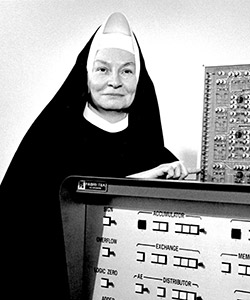
Sister Mary Kenneth Keller established herself as a strong influence in the world of computer science at a time when women in the field were unheard of. At the same time, her work paved the way for what we now understand as the information economy – a key driver of wealth creation. She was the first woman in the United States to earn a Ph.D. in computer science and later went on to help develop the BASIC programming language (Beginners All-Purpose Symbolic Instruction Code), which transformed the world of computer science.
Relatively little information is known about Keller’s early life. She was born on December 17, 1913, to John Adam Keller and Catherine Josephine (née Sullivan) in Cleveland, Ohio. In 1932, she followed God’s call to the Sisters of Charity of the Blessed Virgin Mary in Dubuque, Iowa, and in 1940 took her vows with the congregation. She then began her academic career in Chicago, completing both a B.S. in math and an M.S. in math and physics from DePaul University in 1943 and 1953, respectively.
In 1958, Keller started at the National Science...
-
The politics of apocalypse
-
"Disarmageddon” is what The Economist earlier this year called “complacent, reckless leaders” who “have forgotten how valuable it is to restrain nuclear weapons.” The politics of nuclear weapons – deterrence doctrines, mutually assured destruction and so on – have been the obsessive stuff of international politics since the Manhattan Project. There is, as Alissa Wilkinson and I argue in our 2015 book How to Survive the Apocalypse, something unique about the nuclear age, in which it becomes terrifyingly clear that human beings could end up as authors of their own destruction. The Bulletin of Atomic Scientists has run a clock on the odds, a literal Doomsday Clock, since 1947.
Debates in religious communities have run hot over things like nuclear weapons, regarding not only the use of them (which most are absolutely against) but also the possession of them. The anxiety that we have spent the last 60 years or so in creating the architecture of our own destruction is hard to miss. But nuclear weapons are just the tip of the iceberg of the politics of apocalypse, the most visible and spectacular perhaps, but a piece of a plague of fears and uncertainties about what it means to...
-
Editor's Note: Summer 2018
-
In early July, an Indian court issued a ruling that accorded the status of “legal person or entity” to animals in the state, saying “they have a distinct persona with corresponding rights, duties and liabilities of a living person.” With this measure, designed to prevent cruelty to animals, justices of the Uttarakhand High Court in northern India declared that “the entire animal kingdom, including avian and aquatic ones, are declared as legal entities having a distinct persona with corresponding rights, duties and liabilities of a living person.”
The cover story in this Summer 2018 issue of Religion & Liberty reports that “the drive to grant rights to the entirety of the natural world has already achieved stunning victories.” Writer Wesley J. Smith cites cases in places like Ecuador, Bolivia, Argentina and more than 30 U.S. cities. The New Zealand Parliament declared the Whanganui River (pictured on our cover) to be an “integrated, living whole” possessing “rights and interests.” Smith warns that unless “we act to ensure that only human beings and our associations and enterprises are the proper subjects of rights and legal standing in courts of law – we face a darker and less prosperous human future.”
Robert J...
-
Labor unions, yesterday and today
-
Along-cherished predisposition on the part of the Roman Catholic Church is that labor unions act as a protection against the exploitation of workers. From Pope Leo XIII’s 1891 encyclical Rerum Novarum forward, the Church has been an outspoken proponent of organized labor, worker safety and human dignity.
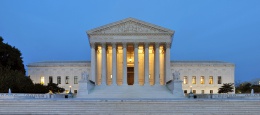
Thus, it comes as little surprise that the U.S. Catholic Conference of Bishops weighed-in when the U.S. Supreme Court heard arguments in February regarding the Janus v. American Federation of State, County, and Municipal Employees case. At issue is AFSCME’s collection of dues from nonmembers in Illinois and the USCCB’s opposition to right-to-work legislation.
The USCCB’s amicus brief, however, succumbs to romantic notions of unions protecting employees from the child-labor sweatshops out of some 19th-century Dickensian dystopia or even Solidarity, the 1980s Polish trade union movement’s struggle against oppression of workers by the Communist state. The contemporary reality of collective bargaining, particularly that conducted by public- sector unions, is vastly different.
“Beginning with Rerum Novarum in 1891, the social doctrine of the Catholic Church has contained ‘repeated calls ... for the promotion of workers’ associations that can defend their rights”, reads the USCCB’s brief, quoting in part Pope Benedict XVI’s encyclical Caritas in...
-
Arvo Pärt and the universal soul of music
-
Sacred music is not only a devotional exercise composed and performed to honor our Creator but also a bulwark against human sinfulness and frailties. Composer Arvo Pärt has been creating music of faith that inspires while at the same time subverts several of the most oppressive systems of government of the past century.
The composer’s lifelong development as a professional composer also led him to a deeper faith. He converted to Orthodox Christianity in 1972.
Theologian Peter Bouteneff observed that Pärt is frequently connected with the sacred life. “Although the composer’s religious affiliation is specifically Orthodox Christian, his music and its impact carry an appeal beyond confessional and religious boundaries, ” he said. “His popularity crosses over customary distinctions between classical and popular music, sacred and secular art, liturgical space and concert hall.”
Born in Estonia in 1935, Pärt (pronounced PAIRT) emerged as one of the most prominent composers of the past 75 years. His music exhibits deep religious faith that once was brutally suppressed by the state, which was a republic of the Soviet Union from 1940 until independence was declared in 1988.
Early years
Pärt learned to play piano on a keyboard that was missing several keys. He...

-
GMOs, CRISPR and the fight against hunger
-
Then God said, ‘Let the earth sprout vegetation: plants yielding seed, and fruit trees on the earth bearing fruit after their kind with seed in them’; and it was so.”
–Genesis 1:11
Thus began humanity’s reliance on the earth and its bounty for sustenance, aesthetics and a persistent reminder of – in the words of Gerard Manley Hopkins – “God’s Grandeur.”
The Jesuit priest and poet cast a cold eye on humankind making a hash of the environment. He further asserted that the encroachment of civilization has disconnected Earth’s inhabitants from the natural world.
Hopkins depicts the majority of humankind as oblivious to God’s presence throughout nature and further unaware that God’s handiwork will endure despite human ineptitude or natural disasters. Such temporal matters are usurped by God’s concern for all His creation, which is divinely nourished and protected: “Because the Holy Ghost over the bent/World broods with warm breast and ah! bright wings.”
However, there are times when widespread drought and other weather events and pestilence destroy carefully cultivated agricultural crops. The economic impact on farmers can be devastating, while the societal impacts are potentially apocalyptic.
Human efforts to either alleviate the negative impacts of pests and droughts or...

-
Edith Penrose
-
I don’t take sides. I just gather facts and if people don’t like my work they just don’t like the facts.
–Edith Penrose
Economist Edith Penrose helped bridged the gap between economics and business strategy. While Penrose is not as well-known as she should be, nonetheless her 1959 work The Theory of the Growth of the Firm was widely influential. American-born and living for much of her life in Britain, Penrose taught in Baghdad, London, Australia, Cairo, Beirut, Tanzania and many more places.
On November 15, 1914, Edith Elura Tilton was born in Los Angeles to George Albert Tilton Jr., a construction engineer, and his wife, Hazel. Edith received a bachelor’s degree from the University of California at Berkeley where she excelled in both academics and debate society. In her senior year, she studied under economic professor Ernest Francis Penrose. Edith would marry him in 1944.
Penrose suffered her fair share of tragedy. While hunting in 1938, her husband of just a few years, David Burton Denhardt, was mysteriously shot. No one was ever charged, but Edith was convinced he had been murdered. In February of the next year, she gave birth to their first child. She lost two brothers...
-
Acton Briefs: Spring 2018
-
A collection of short essays by Acton writers, click a link to jump to that article:
- Free trade and Brexit can help Africa flourish by Ibrahim B. Anoba
- French strike for the right to retire at 52 by Rev. Ben Johnson
- Fifty years later, cities still suffer the economic effects of the 1968 riots by Joe Carter
- How overregulation is stifling the food truck revolution by Joseph Sunde
- Lessons from a craftsman on sanctified work by Joseph Sunde
- Can economics bring back humility and civil discourse? by Steve Stapleton
- Unlocking the future of American incarceration by Kahryn Riley
Free trade and Brexit can help Africa flourish
Ibrahim B. Anoba, African Liberty Organization
In early 2018, all 54 member- states of the African Union (AU) will sign an agreement for a Continental Free Trade Area (CFTA) to make Africa the world’s largest common market. The CFTA could increase trade within the region by an unprecedented 50 percent and create about $35 billion in benefits.
This is necessary, as intra- African trade constitutes only 18 percent of the continent’s total trade – an abysmal rating compared to the European Union’s (EU) 70 percent. But a well-implemented free trade treaty could increase...
-
Page 33 of 112