
Are you brave enough to tell a joke?
-
Tickling Giants (2017) tells how an Egyptian comedian found a way to fight against and call out abusive leaders using creative nonviolence.
This new documentary directed
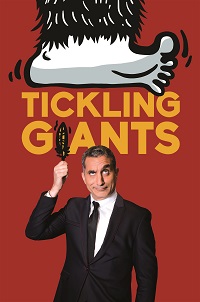 and produced by Sara Taksler follows Dr. Bassem Youssef, the “Jon Stewart of Egypt,” a heart surgeon turned late-night comedian who takes on Egyptian authority. It opens on Tahrir Square in Cairo, where protests have broken out against military control of the government. Youssef and a camera crew walk around talking to the fedup masses. Gunshots constantly go off, some in the distance and some close by.
It’s January 2011, and Hosni Mubarak is still in power. Despite him having ruled Egypt for nearly 30 years without competition, the people are suddenly taking to the streets to demand his removal. This kind of demonstration is practically unheard of in Egyptian culture. The media, who largely support whoever rules Egypt, calls the protestors “insurgents.” This is where Youssef, in a voiceover, explains the two realities that exist in Egypt: the reality on the streets and the “reality” on TV.
The protestors’ work pays off. Mubarak steps down in February 2011. Youssef is thrilled for the new direction of his nation, calling it a “New Egypt.” His...

-
Out of the frying pan into the fire
-
Once men and women leave prison, they have few options and little hope. Edwins is working to change that.
After someone has paid the price for their crime and completed a prison sentence, the difficulties of their life certainly don’t end there. In her research for When Prisoners Come Home: Parole and Prisoner Reentry, Joan Petersilia found that nearly 75 percent of men and women remained jobless up to a year after release from prison. Department of Justice research found that including a criminal record on an employment application reduced the likelihood of a callback or job offer by up to 50 percent. The United States Sentencing Commission found that more than 40 percent of ex-offenders return to prison within three years. The United States has one of the highest prison populations in the world, with nearly 7 million men and women behind bars; this costs the United States more than $80 billion per year, not including social costs.
Desperate, hopeless men and women pay their debts to society in the form of prison sentences and continue to pay in the forms of unemployment and recidivism.
Despite this gloomy outlook, there is hope. Job training, life skills and a...

-
Reagan remembered
-
Bulgaria unveils a statue to Ronald Reagan in the battleground for religious liberty.
Ronald Reagan remains the most influential U.S. president of the latter half of the 20th century. He is remembered as an optimistic advocate of free minds, free markets, free elections and the free exercise of religion. But gratitude, a universal human emotion, is not limited to the United States. Instead, it extends across the transatlantic sphere to the former Soviet bloc.
On May 10, in Sofia, the capital city of Bulgaria, officials unveiled a monument of President Ronald Reagan. Just nine days later the bust, which was erected in Sofia’s South Park, was vandalized—a red stocking pulled over the bronze head, vampire-looking paint put on the face, and the statue and the marble pedestal smudged in white. Volunteers immediately cleaned up the statue.
What was behind the vandalism? Ronald Reagan’s legacy vexes die-hard Communists more than a decade after his death on June 5, 2004. The growing popularity of Communists (and extremists favorably disposed to Nazism) is on the rise in Bulgaria. In a strange twist, due to the better life that Reagan’s ideas brought about, there is a growing trend of Bulgarians forgetting the misfortunes of the...

-
Acton Briefs: Summer 2017
-
A collection of short essays by Acton writers, click a link to jump to that article:
- "If you care about human flourishing, promote growth" by Samuel Gregg
- "Will free trade help the environment after Brexit?" by Philip Booth
- "Anti-Americanism at the Vatican" by Kishore Jayabalan
- "Our economic age of anxiety" by Victor V. Claar and Greg Forster
- "Making college expensive by making it free" by Anne Rathbone Bradley
- "Civil asset forfeiture: What you should know" by Joe Carter
- "The cooperative magic of work" by Dylan Pahman
- "The greatest crony capitalist deal in Wisconsin history" by Joe Carter
- "When good ideas cross the Atlantic" by Alex Chediak
If you care about human flourishing, promote growth
Samuel Gregg, Acton Commentary
Economic data flood our screens these days. But there’s one number upon which everyone should focus: The rate of economic growth in the Gross Domestic Product (GDP). It shows an increase in an economy’s ability to produce goods and services.
How is America doing? Not well. In the first quarter of 2017, the U.S. growthrate was a mere 0.7 percent. That’s the lowest since 2014. In fact, between 2010 and 2016, the economy grew at an annual average of only 2.1 percent...
-
Editor's Note: Summer 2017
-
As summer in Michigan begins to wind down, Religion & Liberty Summer 2017 takes a look at several important issues. We explore religious liberty in Eastern Europe, “pink” issues, Martin Luther, cooking and recidivism, the “Jon Stewart of Egypt” and more.
For the cover feature, I decided to revisit a subject we previously covered. We tracked down several graduates of Edwins Leadership and Restaurant Institute (which was profiled in the Fall 2015 issue of R&L) and talked to them about their struggles and triumphs before and after making their way to fine dining in Cleveland’s Shaker Square.
Ronald Reagan may be considered one of the most influential presidents in the United States, but what about abroad? Krassen Stanchev reflects on his enduring legacy in Eastern Europe in his essay “Reagan Remembered: Bulgaria unveils a statue to Ronald Reagan in the battleground for religious liberty.” Also from our transatlantic partners is a review of European Parliament’s new “House of European History.” Arnold Huijgen recently visited it and found a glaring omission.
The year 2017 represents the 500th anniversary of the birth of the Protestant movement. In honor of Luther’s famous (or infamous) nailing of the 95 theses, Andrew McGinnis reviews...
-
Finding 'happiness' in a Romanian gulag
-
Translated by Gabriela Ailenei nicolasteinhardt.wordpress.com
Nicolae Steinhardt was a 20th-century writer and Orthodox hermit. He was arrested by the Communist Party of Romania in 1959 when he refused to testify against a colleague who was accused of being an enemy of the people. Steinhardt himself was accused of conspiracy against social order and was sentenced to hard labor. He spent 13 years in a gulag-like prison. There he met a Bessarabian hermit and was baptized Orthodox Christian.
After his imprisonment, Steinhardt joined the Rohia Monastery where he was a librarian and wrote prolifically. Most of his writings were published postmortem after the Romanian Revolution. This includes his most famous work, jurnalul fericirii, “The Diary of Happiness.” Due to political censorship, many of Steinhardt's writings were not published until after his death, including the diary. It gained fame when it was broadcast in a series of episodes on Radio Free Europe. The following is an excerpt from this work:
All those—scholars or ordinary folk—who are satisfied to accept, as answers to the big questions man asks about his purpose in the world, about the universe and life, about suffering and injustice, phrases like: the universe has and will always exist...

-
When our success threatens our success
-
Book Review of The Complacent Class: The Self-Defeating Quest for the American Dream (St. Martin's Press 2017).

-
Using a love story to tell the world about the Holodomor
-
A review of the 2017 film Bitter Harvest.
Most Americans are familiar with the Holocaust and revile the regime that committed it. Its symbols and racist ideology evoke a visceral reaction so strong that ideologues use them against their enemies in hopes of tainting them. Knowing that this genocide really happened helps keep us on guard against allowing it to happen here. Outside of rightly vilified hate groups, no one promotes the evil and antiscientific racist ideology that drove the Germans to the “final solution.” Even those who deny the genocidal animus behind the Holocaust are vilified. This is all to the good.
The irony is that another genocide was committed in Europe and has escaped notice. The regime that committed it was no less totalitarian and its ideology no less evil and antiscientific, but its symbols and ideas evoke no widespread visceral reaction. Furthermore, the regime’s defenders and sympathizers—not to mention those who actively deny the genocide it created—receive no condemnation. This genocide is known as the Holodomor (literally, “murder by starvation”), and it was committed against Ukrainians by the Soviet regime. The USSR was committed to the creation of a “New Man” and the destruction of everything...
-
Observing the American experiment
-
The following essay is excerpted from Lord Acton: Historian and Moralist (Acton Institute 2017).
John Emerich Edward Dalberg Acton placed liberty in the forefront of all goods, moral and political. Many people are aware that the great uncompleted project of his life was the writing of a history of freedom. He saw the evolution of liberty as the work of Providence, as the consequence, as he put it, of Christ’s being “risen on the world.” Achieved liberty is the fulfillment of the divine plan. It is for this reason above all others that Acton so valued the American experiment.
Acton repeatedly noted that the Protestant Reformation and the wars of religion led to the establishment of absolutism rather than toleration and freedom. Royal power and bureaucratic administration, whether Catholic or Protestant, was substituted for the imperatives of conscience. Established churches used the power of the state to coerce the consciences of the subject. The Puritan revolution in England appealed to the higher law of conscience but then sank back into intolerance and repression. It was the sectarians, at first in England and then in America, who justified religious nonconformity by an appeal to conscience.
In one manuscript, Acton wrote: “The theory...
-
Lucretia Mott
-
In January 1793, Lucretia was born to ship captain Thomas Coffin Jr. and his wife, a shopkeeper named Anna. The Coffin family were devout Quakers living in Massachusetts. Lucretia was first exposed to the concept of equality between men and women by the example of her mother’s successful shopkeeping while her father spent long periods away at sea. She attended a Quaker boarding school, Nine Partners, where she first learned of the horrors of slavery and the Quaker teachings against the practice. She became a teacher there and met her future husband, James Mott. The two married in 1811.
Tragedy struck Mott in 1817 when her toddler son, Thomas, died. Though always religious, Mott discovered that this difficult time developed her spirituality and led her to become an official member of the Quaker ministry.
Lucretia was disgusted by the horrors of slavery and used her gift for speech to fight the institution. In 1833, she helped create and became president of the Philadelphia Female Anti-Slavery Society. When the Civil War ended and many abolitionists considered their work complete, Mott understood that the real war was hardly over. She continued to fight for black suffrage and advocated for the rights of...
-
Populists push back on global elites and expert rulers
-
Does the Donald Trump supporter in a bright red “Make America Great Again” ball cap have anything in common with the Bernie Sanders–inspired activist who fervently hopes for an end to the “political oligarchy” in America? Maybe on both the left and the right voters have finally had enough of global elites in Washington, Brussels and Davos calling the shots. In his new Acton monograph What’s Wrong with Global Governance?, Robert F. Gorman looks at the rise of a globalist ideology that seeks centralization and regulation of “wide reaching areas of international action.” Gorman is University Distinguished Professor of Political Science and International Studies at Texas State University. He spoke recently with Religion & Liberty's executive editor, John Couretas.
Religion & Liberty: In your new book, you make a distinction between globalization and global governance. You say global governance advocates tend to prefer both transnational regulation of markets and the creation of new human rights norms. If I understand you correctly, you’re not saying economic globalization is in itself a bad thing.
Gorman: Yes, I make a distinction. It’s what the scholar Marguerite Peeters would call a new global ethic that emphasizes centralization of decision-making, reducing the influence of national...
-
The middle class in an age of inequality
-
The political and social crises of our times are rooted in moral and spiritual malaise.
Writing in 2013, Moisés Naím, formerly executive director of the World Bank and currently at the Carnegie Endowment for International Peace, decried the increasing impotency of elites to lead in a fractured and fractious global public square. Naím’s concerns were voiced before the most recent surge in populist movements around the world, from Brexit to Trump’s victory in America.
As Naím put it, “Insurgents, fringe political parties, innovative startups, hackers, loosely organized activists, upstart citizen media, leaderless young people in city squares, and charismatic individuals who seem to have ‘come from nowhere’ are shaking up the old order.” In one sense, Naím’s observations were prescient and foreshadowed the localist, nationalist and populist strains of the last year or so. But in another sense, Naím’s analysis is only half the story. What Naím laments is the resulting “end of power,” as the title of his book casts it, in which political, educational and bureaucratic elites no longer are able to exercise the influence and leadership necessary to good governance in a complex and complicated world. At the same time that in Naím’s account power seems to...

-
Page 36 of 112