
Editor's Note: Spring 2018
-
We lead the Spring 2018 issue of Religion & Liberty with Rev. Ben Johnson’s eye-opening feature about the global scourge of child marriage. “Child marriage offends the Western moral tradition, which holds that minors lack the intellectual maturity and life experience to grant consent,” he writes. “But the harms it inflicts on girls, children and society are anything but abstract.” Aspects involved in reversing the perverse economic incentives behind child marriage include economic freedom, property rights and demolishing the cultural “norms” that undergird the practice.
Bruce Edward Walker contributes two pieces. One looks at GMOs and CRISPR, a gene-editing tool, and how these technologies are used in agriculture. In his other article, Walker examines the career of Arvo Pärt, the Estonian composer of sacred music. The musician, whose Eastern Orthodox faith informs his work, once said: “I am not taking the task in my music to discuss some religious or special Orthodox values. I am trying to reflect the values in my music that could touch every individual, every person.”
Acton president and co-founder Rev. Robert A. Sirico examines the tradition of Catholic social teaching on labor unions and offers a critique for the 21st century. “Despite its long history...
-
To end child marriage, change the economic underpinnings
-
On an afternoon three years ago, Sheskalo Pandey bounded through her front door to receive a life-changing message from her parents: She was going to be married.
They thought their daughter would be as happy as her childhood friends, many of whom had already found husbands. But Sheskalo was devastated. She was only 14.
Sheskalo, who lives in Nepal’s southern province of Kapilvastu, desperately wanted to continue her education, but her parents believed an arranged marriage offered everyone better financial prospects.
Suddenly, Sheskalo had an inspiration that held the key to sparing her, dozens of girls in her village and potentially millions of girls around the world from coerced child marriage: She went into business for herself.
“I begged my brother to lend me enough money to buy some colored paper and glue, ” she said. She began making and selling crafts.
Her mother agreed to give her six months to make enough money to cover her schooling fees – but if she failed, she would be married off. Her father, who was quietly supportive, spent all his savings on a bicycle to expand her sales territory.
Sheskalo paid him back within two weeks. Her entrepreneurial venture now earns more...

-
A conversation about the best policies for the environment
-
An environmental policy expert explains difficulties with environmental concerns and gives examples of the triumphs and failures we, as a society, have made to protect the earth.
"Science” doesn’t have the answers: Case of the marbled murrelet
The marbled murrelet is a small seabird from the North Pacific that nests in oldgrowth forests or on the ground at high latitudes. After an increase in logging in the 19th century, murrelet populations shrunk. According to the International Union for Conservation of Nature, the marbled murrelet is globally endangered.
Todd Myers is director of the Center for the Environment at the Washington Policy Center in Seattle. Curious how to address the issue of protecting this bird, Myers spoke to a biologist who’d spent her life studying and writing on the marbled murrelet. She explained that to protect it, a buffer should be put around the type of habitat it needs to ensure humans don’t encroach upon it. There should also be a buffer around the buffer in case of a natural disaster.
Next, Myers spoke to a forester and asked the same question, “How can we protect the marbled murrelet?” The forester explained that the forest is an ecosystem. “Everything is part...
-
Betting the ranch
-
Property rights, conservation and “social value”
You’ve spent the better part of a lifetime restoring, building and continually improving a prime piece of ranch land just outside Bozeman, Montana, one of the most desirable real estate markets in the West. You look around and comparable properties are fetching big premiums. Time to cash in your chips?
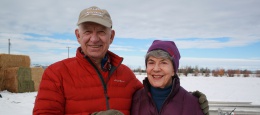
Not for John Baden and Ramona Marotz- Baden, two college professors turned ranchers who have taken their Enterprise Ranch out of development play by placing it in a conservation easement. The property is now reserved “in perpetuity” for agriculture and wildlife preservation.
“We had the opportunity to develop the land for multiple values,” Baden says. “Our goal with the ranch was to bring together liberty, sustainable ecology, and modest prosperity.”
Indeed, over the years the ranch in Gallatin Gateway, on the outskirts of Bozeman, has hosted outings for Warriors and Quiet Waters, a nonprofit co-founded by Baden that brings in service members from national hospitals to fish spring fed chain of trout ponds on the ranch. The Cancer Support Community, a local nonprofit, brings patients and family members to the ranch in the summer to fish the ponds. The local volunteer fire department has...
-
Conscientious environmental stewardship
-
I grew up in Brooklyn, an environment that was decidedly urban yet dotted here and there with parks and green spaces. So it should come as no surprise that it took me at least a couple of decades before I learned to fully appreciate nature’s bounty.
One takeaway from my sojourn as an activist on the left coast was the lessons from the Great Environmental Awakening of the 1960s and 70s. Much of the information used as a basis for our newfound concern with conserving nature stemmed from Rachel Carson’s Silent Spring.
I realize that Carson’s book prompted a host of subsequent rebuttals and even several successful attempts to debunk a few of her conclusions completely. Leaving all that aside for the purpose of this essay, I prefer to hold Carson and her work in esteem for an admittedly abstract reason.
Without Carson, her work and her book, I wonder if the modern environmental movement would have attained the same degree of urgency in so short a time. Certainly, reading newspaper stories and watching newsreel footage of the Cuyahoga River catching fire in 1969 was alarming, and the intense smog enveloping Los Angeles where I lived for a time...

-
Property rights and conservation: The missing theme of Laudato Si'
-
The recent papal encyclical Laudato si’ would have been a more rounded document if it had considered the importance of private property for the protection of the environment.
A stark example of how the lack of private- property rights can have an impact on the environment is given by the dramatic difference between forest cover on the two sides of the border between Haiti and the Dominican Republic. There is a distinct difference between the ecology of the two areas. As the United Nations puts it, “Environmental degradation in the worst affected parts of the Haitian border zone is almost completely irreversible, due to a near total loss of vegetation cover and productive topsoil across wide areas.” The Haitian side of the border is subject to almost complete loss of environmental resources. The same United Nations document reports that Haiti has 4 percent forest cover in contrast to 41 percent in the Dominican Republic.
Private ownership and the institutions that surround it provide the incentives for sustainability. Under private ownership, the value of a piece of land at anytime will reflect the present value of all that can be yielded from the land in the indefinite future. The costs of...
-
Aldo Leopold
-
"A land ethic, then, reflects the existence of an ecological conscience, and this in turn reflects a conviction of individual responsibility for the health of the land.”
-
Growing pains in the romance lands
-
“Conservation will ultimately boil down to rewarding the private landowner who conserves the public interest.” Aldo Leopold, in “The River of the Mother of God.”
In December, several dozen people gathered for conversation and drinks in Bozeman, Montana, to discuss a long-simmering controversy over urban growth in this incredibly scenic corner of the American West. The event, which drew mostly younger men and women with a penchant for community engagement, was hosted by the Gallatin Valley Land Trust, an organization that is working to conserve land from rapid development in and around this city of 45,000 people an hour’s drive from Yellowstone National Park.
“There’s a worry that people would just come for the jobs and not be invested in the community,” says Penelope Pierce, executive director of the organization. “I always marvel at how smart and curious and engaged they are.”
At the meeting, Pierce heard good things about what comes with economic growth: more cultural choices, a better restaurant scene, greater ethnic diversity and not least, more jobs and better wages. But there are also misgivings about what growth is doing to housing affordability, urban sprawl and a lack of planning. Against this, there are tensions about...
-
A balanced view of the Great Lakes
-
A review of The Death and Life of the Great Lakes by Dan Egan (W.W. Norton & Company 2017)
It’s been several months since we young-Hemingway wannabes in Michigan put away our rods and reels, cleaned our lines and continuously embellished the length and weights of the prey we caught – and especially the ones that got away. It’s a cycle we have learned to live with. There have been good years, great years and sometimes years when we couldn’t get a trout to take a worm much less a dry fly. Then there are also those pesky invasive plant and aquatic species.
The Great Lakes surrounding Michigan, Minnesota, Wisconsin, Illinois, Indiana, Ohio and New York (and, yes, Canada) are no different. Fluctuations of water levels and invasive species over the past century have threatened the vibrancy of an ecosystem estimated to contain 20 percent of the world’s fresh water – and, thus, the largest source of surface water on the planet. Additionally, the lakes boast more than 10,000 miles of shoreline.
Unforeseen consequences of human activity and downright poor stewardship of the watershed combined with naturally occurring cycles over the course of the Great Lakes’ history are only portions...
-
Acton Briefs: Winter 2018
-
A collection of short essays by Acton writers, click a link to jump to that article:
- "Wisdom on the environment" by Robert Sirico
- "Blame sin for environmental problems" by Kishore Jayabalan
- "The temptation of faux asceticism" by Andrew P. Morriss and Fr. Michael Butler
- "Pollution causes as many deaths as two jumbo jets crashing every hour" by Joe Carter
- "What is the role of the market with regard to environmental issues?" by Donald P. Hodel
- "Financial realities that affect the environment" by Samuel Gregg
- "A cleaner environment requires human creativity" by Anne Rathbone Bradley
- "3 things you should know about stewardship" by Joe Carter
Wisdom on the environment
Robert Sirico, Acton Institute
The biblical starting point for any discussion of the nature of religious environmental stewardship must begin with the witness of the Book of Genesis: “So God created man in his own image, in the image of God he created him; male and female he created them. And God blessed them. And God said to them, ‘Be fruitful and multiply, and fill the earth and subdue it and have dominion over the fish of the sea and over the birds of the air and over every living thing that...
-
Editor's Note: Winter 2018
-
For our first issue of 2018, the R&L editorial board wanted to put together a very special “green” issue. We traveled across the country and talked to many experts to bring you essays, interviews, reviews and more, focusing on the environment, good stewardship and the importance of property rights.
For the cover story, Director of Communications John and I ventured to Bozeman, Montana, and Yellowstone National Park. In “Growing pains in the Romance Lands,” Couretas describes the difficulties of preserving land while also allowing for businesses to grow and new communities to be built. In an accompanying feature, "Betting the ranch", Couretas profiles John and Ramona Baden, who put their Montana ranch into a conservation easement rather than cashing it in.
Last year, I visited Washington state where I spoke with Todd Myers, director of the Center for the Environment at the Washington Policy Center. We discuss everything from dolphin-safe tuna, leaded gasoline and the importance of where people who care about the environment actually live. You can find all that in “A conversation about the best policies for the environment.”
For our transatlantic sections, you can find an essay from Bishop Dominique Rey about why our language is so...
-
Today’s education reforms benefit religion too
-
One of the clearest consequences of school vouchers, tax credits for private schooling and other programs that provide parents with a nonpublic option for educating their children, is the growing demand for parochial placements – and not just because of their relatively low cost. The bold 2007 prediction by the Journal of Urban Economics that religious schools would prove to be the primary beneficiary of K-12 reform is turning out to be, if anything, an understatement.
Today in Indiana, where more than 34,000 children are publicly subsidized to attend private schools, a 2016 EdChoice survey found that the top reason families leave their local district is not “better academics” – which comes in second – but “religious environment/instruction.” Similarly, a study of New Orleans parents who put their children in a state-funded voucher program post-Katrina revealed that “having religious subject matter inform the curriculum” was a primary factor in their choice of schools.
With nearly half of all states offering some form of K-12 school choice, organizations such as Notre Dame University’s Alliance for Catholic Education (ACE) have been formed in recent years to ensure sufficient staffing for the predicted increase in parochial schools. John Schoenig, ACE’s director for teacher...

-
Page 34 of 112