
Don’t write off young ‘socialists’
-
In his State of the Union address this year, President Donald Trump warned of the dangers of socialism. But is there any substance to that worry?
Representative Alexandria Ocasio-Cortez (D-NY), a self-declared socialist, has made headlines with her Green New Deal proposal. And more recently, Senator Bernie Sanders (I-VT), who also identifies as a democratic socialist, has been considered one of the frontrunners for the Democratic nomination for president.
Perhaps we should not write off the president’s rhetoric as just a call back to a Cold War trope. Real socialists are growing in popularity in the United States and even winning elections. Sanders placed second in the early polls, behind only former Vice President Joseph Biden, who had yet to officially declare his candidacy.
But what is socialism?

-
‘The Great Awokening’: The threat of America’s new political religions
-
Surveys prove the decline of religion in America is real – depending on how you define “religion.”
Weekly church attendance is falling, as is self-identification with a formal denomination, religion, or belief system. Meanwhile, the rise of the “Nones” seems to be steadily replacing the religious-cultural standards and norms of old with a modern milieu of “personal spiritualties” based on any number of humanistic priorities – from humanitarianism and political activism to the exultation of garden-variety hedonism, materialism, and egotism. All these replacement faiths claim they promote the lofty goal of “progress.”
-
The Burning Bush in the Communist desert
-
From Eastern Europe to China, and from Laos to Venezuela, the followers of Marx and Engels used the most extreme forms of violence to annihilate religion. In many ways, the Bolsheviks only continued the Jacobite hostility towards “the throne and the altar.” Vladimir Lenin said in 1905, “Our propaganda, necessarily includes the propaganda of atheism.” Leon Trotsky said, “The highest expression of serfdom’s ideology is religion.” Pravda never ceased to call priests the “enemies of the people.” During the Russian famine of 1922, Lenin claimed the Orthodox Church was hoarding gold and food as a pretext to confiscate its wealth. Leading Christian intellectuals such as Nikolai Berdyaev (1874-1948), Sergei Bulgakov (1871-1944), and Nikolai Lossky (1870- 1965) were put on “the philosophers’ ship” and forced into exile. Trotsky, who organized this trip, believed that all religions expressed an “illogical primitive ignorance.” This explains how even a scientific giant like the polymath mathematician and theologian Pavel Florensky was regarded as backward. By the late 1930s, Fr. Pavel ended up martyred by the NKVD in the Gulag Archipelago.
The eminent British scholar Andrew Louth described the spiritual devastation that followed the October Revolution:
The state of the Church in the Soviet Union made...

-
The Israeli kibbutz: a victory for socialism?
-
While eating lunch at an Israeli kibbutz last winter, I learned firsthand about what used to be a self-contained, socialist community. I was struck by the local guide’s positive view that socialism produces strong communal life and economic prosperity. The guide’s praise only echoes A.I. Rabin and Benjamin Beit-Hallahmi from Michigan State University. They wrote that “[t]he most successful attempt at building a Utopian commune has been the Israeli kibbutz.” The optimism expressed by these observations is not without cause: The kibbutz movement was foundational to the establishment and success of the Israeli state.
The “kibbutz” system refers to collective communities in Israel that were historically characterized by collective ownership of property, an emphasis on the dignity of manual labor, a system of direct democracy, and communal child care. In other words, no member exercised personal property rights but instead received toiletries, food, and other necessities according to a distribution system. All members earned the same allowance for their work – regardless of whether their occupation consisted of milking cows, preparing meals, or managing a large production facility. Children did not live in their family homes but instead grew up in communal childrearing facilities. Marx would have smiled in his...

-
Antonio Gramsci’s long march through history
-
The emergence of identity politics in Western Europe has come swiftly and aggressively. One key figure in the mainstreaming of Marxism in Europe, who enjoys little popular recognition for his success, is Antonio Francesco Gramsci. Gramsci, an Italian philosopher and politician who was imprisoned during Mussolini’s reign, wrote more than 30 notebooks and 3,000 pages of history and analysis during his imprisonment. Many of his writings can be found in his three-volume Prison Notebooks.
Gramsci sought to break with Karl Marx’s economic determinism and base his theory on wielding and maintaining power by the ruling class, which has commonly become known as his theory of cultural hegemony. Gramsci believed that the ruling class, the bourgeoisie, used cultural institutions to maintain power. They use ideology, rather than violence or economic force, to propagate their own values by creating the capitalist zeitgeist. Cultural hegemony is maintained by the capitalist ruling class through the institutions that make up society’s superstructure. Gramscian Marxists define the superstructure as everything not directly having to do with production such as family, culture, religion, education, media, and law.
Gramsci’s counter-hegemony is also deeply rooted in today’s theory of intersectionality. It seeks to dismantle the existing cultural hegemony...

-
Acton Briefs: Summer 2019
-
A collection of short essays by Acton writers, click a link to jump to that article:
- Protecting farmers, or crony capitalism? by Michael Matheson Miller
- Christians in Iraq: The brutal truth by Samuel Gregg
- Should we deep-six the Jones Act? by Jordan Jorritsma
Protecting farmers, or crony capitalism?
Michael Matheson Miller, Acton Institute
Reuters has reported that a large portion of U.S. farm aid went to the wealthiest farmers and advocacy groups:
More than half of the Trump administration’s $8.4 billion in trade aid payments to U.S. farmers through April was received by the top 10% of recipients, the country’s biggest and most successful farmers, a study by an advocacy group showed on Tuesday.
Highlighting an uneven distribution of the bailout, which was designed to help offset effects of the U.S.-China trade war, the Environmental Working Group said the top 1% of aid recipients received an average of more than $180,000 while the bottom 80% were paid less than $5,000 in aid.
The EWG, a Washington-based non-profit, said it obtained data from the U.S. Department of Agriculture through Freedom of Information Act requests for its research, the results of which could not be independently verified by Reuters.As we...
-
Venerable Metropolitan Andrey Sheptytsky
-
The Venerable Metropolitan Andrey Sheptytsky dedicated his life to spreading the Gospel of Christ in the shadow of the two greatest totalitarian ideologies of the twentieth century. He promoted peace and upheld public morality, leading to his arrest or persecution by occupying Poles, Tsarist Russians, Soviet Communists, and German Nazis.
Sheptytsky was born into a noble Polish family on July 29, 1865, as Count Roman Alexander Maria Sheptytsky. Although his parents baptized him into the Latin Rite of the Roman Catholic Church, Sheptytsky petitioned to transfer to the Ukrainian Greek Catholic Church at the age of 23. When he became its leader in 1901, native Ukrainians believed he would further Latinize the church and bring it under Polish domination. Instead, he defended its Byzantine Catholic theology, supported Ukraine’s struggle for independence, and spent his family’s wealth building educational and charitable institutions.
Encounters with socialists in Russia inspired him to write well-developed social theology. He believed the Marxist doctrine of class warfare violates the Christian spirit of peace. The spread of Communism represented the “advance of the kingdom of Satan” on earth. “The enemies of God and humanity have rejected religion – the basis of social order, ” he wrote in...
-
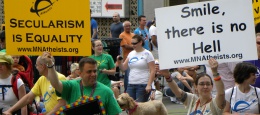
How socialism causes atheism
-
George Orwell’s 1984 defines the booming genre of dystopian literature, but Aldous Huxley’s Brave New World provided a more accurate prophecy of the future. In another of his works, Ends and Means, Huxley offered deep insights into why people choose to become atheists. In a time when 26 percent of Americans are unaffiliated with any religion, and the number of atheists and agnostics in the U.S. has doubled in the last 10 years, people of faith must pay heed to his observations. Huxley wrote that he and “most of [his] contemporaries” saw atheism’s moral vacuum as their “instrument of liberation,” because it allowed them to embrace sexual hedonism and socialism:
The liberation we desired was simultaneously liberation from a certain political and economic system and liberation from a certain system of morality. We objected to the morality because it interfered with our sexual freedom; we objected to the political and economic system because it was unjust. The supporters of these systems claimed that in some way they embodied the meaning (a Christian meaning, they insisted) of the world. There was one admirably simple method of confuting these people and at the same time justifying ourselves in our political and...
-
Single-payer healthcare: A Christian view
-
In the UK, our National Health Service was once described by a former Chancellor of the Exchequer as being the nearest thing we have to a national religion. It certainly gets a lot of support from religious leaders. Indeed, many seem to deify the NHS.
The Anglican Archbishop of Canterbury, Justin Welby, said at his enthronement: “Slaves were freed, Factory Acts passed, and the NHS and social care established through Christ-liberated courage.” This was not just an off-the-cuff remark; it was one of the most important homilies of his vocation. It is certainly true that Christians have a great deal to be proud of when it comes to the provision of healthcare. However, celebrating the creation of a single-payer, nationalised, and centrally planned system is not one of them.
The Roman Catholic Church opposed the creation of the NHS. Cardinal Bernard Griffin managed to negotiate an opt-out from nationalisation of the tiny number of Catholic hospitals arguing, “It will be a sad day for England when charity becomes the affair of the state.”
The most appropriate role for Christians is not campaigning for the state to be a monopoly provider of healthcare but to be active in the provision of...

-
Editor's Note: Summer 2019
-
“When anyone hears the word of the kingdom, and does not understand it, then the wicked one comes and snatches away what was sown in his heart” (St. Matthew 13:19). No nation has been as uniquely marinated in the Scriptures as the U.S., yet our peril is represented by two crisscrossing charts. Millennials are four times more likely to disdain religion than members of the Greatest Generation, and nine times more likely to view Communism favorably.
This issue of Religion & Liberty focuses on the interrelationship between the two words in our title, especially when both are threatened by totalitarianism. Our cover story recounts how socialist utopianism lures believers from true religion to its own secular faith. “Socialism is precisely the religion that must overwhelm Christianity,” wrote Antonio Gramsci, as Roger Kiska reminds us.
Mihail Neamtu recounts Marxist oppression of Christians in his native Romania before noting the “stories of resistance and heroism need to be fittingly acknowledged.” Additional stories recognize such heroes of the human spirit as Aleksandr Solzhenitsyn and Metropolitan Andrey Sheptytsky.
Stephanie Klaves writes the socialist Israeli kibbutz system, often celebrated as a successful example of socialism, failed because it stood at odds with Judaism and “innate...
-
First as tragedy, then as farce
-
The notion that there is a crisis in academia, and the ensuing desperate calls for reform, are as old as institutional education itself. From Plato’s Republic, to Rousseau’s Emile, down to present day calls for “free” tuition and student loan forgiveness there is never a shortage of imaginative, sweeping and, often, ultimately dangerous solutions to this perennial problem. Lord Acton spoke of this impulse in his essay on “Nationality,” and his wisdom is equally applicable to the contemporary question of education: “The office of the poets is always nearly the same, and there is little variation in the features of their ideal world; but when philosophers attempt to admonish or reform mankind by devising an imaginary state, their motive is more definite and immediate, and their commonwealth is a satire as well as a model.”
A satire, indeed. What is it about our present circumstances that has made education the focus of our own philosophers’ and politicians’ preoccupation? Thirty years ago, 24 percent of men and 17 percent of women in the United States had completed four years of college or more; today just over 34 percent of men and just over 35 percent of women in the United States...
-
Deportation and annihilation: Turkey’s genocide of Christian Armenians, Greeks, and Assyrians (1894-1924)
-
A Christian missionary working in Turkey, J.K. Marsden, described the roundup of Armenians in the town of Merzifon in the summer of 1915:
They were in groups of four with their arms tied behind their backs and their deportation began with perhaps one-hundred or two-hundred in a batch. As we afterward learned, they were taken about twelve miles across the plains to the foothills, stripped of their clothing and in front of a ditch previously prepared, were compelled to kneel down while a group of villagers with knives and axes quickly disposed of them. For a week, every night, this was repeated until twelve hundred and thirty of the leading Armenian men had been disposed of.
Exposing a buried crime
In The Thirty-Year Genocide: Turkey’s Destruction of its Christian Minorities 1894-1924 (Harvard University Press, 2019), historians Benny Morris and Dror Ze’evi have produced a new “documentary” history of the Armenian genocide that resulted from sifting through thousands of reports, letters, and diary entries from Western observers, including diplomats, military officers, Christian missionaries working in Turkey, businessmen, and other travelers. In this way, Morris and Ze’evi did an end-around the official scrubbing of the archives, or the sealing off of crucial...

-
Page 30 of 112