Marcin M. Rzegocki, is researcher, author and manager. He is assistant professor at University of Information Technology and Management in Rzeszow and CEO of Auxilium Foundation, a non-governmental organization funded by the Diocese of Tarnów, Poland dedicated to realizing projects in education and counseling according to the Christian vision of the human person.
He holds a Ph.D. in social sciences and management from the Warsaw School of Economics and an M.A. degree in philology from the University of Warsaw.
Recent Articles by Marcin Rzegocki
The mounts of piety: A case study in Christian innovation
Hard times require brave solutions. In times of economic hardship, it is important to look for ethical and moral solutions to address social problems and alleviate material poverty.
One such example is the phenomenon of the montes pietatis, or the mounts of piety, a series of medieval Christian banking institutions that provided an innovative response to difficult times.
Mounts of piety were small credit institutions conceived in late medieval Italy to support the poor in their personal and family difficulties. One of the characteristics of medieval Europe was the scarcity of money, which disproportionately affected the poor. Many were not able to meet even their most primary needs, another defining trait of the turn of medieval and modern eras.
This weakness of purchasing power gave rise to the development of the credit system on the Italian Peninsula. It was later exported by the Italians themselves throughout Europe, creating the basis of the modern banking system. Consumer credit therefore arose from the need for consumer support. This credit system was composed of both Christian and Jewish institutions, the clients of which were the "less poor poor," unlike the poorer ones to whom the practice of almsgiving was reserved.
As...

Charles Aznavour championed persecuted Christians and private property
All of Europe has been grief-stricken over the death of one of the greatest French singers of the last century. Charles Aznavour, known as the “French Sinatra,” died on October 1 at the age of 94. In his long career, Aznavour was a singer, composer, and actor. His hits included “She,” “La Bohème,” “Hier Encore,” and “La Mamma.” But this celebrated celebrity in the worlds of music and cinema may be less known for his involvement on behalf of victims of political and religious persecution, private property rights, and the world’s most vulnerable people. Charles Aznavour deserves to be remembered, not just a legendary artist, but as a great fighter for historical truth and freedom.
His sensitivity to the fate of minorities is with no doubt due to his own family history. Charles Aznavour was born Shahnour Vaghinag Aznavourian, a son of Armenians immigrants to France. His father emigrated from Akhaltsikhe in Georgia; his mother fled from Smyrna (today’s Izmir in Turkey) during the massacre of the Armenians by the Ottoman Turks in 1915. This massacre became classified as the first genocide in modern history.
This diabolical persecution, in which many of the victims were crucified, blanketed the...

In the welfare state, human life is just another budget item
Statist economic policies inevitably lead to devaluing the human person, as lamentable developments in my home country of Poland demonstrate.
After the Irish referendum which repealed the Eighth Amendment of its Constitution, Poland is the largest country in Europe in which abortion is strictly limited. This limitations date back to 1993 when, after the collapse of Communism, the Polish parliament instituted what became known as the nation’s “abortion compromise.” This new law has allowed abortion only when a pregnancy threatens the life or health of the mother; when the pregnancy is a result of a criminal act such as rape, incest, or a sexual act involving a minor; or in the case of serious fetal deformity.
This legal step toward protecting life, together with the strong ministry of the Roman Catholic Church to the unborn, bore positive fruit: The number of legal abortions performed in Poland dropped from 11,640 in 1992 to less than 2,000 yearly after 1999. And according to UN data, Poland has remained among the world’s top countries in terms of maternal mortality. Perhaps as a result of these successes, the number of people supporting abortion plummeted from 53 percent in 1992 to 12 percent in 2016.

Catholic cardinal: Karl Marx is a source of Catholic social teaching
Cardinal Reinhard Marx has given an interview to the German Sunday newspaper the Frankfurter Allgemeine Sonntagszeitung on the occasion of the 200th birthday of the philosopher with whom he shares a surname: Karl Marx, the theoretical father of scientific socialism and inspiration of Communist regimes the world over. In his interview, the cardinal — who is himself in the vanguard of progressive thought inside the Roman Catholic Church — pays tribute to the creator of Marxism.
“We are all on the shoulders of Karl Marx” he said. “Without Karl Marx, there would be no Catholic social teaching.” According to the cardinal, Karl Marx showed that human rights remain incomplete without the material well-being of people, and he praised Marx for paying attention to the real conditions of the people.
This interview, together with another one published in the Rheinische Post was reported without critical comment in the Vatican newspaper, L’Osservatore Romano, which summarized his thought thus: “Catholic social doctrine has a significant debt of gratitude towards the father of Marxist doctrine.”
“We should not have let ourselves be stolen by a capitalism,” the cardinal said, accusing capitalism of inspiring greed and nationalism. “In wars, like the First World...

Macron’s Orwellian fake news fix
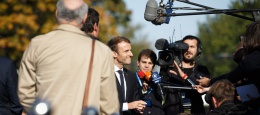
On January 3, during his first press event of the new year, French President Emmanuel Macron presented a proposal intended to "protect the democratic life" of France from "fake news." According to the French president, so-called fake news constitutes a threat to democracy itself. “We are going to develop our legal means of protecting democracy against fake news,” he said in a video posted on Twitter.
These proposals would mandate greater transparency from internet portals about the sponsored content that they publish during an election season. The identity of the advertisers and those who finance them would have to be clearly indicated. The amount of money spent for such content would be limited. It would also be possible for judges to remove fake news stories, delete the links to them, block the sites, or close the offending users’ accounts. He also announced that the Higher Audiovisual Council (CSA) would be given the power to fight against any attempt by television services controlled or influenced by foreign states to destabilize society. This refers to Russian-state-owned francophone media outlets, specifically Russia Today and Sputnik News, which are considered Russian propaganda tools.
“If we want to protect liberal democracies, we must have...