
The Flawed Greatness of Thomas Jefferson
-
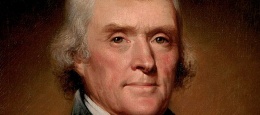
It is always hard to know where to begin with Thomas Jefferson—or where to end. In that respect, he is not that different from a great many other talented political figures in our history. The politician’s art all but requires a talent for enigma, an ability to draw in disparate followers and factions while remaining mysterious, un-pin-down-able, containing worlds of seeming contradiction within both public image and private life. Think of the tangled moral complexity of men like Woodrow Wilson, Lyndon Johnson, or Martin Luther King Jr., for example. In each of those cases, and there are a great many more that could be adduced, one must find a way to account for extraordinary moral lapses in careers that were generally successful, built around high ideals that largely benefitted the nation.
-
Antigone: A Hero for Our Time
-
Sophocles’ Antigone is a Rorschach test. People see in it whatever they are thinking. To the self-professed and much married communist philosopher Slavoj Žižek, Antigone is a “bitch,” though she may also be an admirable figure in her zealous and determined striving against her government. Or perhaps, Žižek suggests alternately, she is a troublemaker creating havoc within an otherwise healthy, well-organized state. In recent versions of the play that he has published with differing endings, Žižek has put forward both points of view. More common interpretations, however, see Antigone not as a rebel but as a self-obsessed martyr and a fanatic.

-
The Black Church: A World Within a World
-
What we mean when we use the word “Black” (and whether or not we capitalize it) causes constant confusion in American life. We are liable to contrast Black with white, and to treat the two terms as though they belong to the same category: race. But this is a mistake. As a matter of historical fact, Black Americans formed separate cultural institutions because they were excluded from white institutions or forced to be subordinate within them on account of the color of their skin. But those separate institutions, greatest among them the Black church, grew into unique and powerful cultural forces that shaped Black American life in ways that are both quintessentially American and distinctively Black. As Denzel Washington says, “It’s not color; it’s culture.”

-
The Evolving Religion of Journalism
-
With the 2016 presidential election looming, the New York Times published a journalism manifesto that was disguised as a mere political commentary.

-
The Cult of Celebrity in the Church of Christ
-
In a profile for The Guardian from 2012, Kim Kardashian was perplexed. “When I hear people say [what are you famous for], I want to say, ‘what are you talking about?’… I have a hit TV show. We’ve shot more episodes than I Love Lucy!”

-
Plato’s "Republic" and Our Own
-
The expectations of justice reside deeply within us. Figures in both the Hebraic and Hellenic worlds placed the demand for a just society at the center of their work. Those demands have echoed through the ages and into our streets. At the earliest of ages we complain about things we deem unfair and dog our parents over broken promises. Of all the virtues, justice seems most ingrained. And yet it is the one most likely to create havoc and wreak confusion. We seem to have a clear understanding of what courage demands, and we rarely talk about prudence and temperance except elliptically, but our insistence on justice relates inversely to our understanding of it.

-
The Existential Threat of Anti-Christian Nationalism
-
In the early days of the COVID-19 pandemic—well beyond the initial two weeks to flatten the curve, but in August of 2020—the New York Times reported, in an article entitled “Your Coronavirus Test Is Positive. Maybe It Shouldn’t Be,” on scientists’ worries about the polymerase chain reaction (PCR) test. The means by which public health workers and government officials (not to mention journalists) were assessing the spread of the virus was, some feared, too sensitive. People were testing positive who “may be carrying relatively insignificant amounts of the virus.” Results from three states (Massachusetts, New York, and Nevada), the story added, showed that “90 percent of people testing positive carried barely any virus.” In other words, 85% to 90% of people testing positive would have been technically COVID-free if the test’s sensitivity had been recalibrated.

-
In the Liberal Tradition: Francisco de Vitoria
-
Francisco de Vitoria probably isn’t a name that rolls off the lips or even vaguely registers in the minds of most, but he is worth knowing. This highly influential 16th-century Spanish Dominican priest is known as no less than the “father of international law.”

-
Reason and Revelation in the Singularity
-
Harris Bor’s Staying Human: A Jewish Theology for the Age of Artificial Intelligence is an ambitious book. Its message can be put simply: Jewish religious tradition has the resources to respond to a world in which technology controls human beings. Bor is responding to the promise and threat of a future in which artificial intelligence renders human choice and individuality obsolete, a future Bor refers to as “the singularity,” following techno-futurist Ray Kurzweil. Bor is convinced that the singularity is a “quasi-religious” notion that raises “essentially theological” questions about the nature of the universe and human life. Indeed, Bor approaches the Jewish religious tradition in light of the philosophical concepts of Spinoza and Heidegger because he believes that “the philosophical roots of the idea of the singularity as God” need to be uncovered.

-
Methods Out of Madness
-
In his famous poem “The Second Coming,” W.B. Yeats warns about what happens when a society, or in our case a church, descends into anarchy and lawlessness:
Turning and turning in the widening gyre
The falcon cannot hear the falconer;
Things fall apart; the centre cannot hold;
Mere anarchy is loosed upon the world,
The blood-dimmed tide is loosed, and everywhere
The ceremony of innocence is drowned;
The best lack all conviction, while the worst
Are full of passionate intensity.

-
Our Smartphones, Our Humanity
-
By now it’s fairly well known just how much harm digital technology and the internet can do to individuals and communities. They’re addictive distractions that isolate people from one another, and they have become the powerful propaganda tools, supplying a constant stream of misleading narratives, periodic outrages, and blatantly false information—all while claiming the mantel of truth and objectivity. Already adults suffer from their excessive consumption of shallow social media, mindless entertainment, and abundant pornography, but today’s children stand to suffer even more, having never known a life without these devices.

-
The Digital Economy in Christian Perspective
-
In 2021 the parent company of the massively popular social networking site Facebook changed its name to Meta Platforms. Mark Zuckerberg, its creator and chairman, plans for the company to develop a “metaverse,” a virtual reality (“VR”) world in which all kinds of social and economic business can be conducted by users via VR avatars and digital transactions. Not to be outdone, rapper Snoop Dogg has developed his own “Snoopverse,” and other celebrities are getting in on the VR real estate game as well. Is this the way of the future? Should Christians strap their phones to their faces and dive into the metaverse? And what does this imply about those who can’t afford to do so?

-
Page 18 of 112