
Reawakening the Evangelical Imagination
-
All cultures are intertextual. Our media, music, art, and literature are shaped by, well, older media, music, art, and literature. Consider this: Indiana Jones is simply a rehash of H. Rider Haggard’s character Allan Quatermain from King Solomon’s Mines. The TV sitcom The Simpsons is a rehearsal of The Flintstones, which itself was a cartoon expression of the 1950s sitcom The Honeymooners. Today’s Marvel superheroes are just secularized saints from the Middle Ages. Concerning religion, that too bears the imprint of older books, prints, and literary expressions. The many biographies about modern, popular figures like Billy Graham, Dwight Moody, and Charles Spurgeon contain a similar mix of history and hagiography that one finds in Athanasius’ Life of Antony from the fourth century. The extraordinarily popular self-help guide to Christian manhood, the bestselling Wild at Heart by John Eldredge, is a cross between a Carolingian chivalry code and a monastic charter for cloistered monks.
-
The Thrill and Chill of Compassionate Conservatism
-
For this special “poverty” issue of Religion & Liberty, I was asked to revisit two of my books, The Tragedy of American Compassion (written in 1990) and Compassionate Conservatism (1999). My brief was to (1) address what I had originally hoped to accomplish with those works; (2) discuss whether a “compassionate conservatism” ever resonated with the American public; (3) summarize what has transpired in terms of poverty intervention and amelioration on the federal, state, and local levels; (4) show where we are now; (5) answer the question, “Is the road ahead now different in some ways from what you outlined in your two books?”

-
Two Minds for Neo-Calvinism
-
In his foreword to Cory C. Brock and N. Gray Sutanto’s Neo-Calvinism: A Theological Introduction, George Harinck notes:
Internationally the interest in neo-Calvinist dogmatics is on the rise. A new generation of theologians from all over the world, and often without historical connections with the Dutch neo-Calvinist tradition, came into contact with its theology through the translations of Bavinck’s Reformed Dogmatics, Kuyper’s Stone Lectures on Calvinism, and many other publications they wrote. Since about 2000 this translation got a new and decisive impulse and developed into an industry, thanks to many, but especially through the effort of John Bolt (Bavinck) and Rimmer De Vries (Kuyper).

-
An Evangelical Journey with Mike Cosper
-
Mike Cosper is the director of CT Media and the producer of Christianity Today’s podcast The Rise and Fall of Mars Hill. He’s the author of several books, including Recapturing the Wonder and Faith Among the Faithless.
Tell us a little about your spiritual journey and how it led to your podcasting career at Christianity Today.
I grew up in a Christian home and have one of those faith stories that is murky even to me. I walked an aisle in the second or third grade and was baptized shortly thereafter, but it wasn’t until I was 16 that I had a real encounter with the power of the Gospel and the presence of God—a kind of Damascus Road experience. So for me there’s no precise beginning for my faith, but there are important milestones that made it more concrete for me.
We were Southern Baptists until we moved into a town with no thriving Baptist churches. We attended a nondenominational church throughout my teen years, but I came back to the Baptists when I stumbled into church planting at the age of 19, when I was in college. I remain at that Baptist church plant...

-
Christina Rossetti: A Woman for All Seasons
-
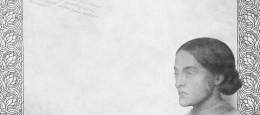
As the Pre-Raphaelite painter William Holman Hunt was working on The Light of the World (1851–1854), his portrayal of Jesus knocking on a vine-covered door, he found perhaps an unlikely model for the face of Christ: Christina Rossetti, the sister of his fellow Pre-Raphaelite artist Dante Gabriel. Hunt admired her “gravity and sweetness of expression,” and thus thought this young woman perfect to convey the Savior’s gentle persistence on the door of the human heart. Indeed, “gravity and sweetness” would mark Christina Rossetti’s own faith, as well as her poetry.
-
Presbyterians Yesterday and Today
-
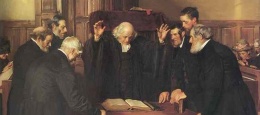
Presbyterians continue to play an important role in American religious life. While making up less than 5% of the population today, historically Presbyterians have punched above their weight in both politics and governance. Eleven signers of the Declaration of Independence were Presbyterians; nine members of a Presbyterian church have served as president of the United States. During the earliest days of the republic, it was Presbyterians who were among the leading lights in industry and political theory—so much so that in 1776, King George III was advised that the Revolutionary War was “a Presbyterian war from the beginning.” Though the exact quote is disputed, King George is said to have referred to it in a similar way, as “a Presbyterian rebellion.”
-
Paul Johnson: A Modern Victorian
-
On the 12th of January this year, British journalist and writer Paul Johnson died at the age of 94. Setting to the job of writing about him, it quickly started to seem as if 94 years were far too few to fit in everything he is reported to have said, done, and written. Wikipedia ominously offered up a “partial bibliography,” which includes dozens of books on every imaginable subject (including a 1,000-page history of the modern world).

-
Horace Mann and the Irony of Secular Education
-
Unless we live in the night when all cows are black, we occupy a multihued world whose contours become more distinct as light intensifies. Our tendency to simplify brings us deeper into the shadows, and perhaps one of our greatest oversimplifications is the uncritical faith in progress, and one of the unfortunate side effects of this tendency is that we too easily identify those on the right side of it and those on the wrong side.

-
Brother Andrew: God’s Smuggler
-
Modern Christians typically visualize martyrs as historical figures, such as believers killed for entertainment in ancient Rome’s Coliseum. However, Christians of all varieties continue to die for their faith to this very day. Many more face imprisonment and torture, subject to the brutal whims of others.

-
Saint Paul the Not-Quite Revolutionary
-
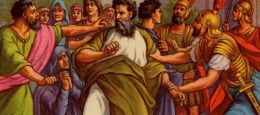
In the New Testament, Paul introduces himself to his readers as an “envoy” and an “ambassador” of Christ Jesus. While we might be quick to glance over such designations or translate them into the familiar Christian theological sobriquet “apostle,” such titles carried with them a certain amount of political and cultural significance in the first century. Throughout Asia Minor, various inscriptions bore homages to Augustus Caesar as the world’s “savior,” and emissaries throughout the Roman Empire spoke of the “good news” of his reign. Of course, Paul spoke on behalf of a very different kind of ruler, the crucified and resurrected Jesus, who had commissioned him to preach “obedience of faith among all the nations” (Rom. 1:5). Given the imperial Greco-Roman context that the first Christians moved in, what should we make of these rhetorical similarities between the gospel preached by Paul and the gospel promoted by Caesar? Was Paul being strategically subversive, perhaps even revolutionary? How oblique or explicit was Paul in using these imperial Roman motifs and terminology? Just how political was the Apostle Paul? The Apostle and the Empire: Paul’s Implicit and Explicit Criticism of Rome by Christoph Heilig attempts some answers.
-
Is the New Right Fascist?
-
A common experience for American conservatives is to hear a progressive call their policy positions “fascist.” Usually the connection between said policy and fascism is, at best, tenuous: “Oh, you support school choice? You know who else went to school? Fascists.”

-
To Defend Shakespeare Is to Defend the West
-
Long before American higher education became almost a wholly owned subsidiary of progressive thought control, literature departments fell much earlier to many of these same forces, with the deconstruction of classic texts by “new historicism,” “cultural materialism,” or “post-colonialism.” One of the biggest targets of these postmodernist efforts was and remains the grand work of William Shakespeare. Understanding this ongoing phenomenon and what it all means is the subject of R.V. Young’s Shakespeare and the Idea of Western Civilization.

-
Page 15 of 112