
A new era of constitutional drift
-
Just over 100 days into President Joe Biden’s administration, whatever hopes we held out that he would govern as a moderate are gone. The president seems determined to transform American society from the top down. Candidate Biden promised national unity and the restoration of lawful government. President Biden has, thus far, given us budget-busting spending packages, interference in the courts, and a flurry of executive orders of dubious constitutionality. These are not just bad policies; Biden’s program strikes at the heart of self-government itself. Americans must be alert: We’re in the midst of a constitutional revolution.
President Biden’s legislative agenda is both dangerous and dishonest. The $1.9 trillion American Rescue Plan was sold to the public as a COVID-19 relief act, but less than 10% of that bill was directly devoted to fighting the virus. The vast majority of the bill was a payout to longstanding progressive constituencies. Bailouts for profligate state governments and insolvent pensions might be good politics, but they have nothing to do with stemming the pandemic.
The same applies to the president’s $2.3 trillion infrastructure proposal, the American Jobs Plan. “Infrastructure” is defined so broadly that it’s become an internet meme: “Everything is infrastructure!” When most...

-
Institutionalizing the critical race revolution
-
More and more, Americans are becoming cognizant of something called critical race theory and the growing role it is playing in their lives now that the Biden-Harris administration has elevated this approach to the status of official state ideology. CRT is hardly new, however, and has been building momentum for years, if not decades – wreaking havoc in schools, workplaces, and legislatures. To vastly simplify matters, CRT is the belief that racism in America is structural, institutional, and systemic; therefore, to extirpate it from our lives, we must radically alter all structures, institutions, even the American system itself through training programs and curricula that deconstruct our assumptions and thoughts. All racial disparities are evidence of this deeply embedded racism and compel the heavy-handed use of racial preferences. CRT rejects the traditional view that racism is an individual issue, one in which racist individuals can be prosecuted when they act upon their racism by using the statutes created after the passage of the Reconstruction Amendments and the Civil Rights Act of 1964, which ended state-enforced racism.
What CRT is in practice was already on display in New York City three years ago, well before Joe Biden acceded to the presidency. One...

-
The road to Sino-serfdom
-
President Joe Biden has kicked off his administration by confidently calling for another four years of wasteful and harmful spending. Unfortunately, the Biden-Harris administration’s fiscal agenda will slow the American people’s economic growth at home, and undermine America’s ability to support its allies and challenge its competitors abroad.
Biden’s proposed infrastructure bill, the “American Jobs Act,” offers a worthwhile starting point. For decades, Democrats and Republicans alike have turned to infrastructure spending as a way to demonstrate their willingness to “reach across the aisle” and “get things done.” After all, the public largely supports fixing roads and bridges, and there seems to be no political or cultural agenda attached to such bills.
Or so one would think. First of all, Americans are increasingly skeptical of big infrastructure spending boondoggles. In 2018, 64% of the population supported President Donald Trump’s $1 trillion dollar infrastructure plan – an impressive level of consensus given the anti-Trump hysteria on the Left at the time. But a CNBC nationwide survey from early in April 2021 showed that only 36% of respondents backed Biden’s $2.25 trillion proposal. The same respondents supported measures like fixing roads and expanding broadband internet by large margins, so it would seem...

-
Editor's Note: Spring 2021
-
While political fortunes ebb and flow, our destiny remains in our own hands. That balanced approach to the newly installed Biden-Harris administration guides this issue of Religion & Liberty, which is a special one for me.
Alexander W. Salter offers his first contribution. “We’re in the midst of a constitutional revolution,” he warns. “Constitutional drift refers to the tendency for de facto government to diverge from de jure government,” he writes. He offers little hope, except that this nation will experience a new birth of freedom, one individual at a time.
Heritage Foundation scholar Mike Gonzalez turns his gimlet eye on critical theory, the “bizarre ideology,” which “has, sadly, become our new state religion.”
Up-and-coming young author Chris Nagavonski notes how enormous (and often deceptive) new spending bills threaten both our economic standing and our place in global affairs.
The Discovery Institute’s Wesley J. Smith warns that “something authoritarian this way comes”: a coordinated attempt to force Christian medical providers to perform abortions, gender reassignment surgeries, and assisted suicides. Preserving the right of Christians and other faithful believers to express their values in their work life is “the next civil rights struggle.”
Bradley Birzer and Ray Nothstine glean insights...

-
The political temptation
-
Serious proposals to fundamentally change the governance of these United States, made by unserious yet politically powerful people, are made with ever-increasing frequency: statehood for the District of Columbia, the packing of the Supreme Court, and one of the world’s largest tax on capital gains have all been placed on the table and are now the subject of public debate. Any reasonable observer knows that these proposals would alter the composition of the American republic, compromise its separation of powers (arguably the most important contribution the American founding offered to political arrangements), and radically alter its capital markets. Underlying all of these fundamental proposals is a deep-seated suspicion that our democracy, institutions, and economy as currently configured cannot meet the challenges we face today, or that they were utterly corrupt from the outset. These suspicions deserved to be addressed honestly, because they contain valid criticisms.
The COVID-19 pandemic, along with the ineffectual response to it by our political leaders, is a case in point. Massive government bailouts, pervasive restrictions on civil liberties, and enormous economic displacement have become commonplace. While scientific innovation, the extraordinary sacrifices of individuals, and the innovative adaptations of communities to the crisis have contributed to advances...

-
How irrationality triumphed
-
One of the great benefits of the university lies in the leisure for advanced study. While the tenured professor may be a dying breed, the ideal of a profession whose adherents study important questions so that they might then share their learning through writing, teaching, and speaking remains an important ideal for the university. While that ideal is rarely realized, Carl R. Trueman's The rise and triumph of the modern self: cultural amnesia, expressive individualism, and the road to sexual revolution brings together years of scholarly reading to provide an analysis explaining a specific intellectual shift.

-
Ryszard Legutko: the cursing of freedom
-
What is freedom? Do we need freedom? And if so, to what extent? These are questions that have been debated for millennia. Particularly in our time, when everyone is allegedly in favor of freedom and liberality, the discussion has heated up. In The Cunning of Freedom: Saving the Self in an Age of False Idols, Ryszard Legutko aims to define “freedom,” but also to make a scathing critique of prominent definitions of the term in our modern culture.

-
The 3 things you need to make ‘socialism’ work
-
Occasionally, our antagonists think they have discovered the silver bullet argument in favor of "Christian socialism." One such apology recently came into my inbox. In its entirety, it read:
Acts Chapters 4 and 5 Tell of The Holy Spirits Work with The Apostles to Establish SOCIALISM for The Christian Church...What further proof is needed ???
Recourse to the exceptional model of charity practiced by the early Christian community in Acts 4:31-35 is as perpetual as it is erroneous. As I’ve noted in print and on television, the early church was not socialist. The "lived experience" of my church, the Eastern Orthodox Church, has concluded that socialism will do anything to eradicate Christianity, and every other religion.
However, let’s agree that the apostles, in exactly one of the many church communities they founded, “had all things in common” – that believers gladly laid all their earthly goods “down at the apostles' feet: and distribution was made unto every man according as he had need” (Acts 4:31-35).
There are still communities that follow the early church model of radical sharing. They’re called monasteries.
Before exploring how monasteries show us how “socialism” can work, let me acknowledge that I’m hesitant to present monasticism...

-
Eugene McCarthy, St. Damien of Molokai, and the limits of politics
-
Former U.S. Senator Eugene McCarthy, D-Minn., ran for president four times, but his most memorable campaign was in 1968, where a strong insurgent showing led to the political downfall of President Lyndon Baines Johnson. McCarthy, in his first run, challenged LBJ as a peace candidate in the first-in-the-nation primary of New Hampshire, garnering a shockingly high 42% of the vote against the sitting president of his own party. President Johnson won but did not even reach 50% support from the voters. Politically eviscerated by Vietnam and the growing unrest at home, Johnson withdrew from the race a few weeks later, in a televised speech in March 1968.
In many ways, the late 1960s was the high tide of American liberalism. With the Great Society recently implemented and Johnson’s “guns-and-butter” policies in full swing, there was a belief that the nation could wage war during a U.S.-Soviet arms race while spending prodigiously on social engineering. Optimism in state power and bureaucratic expertise morphed into what Amity Shlaes called “an almost mystical belief in the infinite potentials of American society.”
McCarthy, a devout Roman Catholic, was liberal on many issues, but even his entrance into the race as a peace candidate was...

-
Russell Kirk’s path to Christ
-
Every once in a while, someone online, being either sincere or sincerely mischievous, loves to ask about the status of unrecognized saints. Who is the person most likely to be saint that the church has yet to recognize and, therefore, deserves our petitions for intercession? That list is fairly easy for me: my maternal grandfather (1907-1982); J.R.R. Tolkien (1892-1973), whom I’ve been asking for intercession since the late 1970s; and Russell Kirk (1918-1994). You don’t know my grandfather, of course, but you do know – as a matter of public record via his letters –Tolkien and his several mystical experiences in life, his extreme devotion to the Blessed Sacrament, and his religious instruction to his sons. But what about Russell Kirk, the writer of horror stories, the author of postwar conservatism, and a practitioner of the occult arts (specifically tarot) late into his adult life?
Kirk’s journey to Christian orthodoxy is a fascinating story and, at times, a fractious one. Like many poor but learned families in America and England at the turn of the nineteenth and twentieth centuries, the Kirks had embraced an intellectual variety of spiritualism. Though descended from New England Puritans, the Kirk family had come to...

-
In the Liberal Tradition: Walter Williams
-
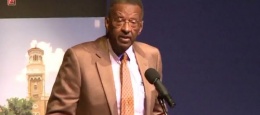
The world lost a voice for logic, liberty, and love of the U.S. Constitution when economist Walter Williams died on December 2, 2020, at the age of 84. Williams worked his way out of grinding poverty in the Philadelphia housing projects to chair George Mason University’s economics department, author 10 books and more than 150 publications, and become one of the most insightful commentators of the last four decades. Williams spread his message of racial equality, the dignity of work, and the morality of capitalism through his syndicated newspaper column, PBS documentaries, and frequent radio and TV appearances.
Walter Edward Williams was born on March 31, 1936, in Philadelphia. His father abandoned the family, leaving his wife, Catherine, to raise their three-year-old son and two-year-old daughter. Williams credited his (illegal) child work history with instilling the drive and habits that propelled him to success.
Williams earned his Ph.D. in economics from UCLA in 1972 and taught at Philadelphia’s Temple University for five years before moving to George Mason University, where he chaired the economics department (1995-2001). For 40 years his nationally syndicated column, “A Minority View,” appeared in 140 newspapers. He wrote 10 books, beginning with 1982’s The State Against...
-
Medical conscience rights: the next civil rights struggle
-
Something authoritarian this way comes. Powerful forces are striving to impose a secular ethic on the entire medical professional which – in the name of “patients’ rights” – seeks to compel doctors, nurses, pharmacists, and other medical professionals to violate their religious beliefs on issues like abortion. At stake is the right of doctors to practice medicine consistent with the Hippocratic Oath, and specifically of Roman Catholic hospitals and other religious medical institutions to run their institutions in conformity with their faith’s moral teachings.
For most of our history, healthcare was not culturally controversial. In recent decades, that consensus shattered. Substantial disagreement now exists about the meaning of “do no harm.”
This rending began in earnest after Roe v Wade invented abortion as a constitutional right. Roe tore the moral fabric of the country apart. In the years since Roe, the country has continued to splinter on the morality of healthcare. Many now see healthcare not only as about curing sickness, but also as a technocratic endeavor extending well beyond maintaining physical health. It now includes helping patients attain life satisfaction and personal fulfillment.

-
Page 23 of 112