
Catholic Social Teaching and the Spillover Fallacy
-
For all her undoubted wisdom, even the rich tradition of Catholic Social Teaching (CST) is not safe from the snares of logical fallacies. While the faithful owe fidelity to the teachings of the Catholic Church on matters of faith and morals, the commentaries of popes and ecclesial officials on matters of society, economy, and politics can be met with careful discernment and conscientious disagreement. One of the grounds for respectful disagreement with the reflections of a papal encyclical or the recommendations of a Vatican document is often a lack of prudence in judging the practical application of Catholic principles to concrete realities. A common culprit behind such misjudgments is the spillover fallacy, which is perhaps more influential in discussions of Catholic social thought than sometimes recognized.

-
The Spirit of 1776 vs. Socialism
-
We must make the building of a free society once more an intellectual adventure, a deed of courage. —F.A. Hayek
Seventeen seventy-six was an auspicious year. The Bolshoi Opera began in 1776. Also in 1776, the Duchess of Kingston was found guilty of bigamy. For conspiracy theorists, 1776 was a very important year: The Illuminati was founded. For scholars, the first chapter of Phi Beta Kappa was formed at the College of William & Mary.
The year 1776 proved to be a mixed blessing for economists, however: On the dark side, Rhode Island established wage and price controls. On the bright side, a book was published entitled: An Inquiry into the Nature and Causes of the Wealth of Nations.

-
Effective Charity: Compassionate Conservatism Reborn
-
“Compassionate conservatism” is not a phrase you hear often these days, but at its height it represented a new brand of Republican governance. Compassionate conservatism originated with a coherent understanding of the cause and impact of civil society’s reversal across the 20th century, the result of an increasingly mechanistic approach to solving social problems. Previously, America had been celebrated by Alexis de Tocqueville and others as a bastion of voluntary association, relying for social cohesion and problem-solving on the marketplace, but first and foremost on family, church, civic groups, charities, and mutual aid societies. In Liberty Lost: The Rise and Demise of Voluntary Association in America Since Its Founding, Robert E. Wright lays out the almost comical number of clubs and organizations that Americans started for the purpose of solving problems, debating ideas, and entertaining themselves. These served to create strong social bonds and networks, regardless of the particular goals of this or that organization. However, the rise of progressivism at the turn of the 20th century created an elite class of expert planners whose regulatory schemes, administrative agencies, and massive reorganizing of social, cultural, and economic life crowded out these organic social institutions.

-
After Theology: The Hidden Origins of the Market
-
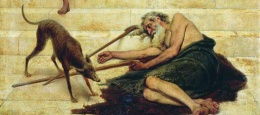
Modern economics tends to understand itself as a discipline that has left behind the theological presuppositions of its own emergence. It operates in the vocabulary of models, incentives, and equilibria; its authority rests on abstraction and formalization, not revelation. And yet, as this ambitious and erudite volume demonstrates, a significant portion of what now appears as self-evidently “economic” thinking in fact rests upon a much older moral-theological tradition. A History of Christian Political Economy: From the Patristics to the Present by Jordan J. Ballor and Erik W. Matson invites a reconsideration of the standard narrative—not as the emancipation of economic reason from religion but as a transformation internal to it.
-
Joan of Arc: Saint of the Modern
-
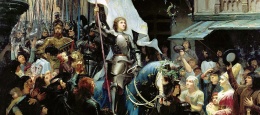
Dante had his Beatrice and Mark Twain had his Joan of Arc. Granted, they are not quite the same sort of muse, one devoted to peace and the other a famous warrior, but they may play similar roles for our great poets of comedy. Dante’s readers, perhaps not a little under the spell of Beatrice themselves, eventually called that comedy (the story has a happy end) divine; whereas Twain’s comedy is decidedly all-too-human. The difficulty is rather elsewhere: Everyone who’s heard of Dante has heard of Beatrice, but almost no one who reads Twain has read his Personal Recollections of Joan of Arc (1896, his last novel), despite his repeated statements that it was his best book, the one he most loved, and other words to that effect aimed to persuade posterity, since his contemporaries did not admire or much read the novel either.
-
St. Francis of Assisi: The Friar Abides
-
St. Francis of Assisi died 800 years ago, in his mid-40s, on the third of October 1226. He is remembered the world over as the gentle patron saint of the poor, peace, nature in general, and animals in particular. He is remembered especially by the religious orders that bear his name and by his Church, which celebrates his feast day on October 4. He is remembered well, but often poorly. G.K. Chesterton, in his concise and illuminating biography St. Francis of Assisi, wrote that “St. Francis anticipated all that is most liberal and sympathetic in the modern mood,” and yet when modern readers study his life, they find aspects of the saint “quite remote and repulsive.”

-
How Paul Ehrlich Got Everything Wrong
-
From 1966 to 1967, tens of thousands of people in the Indian state of Bihar died from drought-induced starvation. This was orders of magnitude less than the estimated two million policy-induced famine deaths suffered decades earlier by its neighboring state of Bengal (modern-day West Bengal and Bangladesh). Yet the suffering in Bihar garnered arguably more attention than the Bengal famine of 1943 due to the work of photojournalists like Thomas Hoepker, who was awarded third place in the World Press Photo Contest for his evocative images of the famine. His unnerving photos of emaciated bodies, originally published for Stern magazine, haunted the imaginations of many Westerners. Then, just a year later, that discomfort turned into alarm when Paul Ehrlich published his bestselling book The Population Bomb, where he characterized his 1960s visit to Delhi in this way:

-
Conversation Starters with ... Wilfred M. McClay
-
Wilfred M. McClay is the Victor Davis Hanson Chair in Classical History and Western Civilization at Hillsdale College, where he is also professor of history. Among his books are the award-winning Land of Hope: An Invitation to the Great American Story, The Student’s Guide to U.S. History, and Religion Returns to the Public Square: Faith and Policy in America. Prof. McClay has been the recipient of fellowships from the Woodrow Wilson International Center for Scholars, the National Endowment for the Humanities, and the National Academy of Education, and was a 2022 recipient of the Bradley Prize. He received his B.A. from St. John’s College in Annapolis, and his Ph.D. in history from Johns Hopkins University.

-
In the Liberal Tradition: Benjamin Rush—The American Revolution’s Indispensable Doctor
-
One of the most consequential conversations in American revolutionary history occurred in a Philadelphia bookstore, a meeting place for colonial leaders unhappy with the English Crown. In March 1775, Benjamin Rush, a young physician, walked into the shop. He was introduced to a down-on-his luck British ex-patriot hired by the shop’s owner, Robert Aitken, as an editor for his new Pennsylvania Magazine.
Rush had been working on a document arguing the case for American independence. But he wasn’t sure he should publish it because Philadelphia was the place of his livelihood, and the city was divided over the question of independence. “I shuddered at the prospect of the consequence of it not being well received,” he wrote later.
Impressed by this British national, Rush suggested he should take up the task instead. The man agreed. His name was Thomas Paine.

-
Presbyterians Aggressive and Moderate
-
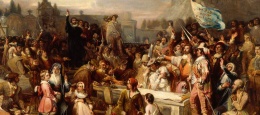
Darryl Hart’s most recent monograph, Protestants and Patriots: Presbyterians in the Age of Revolution, is perhaps his most ambitious study to date. Having spent his career studying the Reformed tradition—its worship, history, and major figures—Hart has now provided a survey of Presbyterians’ relationship to the civil government, rarely sanguine and sometimes revolutionary. The book’s ambition lies in the fact that Hart’s narrative covers Presbyterianism in England, Scotland, Ireland, the United States, and Canada from the mid-16th to the late 19th century. Hart traces intra-ecclesiastical disputes (such as the patronage controversy among Scottish Presbyterians that came to a head in 1843) as well as broader conflicts involving the civil magistrate (such as the Bishops’ Wars in the late 1630s) and Anglicans (as exemplified in Cartwright and Whitgift’s pamphlet war over the Elizabethan Religious Settlement). His basic thesis is that whatever political radicalism one does find among Presbyterians, it originated within the English and Scottish church-state nexus rather than as something inherent in Reformed theology, and that the liberal outcomes were an unintended correction to its theocratic origins.
His whirlwind account begins with Calvin, whom Hart identifies as advocating a form of Presbyterianism that Hart describes as a middle way between...
-
History and Identity
-
More than most disciplines in the humanities and social sciences, history has been victimized by ideological pressures that have undermined its presence in public life throughout the Anglosphere. Mythmaking that looks to the past in search of heroes and villains abounds, and in recent years this sort of pseudo-historical writing has done much to harm public debate, particularly in the United States. Whether it is the damage that progressive critical-historical scholarship has done to public belief in the American political order or the excessive nostalgia with which many conservatives look upon a bygone era, a reasonable understanding of the past in public life is often made impossible.
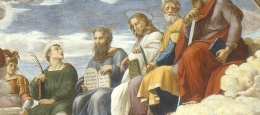
In God and Country: Upholding Faith, History, and National Identity, John D. Wilsey offers some remedies to these dangers. The book introduces readers to the discipline of history with a particular emphasis on how Christians ought to approach the study of the past and what they might learn from it. Wilsey’s concern for the fate of history as a discipline runs in two somewhat different directions. First, he’s convinced that without developing certain virtues, Americans will continue to disrespect and misunderstand their past. As he puts it, the “virtue-less historian is like...
-
Capitalism’s Western Marxist History
-
The essential fact about Sven Beckert’s Capitalism: A Global History is its size and scope. The book is 1,100 pages in length, it has another 150 pages of endnotes in print so small it is unreadable without a magnifying glass, and its acknowledgements run half a chapter long at 3,000-plus words. Capitalism weighs about five pounds. As for scope, it is global and covers a thousand years. As Beckert puts it in the introduction, “This book understands capitalism as, above all, a global development whose local articulations can only be understood globally” (emphasis in the original). Or, among the many restatements of this point throughout the 1,100 pages: “Capitalism cannot be understood in local, regional, or national terms; it can be understood only by focusing on the permanent combination and recombination of its fragments across the world.” If Capitalism had come out not now but perhaps several decades hence, when there are Elon Musk–style colonies in space, presumably it would insist on a universal history of capitalism, and surely the book would be even more extended for it.
Size and scope are in a cooperative relationship with each other in Capitalism, as the formal justification for the length...
-
Page 1 of 112