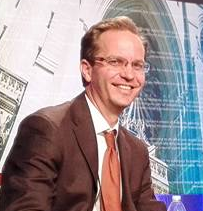
Michael Severance earned his B.A. in philosophy and humane letters from the University of San Francisco, where he also studied at the university's St. Ignatius Institute, a great books program. He then pursued his linguistic studies in Salamanca, Spain where he obtained his Advanced Diploma in Spanish from Spain's Ministry of Education before obtaining his M.A. in Philosophy and Modern Languages from the University of Oxford. While living in Italy, Michael has worked in various professional capacities in religious journalism, public relations, marketing, fundraising, as well as property redevelopment and management. As Istituto Acton's Operations Manager, Michael is responsible for helping to organize international conferences, increase private funding, as well as expand networking opportunities and relations among European businesses, media and religious communities, while managing the day-to-day operations of the Rome office.
For over 20 years, the Acton Institute’s Rome office has had a number of extremely impressive academic fellows come through their prestigious scholarship programs promoted to graduate students of pontifical universities. Assisting students studying theology, moral philosophy, and social sciences, Acton’s grants and awards program is now paying huge dividends. Its alumni are now serving in highly leveraged positions across all continents as diocesan pastors, international missionaries, development economists, university professors, and episcopal advisers. This interview is the first of several to follow that will highlight the whereabouts and continued journeys of Acton scholars after leaving Rome.
I caught up with our latest Rome-scholar success story, a Venezuelan priest and Calihan fellow in dogmatic theology at the Pontifical Lateran University (aka the “pope’s college”), Fr. Alberto Marquez.
At the oppressive height of COVID-19 lockdowns in Rome, a determined Marquez carried on and “virtually” defended his unique doctoral thesis on the “economic Trinity” while receiving the highest academic honors. He was subsequently called back to his native Valencia to serve as the new rector of the Archdiocese Seminary Nuestra Señora del Socorro. He is considered a protégé of the recently deceased cardinal Jorge Urosa, the former Catholic primate of Venezuela...
José María Arizmendiarrieta was a Spanish Basque priest whose visionary work in founding Mondragon University, and later a corporation of highly competitive cooperatives, helped impoverished Spaniards reclaim their dignity after the Spanish Civil War. Pope Francis declared him a “venerable servant of God” in 2015, that is a “person of demonstrable heroic virtue,” which is the first step in the process of becoming officially a saint in the Roman Catholic Church.
This is the sixth installment of the "Romenomics” series, which aims to study commerce in ancient Rome in order to better appreciate the economic present. See part one, part two, part three, part four, and part five of the series.
In this Romenomics series, I have already commented on pecunia (money). The Latin word derives its original meaning from pecus – that is, sheep, cattle, and other livestock once used as major trading commodities in the early Kingdom and Republic of Rome.
As Rome expanded across the Mediterranean basin and transitioned to a veritable political and economic powerhouse, primitive bartering instruments would have stifled its overall wealth creation. A universal, state-recognized, precious metal-backed currency was an absolute necessity for long-term stability and industrial growth.
In this essay, my intention is to take a deeper dive into some monetary and spending policies, with particular attention given to the period of the Five Good Emperors when wealth, power, and peace all reached their peak.
First, let’s briefly summarize the common monetary units in ancient Rome. The Romans had a gold standard with the aureus, while the most common currencies were minted in silver and bronze but measured their...
This is the fifth installment of the "Romenomics” series, which aims to study commerce in ancient Rome in order to better appreciate the economic present. See part one, part two, part three, and part four of the series. - Ed.
Anyone who thinks it is easy to understand price trends over a millennium and billions of transactions in ancient Rome has a lot of reading to do, starting with this 300-page study. In a way, it is impossible, as in any market study over such an extended period and with very little written testimony. Nonetheless, not everything boils down to conjecture.
No doubt, Roman prices fluctuated in the short-term and rose over the long-term; there were severe crashes followed by recoveries; above all, prices acted as “signals” for several factors: overall demand, overall supply, personal preferences, as well as economic interventionism with state-mandated controls, price ceilings, subsidies, and even currency devaluation.
In general, pricing in the laissez-faire Roman Empire was determined by the natural laws of markets in which consumers would offer what they believed was a fair exchange for the product or service they received from vendors.
A good sector to focus on and with greater certainty for establishing price points was grain, the very staple of...