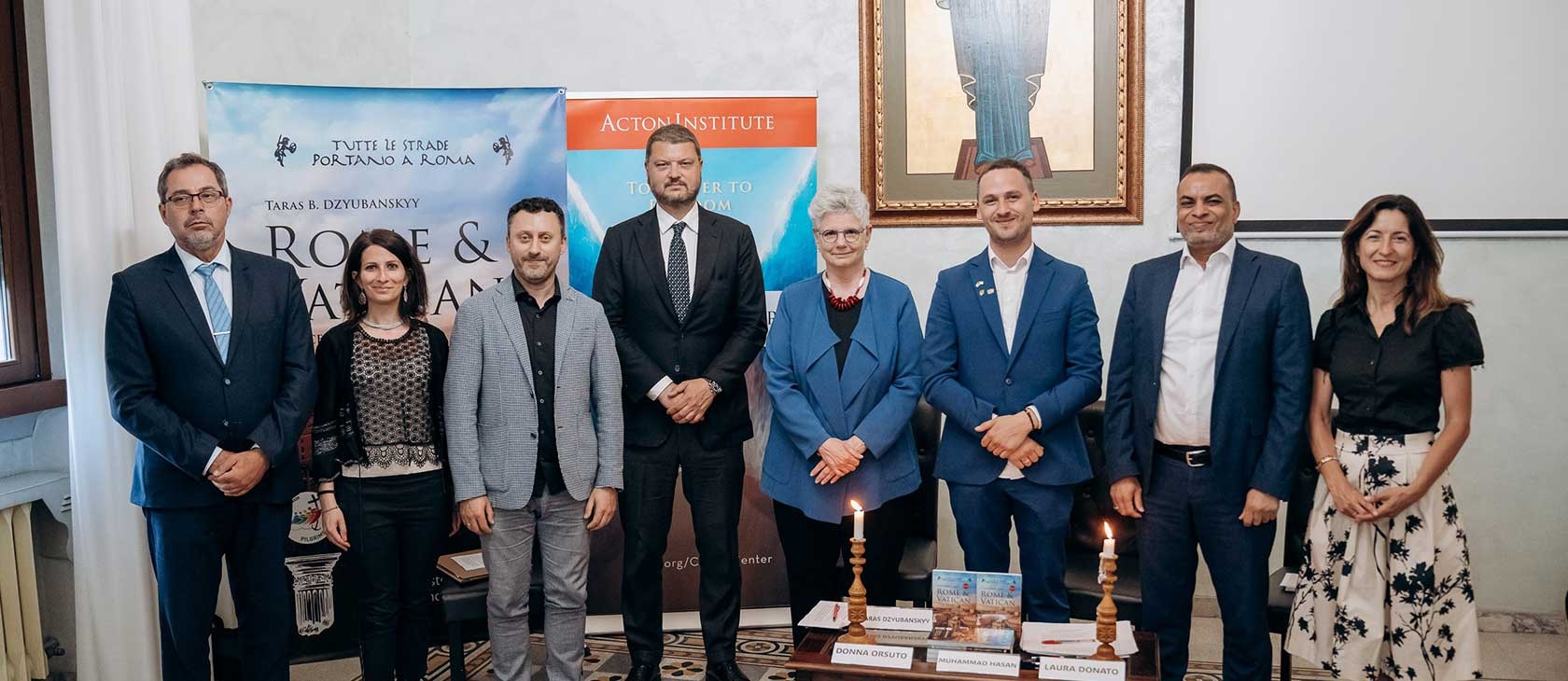
A landmark interfaith event titled “In Cerca di Orizzonti Comuni: Pellegrinaggio, Speranza e Libertà nelle Fedi Abramitiche” (“In Search of Shared Horizons: Pilgrimage, Hope, and Freedom in the Abrahamic Faiths”) was held this week at the Pontifical Ukrainian College in Rome. The gathering brought together over 50 participants, including representatives from Vatican colleges, scholars, pilgrimage and tourism experts, seminarians, and clergy. It explored the profound spiritual, symbolic, and civic dimensions of pilgrimage, along with its deep ties to freedom and hope, especially in the context of the Jubilee Year of Hope.
Organized by the Collins Center for Abrahamic Heritage of the Acton Institute, the Rome event followed successful previous editions in London (February) and Glasgow (May). It was supported by key promotional partners: the John Paul II Center for Interreligious Dialogue, Roots in Rome, and the International Committee on Countering Extremist and Hate Speech (ICCEHS).
In their opening remarks, Hon. Gennaro Migliore—former Undersecretary of Justice and Italian parliamentarian, now member of the Board of Directors of the International Committee on Countering Extremist and Hate Speech (ICCEHS)—and Dario Petrone, entrepreneur and member of the Advisory Board of Harambee Africa International, underscored the importance of building bridges and fostering integration as essential components of state policy for people of faith, migrants, and refugees. They both affirmed the significance of events like this in advancing peaceful coexistence and respect for human dignity.
At the heart of the day’s discussion was the recognition that pilgrimage, common to Judaism, Christianity, and Islam, is not merely a physical journey, but also a profound expression of inner transformation, spiritual seeking, and liberation.
Muhammad Hasan, former envoy of Egypt and Al-Azhar, previously imam of the Great Mosque of Rome, now co-founder and imam of the Islamic Cultural Center “Fratellanza Umana” in Tivoli and member of the advisory council of the Egyptian Human Fraternity Foundation, emphasized the Hajj as a pillar of Islam and a metaphor for the human condition. “The body walks, but the heart and soul also travel,” he noted. “It is a complete act of devotion, humility, and unity.”
Laura Donato, art historian, Vatican Necropolis guide since 2004, and educator in Art and Image, highlighted the visual power of religious sites in guiding pilgrims. With experience curating exhibitions such as those at the National Museum of Castel Sant’Angelo, and author of works like “Oltre. Un viaggio nelle terre di confine” and “La croce simbolo di fede per l’umanità”, Donato emphasized that “visual materials are companions to pilgrims—they help interpret, inspire, and orient the heart.”
A major feature of the event was the presentation of the documentary Sacred Spaces, presented by Elena Dini and Taras Dzyubanskyy. The film, “Sacred Spaces and Interreligious Dialogue: A Living Document”, reflects on contemporary Rome’s interfaith landscape, intertwining the stories of KAICIID Fellows, religious leaders, and everyday people—migrants, neighbors, seekers—who navigate both the promise and challenge of dialogue in daily life.
In his heartfelt address, H.E. Andrii Yurash, Ambassador of Ukraine to the Holy See, stressed the importance of events where human dignity and freedom are upheld—especially for communities suffering from war and violence. “These initiatives remind us of the sacred value of freedom and the necessity of standing together for peace,” he said.
The event concluded with a powerful common prayer for peace, prepared by Rabbi Jack Bemporad, renowned Jewish scholar and long-time professor at the Pontifical University of St. Thomas Aquinas in Rome. The prayer brought together the voices of all participants in a unified call for reconciliation, healing, and hope
As the Jubilee Year of Hope continues, “In Cerca di Orizzonti Comuni” stands as a testament to the transformative power of pilgrimage, dialogue, and shared spiritual values. Participants left with a renewed commitment to journey together in freedom, guided by faith and inspired by the possibility of a more united future.