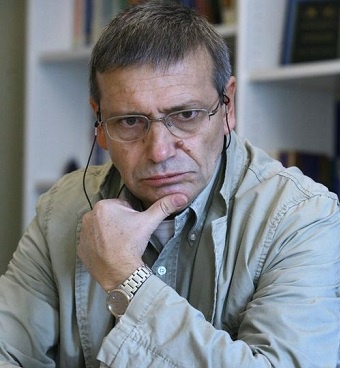
Krassen Stanchev is a professor in Public Choice and Macroeconomic Analysis of Politics at Sofia University in Bulgaria, where he also teaches the history of economics at the post-graduate level. He is also CEO of KC 2 Ltd. and board chairman, founder, and former executive director of IME, Bulgaria’s first independent, free-market think thank. He is a former member and committee chairman of Bulgaria's Constitutional Assembly (1990-1991), and a principle drafter of reforms leading Bulgaria from central planning to a market economy.

Recent Articles by Krassen Stanchev

  • The Prague Spring, 50 years later

    On this date in 1968, armies of the Warsaw Pact invaded Czechoslovakia out of fear that the tiny nation might liberate itself from the yoke of Communism. A nascent liberation had begun in the cultural, religious, and social life of the country, if not its economy. By the mid-1960s, the Marxist government had failed to suppress the Church and extinguish the intellectual quest for freedom of expression, a quest that penetrated all walks of society – from pop music to the Scouting movement. A vigorous defense of religious and human rights came from priests, high literary circles, and even supported to a degree by some honest – though naïve – individuals in the ranks of the Communist Party. This would-be liberation became known as the Prague Spring. The August 20-21 invasion attempted to obstruct this embryonic thirst for freedom, deferring liberation for 21 years. Yet today, people in former Warsaw Pact nations – including young Czechs and Slovaks – seem to have forgotten the lessons of that Czechoslovak summer invasion.

    Between 250,000 and 500,000 soldiers of the Warsaw Pact (WP) armies stood on high alert, massed at the border of the nation then known as Czechoslovakia, and poised to attack...

  • Are Orthodox Christians naturally statists?

    In April, the World Bank published a working paper titled “Communism as the Unhappy Coming.” It is co-authored by two my fellow Bulgarians, Simeon Djankov (whom I have known well for years; we worked together) and Elena Nikolova. They have concluded that members of the Eastern Orthodox Church, the second-largest church in Christendom, are likely to support left-wing economic policies. The report states that “relative to Catholics, Protestants, and non-believers, those of Eastern Orthodox religion have less social capital and prefer old ideas and safe jobs.” Further, “Orthodoxy is associated with left-leaning political preferences and stronger support for government involvement in the economy.” The report was soon picked up by Bloomberg News and The Economist.

    It is probably true that historically Orthodox countries (the study lumps in believers and non-believers alike) would fall into the group of those supporting greater government intervention in the economy. This has been the case in the last decade in Russia and, before 2008, it would have held true for Serbia and Montenegro. But the implied causality between Orthodoxy and economic policy is premised upon the authors’ tacit assumption that many of Orthodox and/or Catholic nations remained Christian throughout their Communist occupation...

  • Three reasons the EU may be no match for Erdoğan

    On Monday, the leaders of the EU will hold a summit in my home country of Bulgaria, which they have invited Turkish President Recep Tayyip Erdoğan to address. The meeting will take place in Evksinograd Palace near the Black Sea port of Varna, a structure built by Bulgarian King Ferdinand of Sax-Cobourg and Gotha, who led the First Balkan War against the Ottoman Empire in 1912-1913. Erdoğan is unlikely to be sentimental about the meeting’s location or content. In their invitation, Donald Tusk and Jean-Claude Junker wrote that the meeting “will be a good opportunity to jointly assess matters of mutual interest and recent developments in your country, including in the area of rule of law and fundamental freedoms, which remain fundamental to the fabric of and prospects for EU-Turkey relations, as well as regional and international issues.”

    Those issues are mounting by the minute.

    Turkey is leading a military campaign – with the oxymoronic name “Operation Olive Branch” – against the U.S.-based Syrian Defense Forces in Afrin. Although the SDF includes Kurdish separatists linked to those who have committed terrorism against Turkey, the SDF is the key factor checking the spread of ISIS in northern Syria. Their defeat...

  • Book review: ‘The Russian Revolution: A New History’ by Sean McMeekin

    The Russian Revolution: a New Story. Sean McMeekin.
    New York: Basic Books, 2017.  496 pages.

    I am writing this review of in a downtown Moscow hotel, on the eve of the 100th anniversary of the Russian Revolution – and around me there are no signs of glorification, celebration, or even remembrance of the grave events of 1917. Even public officials are shy of commemorating that part of the country’s history. According a friend, Andrey Kolesnikov who is a Senior Fellow at the Carnegie Moscow Center, the reason for such behavior is very simple:

    The Revolution is “irrelevant” because “the generations that still had romanticized notions about [it] are departing, and the number of respondents who believe that “the early years after 1917 brought more bad than good” consistently grows: it went up by 10 percentage points from 1994 (38 percent) to 2016 (48 percent).”

    There are other bits of contemporary history, shown in a poll from the Levada Center, which constitute the national pride of contemporary Russians. What makes Russians proud is the actions of the imperial nineteenth century, the conquering of vast lands in Europe to the Far East, and what is, in their mind, the correction of history with the...

  • Bulgaria unveils a statue to Ronald Reagan in the battleground for religious liberty

    Ronald Reagan remains the most influential U.S. president of the latter-half of the twentieth century. He is remembered as an optimistic advocate of free minds, free markets, free elections, and the free exercise of religion. But gratitude, a universal human emotion, is not limited to the United States. Instead, it extends across the transatlantic sphere to the former Soviet bloc.

    On May 10, in Sofia, the capital city of Bulgaria, officials unveiled a monument of President Ronald Reagan. Just nine days later the bust, which was erected in Sofia’s South Park, was vandalized – a red stocking pulled over the bronze head, vampire-looking paint on the face, and the statue and the marble pedestal smudged in white. The monument was immediately cleaned up by volunteers.

    What was behind the vandalism? Ronald Reagan’s legacy vexes die-hard Communists more than a decade after his death on June 5, 2004. The growing popularity of Communists (and extremists favorably disposed to Nazism) is on the rise in Bulgaria. In a strange twist, due to the better life that Reagan’s ideas brought about, there is a growing trend of Bulgarians forgetting the misfortunes of the past.

    The nation is undeniably better off today than under Marxism. In 1994...