


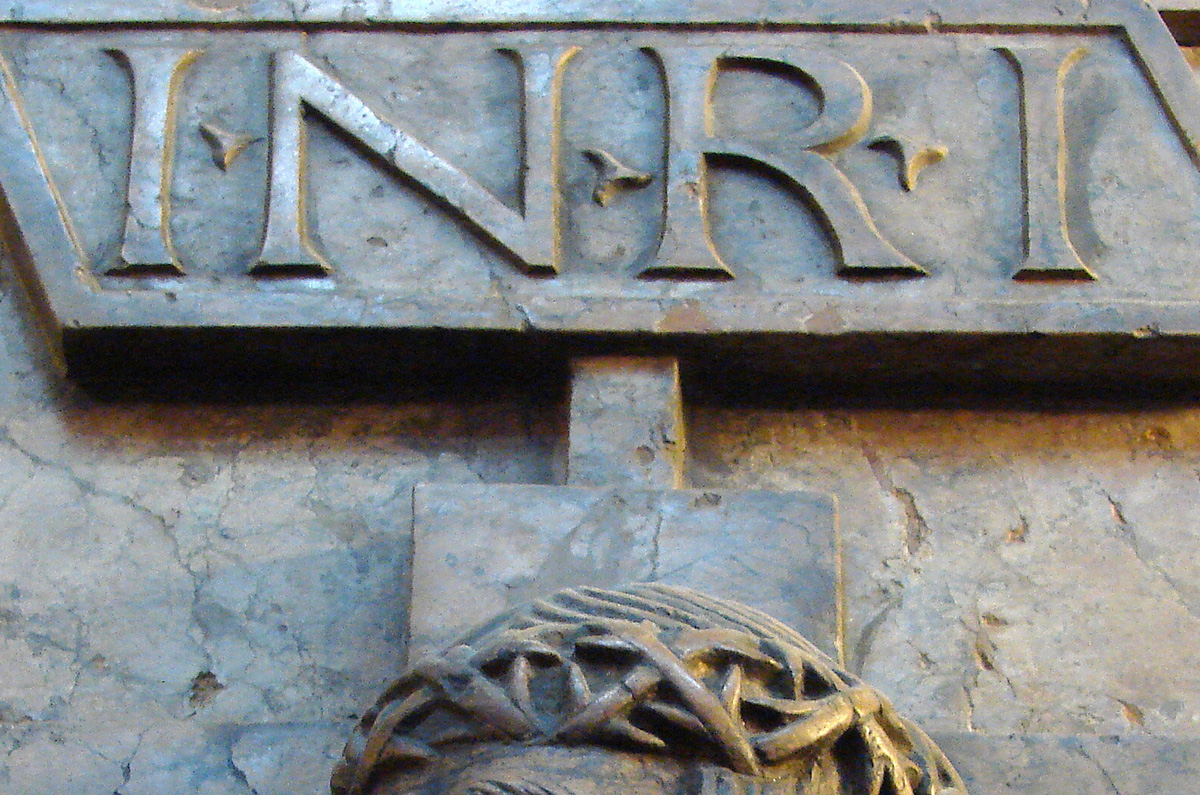
Atop a wood carving of Christ on the cross, affixed to St. Vitus Cathedral, is a sign with the letters I-N-R-I. The origin of these letters is related to us in the 19th chapter of the Gospel of John:
Pilate had a notice prepared and fastened to the cross. It read: JESUS OF NAZARETH, THE KING OF THE JEWS. Many of the Jews read this sign, for the place where Jesus was crucified was near the city, and the sign was written in Aramaic, Latin and Greek. The chief priests of the Jews protested to Pilate, “Do not write ‘The King of the Jews,’ but that this man claimed to be king of the Jews. Pilate answered, “What I have written, I have written.”
Artistic portrayals of the crucifixion would often render this by using an acronym of the letters of the words in Latin: Iesus Nazarenus, Rex Iudæorum: I-N-R-I.
“Christ is King” has become a popular internet meme. It’s doubtful that its users know what they are saying. They're not alone.
Jesus of Nazareth, King of the Jews. In this notice Pilate has unwittingly provided a concise summary of Jesus’s true identity. We have his proper name—Jesus—and a modifier of his home region in the north, Nazareth. And we have a title: King of the Jews. Between Nazareth and Judea is a picture of a united Israel, which had been split into two kingdoms after the time of Solomon.
Pilate undoubtedly thought of the identity of this people geographically: Judea was that little tract of land on the eastern edge of the Mediterranean where he had been installed as Roman governor, and home to a troublesome people known as Judeans or Jews. We of course realize that, while Jesus was a Jew born into that area in the first century, the status and significance of the people and nation of Israel is far greater than Pilate recognized.
Jesus was born to Mary in what the apostle Paul calls “the fullness of time” (Gal. 4:4) to reconcile Israel and, indeed, the world, to God. And here we can see the connection between those two other words written by Pilate: IESUS and REX, or Jesus and King.
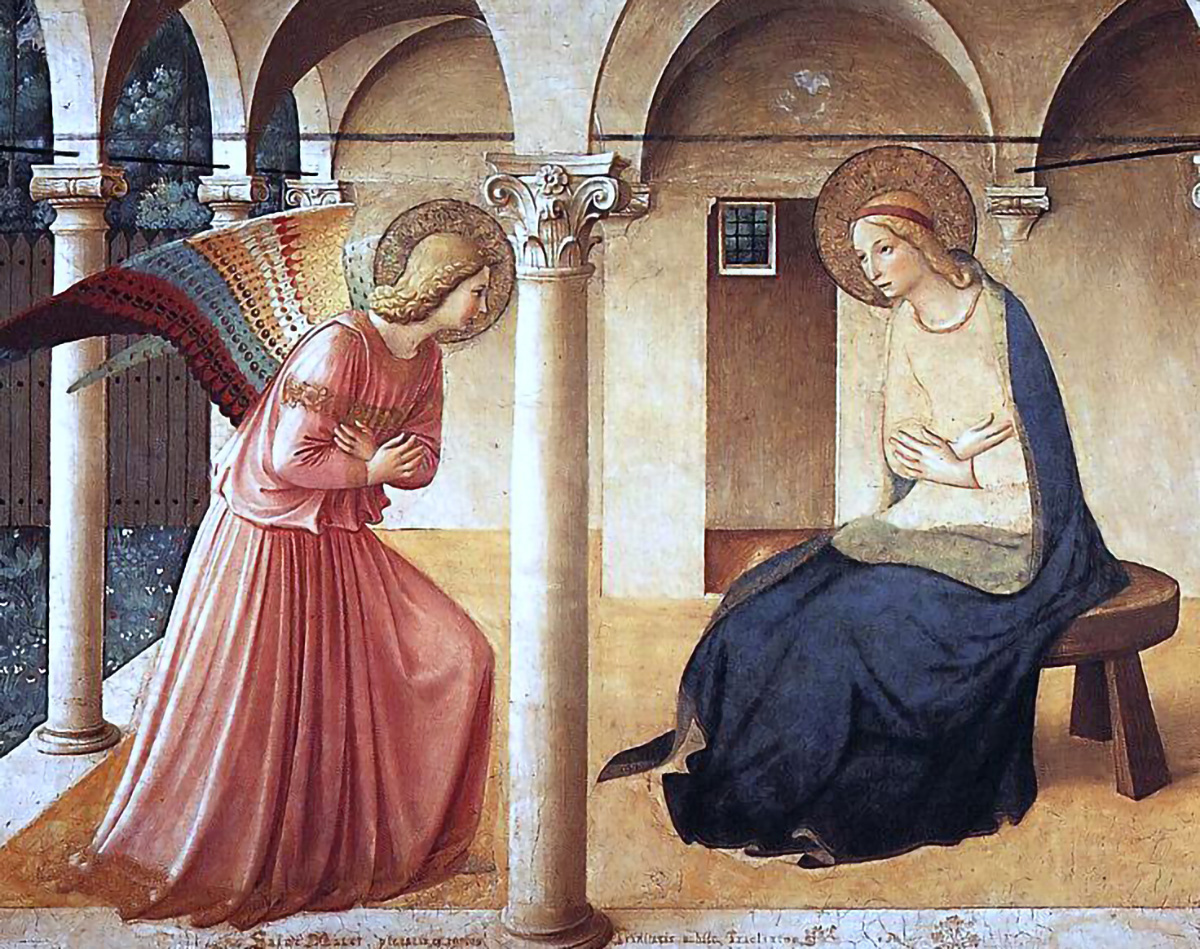
The name Jesus is fundamental to his identity. When Gabriel visits Mary to announce the good news of his birth, he instructs her: “Do not be afraid, Mary, for you have found favor with God. And behold, you will conceive in your womb and bear a son, and you shall call his name Jesus.” Jesus, or Iēsous in the Greek, is a form of the Hebrew name Yeshua, or Joshua, which means “The Lord is salvation.” And just as Joshua led the people into the Promised Land after their time of captivity in Egypt, Jesus would lead his people into a new kingdom.
So in the name Jesus, given before his birth, we see an anticipation of his work of salvation. Jesus is the redeemer, the savior. But as Gabriel continues in his message to Mary, this son is not only a savior—he is also a king. Thus, says Gabriel, “He will be great and will be called the Son of the Most High. And the Lord God will give to him the throne of his father David, and he will reign over the house of Jacob forever, and of his kingdom there will be no end.”
Jesus of Nazareth, King of the Jews. This is his identity from before his birth to after his death. Both Gabriel and Pilate affirm the same truth about his identity: Jesus of Nazareth, King of the Jews. Indeed, he is the Savior of all God’s people and King of all the world. The focus of this essay is on Jesus Christ as a king—and not just any king, but the King of kings and the Lord of lords. As we look at the nature of his kingdom, however, we will see how this kingdom differs in many and radical ways from the kingdoms of this world.
As Christians we must avoid seeking a kingdom without a king, focusing so much on impacting this world for the good that we forget who Christ is for us and for our world. But we also want to avoid claiming to have a king without having any sense of his kingdom. Every king needs a kingdom, and every lord needs a people. How much more is this true of the King of kings and the Lord of lords?
The kingdom of God, Jesus tells us, is like a pearl and a leaven. The kingdom considered as a pearl teaches us that God’s kingdom is upside down. It undoes our expectations about what is valuable. It reverses our understanding of what our relationships in and to this world mean. It revolutionizes our vision of what matters to God and what ought to matter to us.
The kingdom is also a leaven. The kingdom considered as a leavening agent in the world turns our perspective on the world inside out. We see how the gospel radically changes our hearts, making us alive again and sensible to what God wills in the world. Through our remade hearts and transformed minds, God uses our entire person to act as his agents of renewal in the world.
In Matthew 13, Jesus is teaching the crowds about the kingdom of heaven through a series of parables, one of which is called the Parable of the Pearl of Great Value. It goes like this:
The kingdom of heaven is like a merchant in search of fine pearls, who, on finding one pearl of great value, went and sold all that he had and bought it. (Matt. 13:45–46)
The kingdom is a reality of such value, such significance, that it radically changes the way we relate to everything else. The kingdom is itself of the utmost value—and it changes all other values. It turns our evaluation of the world on its head.
That Jesus taught the crowds in parables and explained those parables to his disciples doesn’t mean that his followers always understood what he meant by them. Consider the case of James and John, the sons of Zebedee. In Mark 10 we read their petition: “Grant us to sit, one at your right hand and one at your left, in your glory.” This is a request that recognizes Jesus to be a king. He will be enthroned in glory, and the sons of Zebedee want to have places of honor at his left and right hand.

But it is clear that James and John do not understand how the kingdom of God works. Their world- and lifeview has not yet been transformed by this new vision of a heavenly kingdom. Indeed, Jesus tells them: “You do not know what you are asking.” Their request doesn’t make sense in the logic of Christ’s kingdom.
James and John are working under the assumptions of worldly power and worldly kingship. From the fall into sin, the story of worldly authority was that the stronger ruled over the weaker. Part of the curse was that Adam would “rule over” Eve (Gen. 3:16). Cain was more powerful than Abel, and killed him. Cain’s descendant Lamech would continue that same pattern. He bragged: “I have killed a man for wounding me, a young man for injuring me. If Cain is avenged seven times, then Lamech seventy-seven times” (Gen. 4:23).
The strong and great make the rules. And since James and John understood Jesus to be the greatest, it made sense that he could decide who would be honored at his right and his left hand.
But listen to what Jesus tells them, and take to heart what this means for how his kingdom would be run. First, Jesus says something strange. He answers them not by saying he is all-powerful and can do anything he wants. He doesn’t say it’s up to him who is honored in his kingdom and that he could honor James and John in the way they ask but just doesn’t want to. No—Jesus confesses a kind of powerlessness: “To sit at my right hand or at my left is not mine to grant, but it is for those for whom it has been prepared.” We know of course that the Son of God was involved in the creation and plan for the consummated kingdom. But as God incarnated, Jesus of Nazareth is not here to act arbitrarily as an earthly king or tyrant might, to lift some up to places of honor simply because he can.
Jesus continues:
You know that those who are considered rulers of the Gentiles lord it over them, and their great ones exercise authority over them. But it shall not be so among you. But whoever would be great among you must be your servant, and whoever would be first among you must be slave of all. For even the Son of Man came not to be served but to serve, and to give his life as a ransom for many.
Here we see clearly that we have a king who is different from other kings, and his kingdom is different from other kingdoms. Christ’s kingdom takes worldly ways of ruling and turns them upside down. “My kingdom,” says Jesus, “is not of this world.” And indeed it must have seemed otherworldly to James and John when they got that kind of answer from Jesus.
The kingdom of God is a pearl of great value that must cause us to pursue it above all else and to revalue everything else in light of that reality.
The kingdom considered as a pearl of great value must make us rethink and reorient how we relate to earthly rulers. But it also changes and relativizes all our other earthly relationships. Consider what Jesus taught about those strongest of human bonds, that of love and obedience between family members. In Matthew 12 we read that “whoever does the will of my Father in heaven is my brother and sister and mother.’”
The bonds of love and obedience to God are the primary characteristics of the kingdom of God, transcending and revaluing all other such bonds, even to those of our own parents, siblings, and children. Rather than the rule of the stronger over the weaker, or the greater over the lesser, we have a kingdom defined by obedience to the will of God, where the last shall be first and the first shall be last.
The Kingdom of God causes us to revalue everything. But does this mean that the world itself is of no value?
There’s a wonderful image of this in C.S. Lewis’s book The Great Divorce. In this allegory, the narrator travels through heaven and hell. At one point in his visit to heaven, he sees a grand parade, and following on a procession of bright, musical spirits he spots “a lady in whose honour all this was being done.” The narrator is so impressed by the procession, and by her beauty and grace, by the “clarity with which her innermost spirit shone through [her] clothes,” that he thinks she might be Mary, the mother of Jesus. He asks his guide: “Is it…?” Could it be her?
To this the guide responds: “Not at all. It’s someone ye’ll never have heard of. Her name on Earth was Sarah Smith and she lived at Golders Green.” The narrator is still working under the assumptions of worldly greatness. He thinks she obviously must be “a person of particular importance.” This is true. She is, as the guide relates, “one of the great ones.” But what makes her great in heaven is not what makes people great on Earth. Or, as the guide puts it, “Ye have heard that fame in this country and fame on Earth are two quite different things.” What made her great in the kingdom of God was her love: Every person, “every beast and bird that came near her had its place in her love. In her they became themselves. And now the abundance of life she has in Christ from the Father flows over into them.”
Fame and greatness in the kingdom of God and fame and greatness on Earth are two quite different things. This is what James and John failed to recognize when they asked Jesus to honor them by placing them at his left and right hand. This is what the merchant who sought the pearl of great price did recognize.
The kingdom of God causes us to revalue everything. But does this mean that the world itself is of no value? Does this revaluation utterly evacuate the Earth of significance and meaning? Does this turning upside down of our values mean that only our eternal destiny matters?

Consider also Jesus’s teaching at the conclusion of the Sermon on the Mount, where he contrasts worries about this world with concerns about the kingdom of God. Just as worldly people value strength, power, fame, and greatness in earthly terms, so too do worldly people seek the goods of the world to fulfill their desires and needs.
But Jesus instructs us: “Do not be anxious about your life, what you will eat or what you will drink, nor about your body, what you will put on. Is not life more than food, and the body more than clothing?” (Matt. 6:25). Or, as the Apostle Paul has it, “For the kingdom of God is not a matter of eating and drinking but of righteousness and peace and joy in the Holy Spirit” (Rom. 14:17).
God knows that we need earthly things to live; he has created us to use these things rightly. The radical revaluation of earthly goods in light of the pearl of great value does not thereby devalue everything else. Rather, it helps us to value rightly everything else: Seek first God’s kingdom and all other things will be rightly ordered in light of that transcendent reality.
We have seen that the kingdom of God is a pearl of great value, revolutionizing our perspective of the things of this world and the world to come. As Jesus describes it in that series of parables in Matthew 13, the kingdom is also a leaven: “The kingdom of heaven is like leaven that a woman took and hid in three measures of flour, till it was all leavened” (Matt. 13:33).
Christ call us to radically reorient our loyalties and our identities.
The kingdom of God as leaven works from the inside out. The gospel call and the Spirit’s working regenerate the human person, healing our hearts and manifesting that new life in a renewal of our place in the world. Remember what the narrator in The Great Divorce says about Sarah Smith: “The abundance of life she has in Christ from the father flows into them” and into every created thing she encounters.”
The leavening work of the kingdom is just like this. As Lewis’s narrator continues, “It is like when you throw a stone into a pool, and the concentric waves spread out further and further. Who knows where it will end?”
The kingdom understood as a pearl places the spiritual and eternal destiny of humanity at the forefront; the kingdom as a leaven takes that newly revalued earthly life and invigorates it with significance. Here’s how the great Dutch theologian Abraham Kuyper describes it:
The kingdom of God that is being established and is being reclaimed from Satan must certainly manifest itself in spiritual powers and marvelous glories, but still, it consists first of all of people. A kingdom of God without a people of God is impossible. Therefore the battle against Satan consists not only in reclaiming from Satan the spiritual treasures of human life, but first of all in retrieving human beings from Satan, both in body and soul.
The kingdom of God is not simply about the world to come; it is about this world, too. It isn’t simply about the salvation of souls; it is about the salvation of human persons, body and soul, and the resurrection of the body as well as the immortality of the soul.
Christ’s kingdom is not of this world, but it is a kingdom that exists for this world—for its redemption, salvation, restoration, and consummation.
The people of God are the salt, light, and leaven in the world as it stands between Christ’s first and second coming. The church fathers described the faithful presence of Christians in the Roman world in precisely these terms. The second-century Letter to Diognetus says that
What the soul is in the body, that Christians are in the world. The soul is dispersed through all the members of the body, and Christians are scattered through all the cities of the world. The soul dwells in the body, but does not belong to the body, and Christians dwell in the world, but do not belong to the world.
The second-century apologist Tertullian likewise wrote to the Roman authorities to defend Christians as active throughout the world, serving the public good through their faithful presence:
We sojourn with you in the world, abjuring neither forum, nor shambles, nor bath, nor booth, nor workshop, nor inn, nor weekly market, nor any other places of commerce. We sail with you, and fight with you, and till the ground with you; and in like manner we unite with you in your traffickings—even in the various arts we make public property of our works for your benefit.
The kingdom of God is a leaven, working for renewal and reconciliation in the world. That means that each member of God’s kingdom has some important work to do. If Christ is our king, then we are his stewards, set in charge of some place, some corner of his world. Each follower of Christ has a stewardship responsibility to be a channel of grace and renewal in his kingdom, which is to be manifest over more and more of the created order.
Christ takes us in our worldly situations—our families, our careers, our communities, our nations—and claims us for his own. He calls us to radically reorient our loyalties and our identities, but those newly ordered loyalties and identities likewise radically free us to serve both God and our neighbors in and through those very same relationships. We serve God and further his kingdom by loving others through our various callings, our different places of responsibility throughout society and the world.
For some that means primarily being a parent; for others it means being a preacher or a teacher or a plumber or (dare I say) a theologian, and by God’s grace, even a politician. With God all things are possible.
Christ’s kingdom is not of this world—but it is a kingdom that exists for this world, for its redemption, salvation, restoration, and consummation.
At about the same time as the wooden crucifix mentioned above was being constructed in 14th-century Prague, a poem was being composed in late-medieval England.
This poem is called “Pearl” and relates the story of a father whose very young daughter has died. The father grieves and visits her grave, and in the midst of his lament receives a vision of heaven. As he encounters this heavenly reality, he sees a young woman. In the same way that the narrator in Lewis’s Great Divorce sees a young woman so full of grace and light that he erroneously takes her for Mary, so too does the father in “Pearl” think that this young woman must be the God-bearer. “Are you the queen of heavens blue / Whom all must honour on earth that fare?” he wonders.
The young woman responds that the man is mistaken. He has confused greatness in God’s kingdom with the standards of greatness on earth:
The court where the living God doth reign
Hath a virtue of its own being,
That each who may thereto attain
Of all the realm is queen or king,
Yet never shall other’s right obtain,
But in other’s good each glorying
and wishing each crown worth five again,
If amended might be so fair a thing.
In God’s kingdom, the first will be last and the last will be first:
The wolf shall dwell with the lamb,
and the leopard shall lie down with the young goat,
and the calf and the lion and the fattened calf together;
and a little child shall lead them.
(Isaiah 11:6)
The father’s worldly ways of evaluating and judging persist. When he finds out that the young woman he takes for a queen is not Mary but is in fact his deceased daughter, he thinks that such honor cannot be right. She was just a young child when she died and had done nothing to merit such treatment. “That courtesy gives its gifts too free,” he says. His daughter was not even two years old before she died, not even old enough to know the Lord’s Prayer or the Creed. “I cannot believe,” he says,
God helping me,
That God so far from right would stray.
Of a countess, damsel, I must say,
’Twere fair in heaven to find the grace,
of a lady even of less array;
But a queen! It is too high a place.
The lady corrects him with a lengthy response, invoking the Parable of the Workers in the Vineyard (Matt. 20) to expound the prodigal abundance of God’s grace. She refers to the Parable of the Pearl of Great Value in explaining the excelling grandeur of God’s kingdom. And she refers to the biblical teaching of Christ:
Then Jesus summoned his servants mild,
And said His realm no man might win,
Unless he came there as a child;
Else never should he come therein.
“Truly, I say to you,” Jesus tells us in Matthew 18, “unless you turn and become like children, you will never enter the kingdom of heaven. Whoever humbles himself like this child is the greatest in the kingdom of heaven” (Matt. 18:3–4).
Greatness in the kingdom of heaven and greatness on Earth are not the same things at all. The kingdom of heaven is a pearl turning our values upside down and a leaven working from the inside out.
Greatness in the kingdom of heaven and greatness on Earth are not the same things.
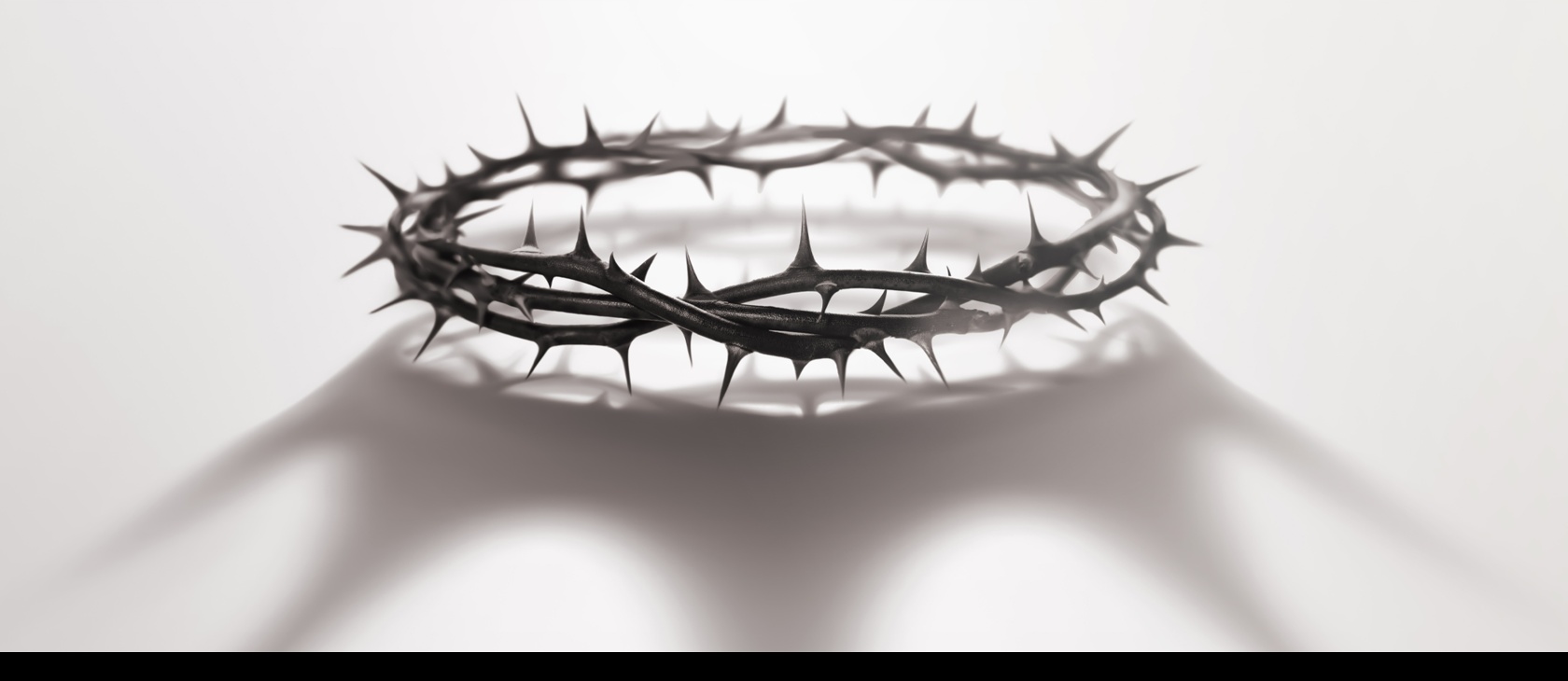
Jesus Christ is the King of kings and the Lord of lords and the crown our King wore at his greatest triumph is a crown of thorns. Our King is the suffering servant. As we read in the book of Hebrews:
In putting everything under him, God left nothing that is not subject to him. Yet at present we do not see everything subject to him. But we see Jesus, who was made a little lower than the angels, now crowned with glory and honor because he suffered death, so that by the grace of God he might taste death for everyone. (Heb. 2:8–9)
In laying down his life, Christ gains life—abundant life—for his people. Christ’s kingdom is a pearl of great value. By comparison, everything else is worth nothing. This is why Paul says:
I count everything as loss because of the surpassing worth of knowing Christ Jesus my Lord. For his sake I have suffered the loss of all things and count them as rubbish, in order that I may gain Christ and be found in him. (Phil. 3:8–9)
Paul counts everything else as “rubbish,” filth, slime, muck—and even stronger language than that.
But everything we “lose” from the upside-down revolution in the kingdom as a pearl of great value, we never truly had to begin with. And when we receive the gift of that pearl, we get everything else back, and receive it truly for the first time when we give into the inside-out reality of the kingdom as leaven, working as agents of God’s grace in its various forms.
“Aim at heaven,” says C.S. Lewis, “and you will get earth thrown in. Aim at earth and you get neither.”
The kingdom of heaven is a pearl and a leaven. We follow a risen savior: Jesus of Nazareth, King of the Jews. It is this King, Jesus Christ, who taught us to pray to the Father:
Thy kingdom come,
thy will be done,
on earth
as it is in heaven.
Amen.