


In the summer of 2024, Louisiana passed a law requiring posters of the Ten Commandments be displayed in public school classrooms. Days after Louisiana Governor Jeff Landry signed the bill into law, the American Civil Liberties Union, the American Civil Liberties Union of Louisiana, Americans United for Separation of Church and State, and the Freedom from Religion Foundation filed suit claiming the law violated both the Free Exercise and Establishment Clauses of the U.S. Constitution. A federal district court judge and a panel of Fifth Circuit judges agreed. The case, and similar cases from Arkansas and Texas, are still being litigated.
For many today, a Bible in the hands of a president is little more than a prop for a photo-op. But history shows that the Scriptures once propped up a nation’s self-definition and provided inspiration for even presidents of a skeptical bent.
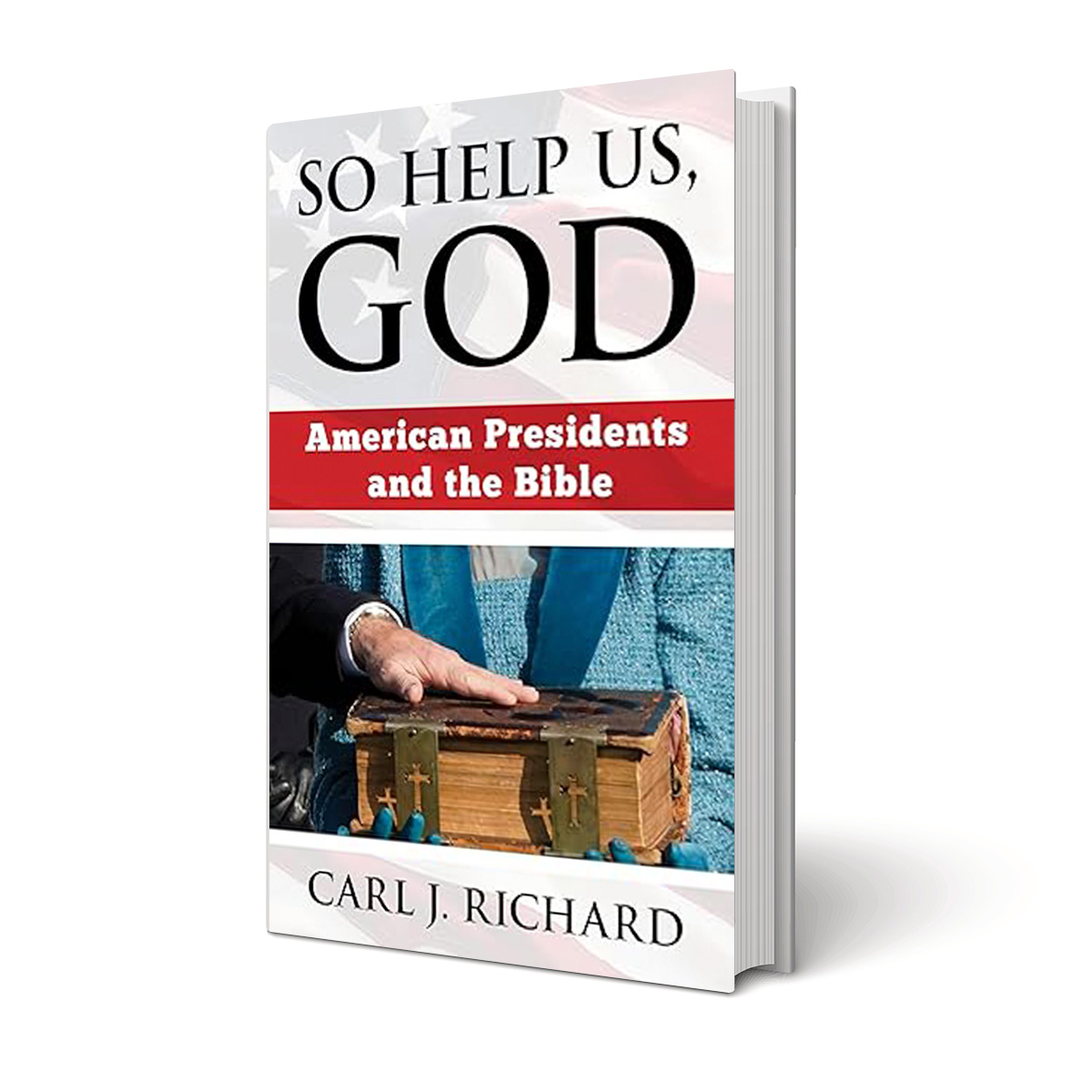
By Carl J. Richard
(Rowman & Littlefield, 2025)
The loud, persistent, and hyperbolic objections to merely displaying the Ten Commandments in public schools obscures the reality that America is a country profoundly influenced by the Bible. Even ardent secularists recognize the Bible’s impact in the early colonies, and although too many scholars have denied its influence on America’s founders, recent books such as Daniel L. Dreisbach’s Reading the Bible with the Founding Fathers have demonstrated that the Holy Scriptures were the most important book in this era.
A central contribution of Carl J. Richard’s So Help Us, God: American Presidents and the Bible is to show that the Bible had profound influence on most American presidents from the founding era to at least the early 21st century. Even the presidents who questioned whether the Bible was the uniquely inspired Word of God were familiar with it and often incorporated it into their speeches and correspondence.
Before proceeding, two qualifications are in order. First, Richard recognizes that some presidents rejected orthodox Christianity and the divine inspiration of the Bible. He never attempts to make presidents seem more orthodox or pious than they were. Second, he understands that some public statements by presidents were written by members of their staff. Yet the fact that they retained scriptural references says something about America’s political culture. And many examples that Richard includes come from private correspondence, diary entries, or conversations not intended for public consumption.
Richard begins by considering how presidents came to know the Bible. The most important influences were “pious grandparents, parents, siblings and wives” followed closely by participation in church services. But particularly relevant in light of recent disputes about the Ten Commandments is the fact that, from the founding era through the 1960s, the Bible played a central role in American education—both private and public. Indeed, college entrance exams in the 18th and 19th centuries often required proof that the applicant had the ability to read the New Testament in Greek. To take just two examples, in 1815 James K. Polk was required to translate the Gospel of John from Greek to English to be admitted to the University of North Carolina. Five years later, Franklin Pierce had to prove he could translate the Greek New Testament to be admitted to Bowdoin.
Even the heterodox Thomas Jefferson spent a great deal of time studying the Bible in multiple languages, including biblical Greek.
Richard makes a persuasive case that many “presidents have studied the Bible throughout their lives.” Even the heterodox Thomas Jefferson spent a great deal of time studying the Bible in multiple languages, including biblical Greek. Surprisingly, at least to this reader, in his retirement Andrew Jackson read a chapter of the Bible to his family at the end of each day and, on his deathbed, encouraged those present to “keep holy the Sabbath day and read the New Testament.” Jimmy Carter regularly read the Holy Scriptures with his wife, even reading “through the entire Bible several times in Spanish.”
The Bible has often been referenced in the political rhetoric of American presidents, especially when they needed heroes and villains. Jesus Christ has often been held up as a role model. In Woodrow Wilson’s words, he offered “the only perfect example of service for love’s sake.” More than a century later, President Obama proclaimed that “through a life of humility and ultimate sacrifice, a life guided by faith and kindness towards others, Christ assumed a mighty voice, teaching us lessons of compassion and charity that have lasted more than two millennia.”
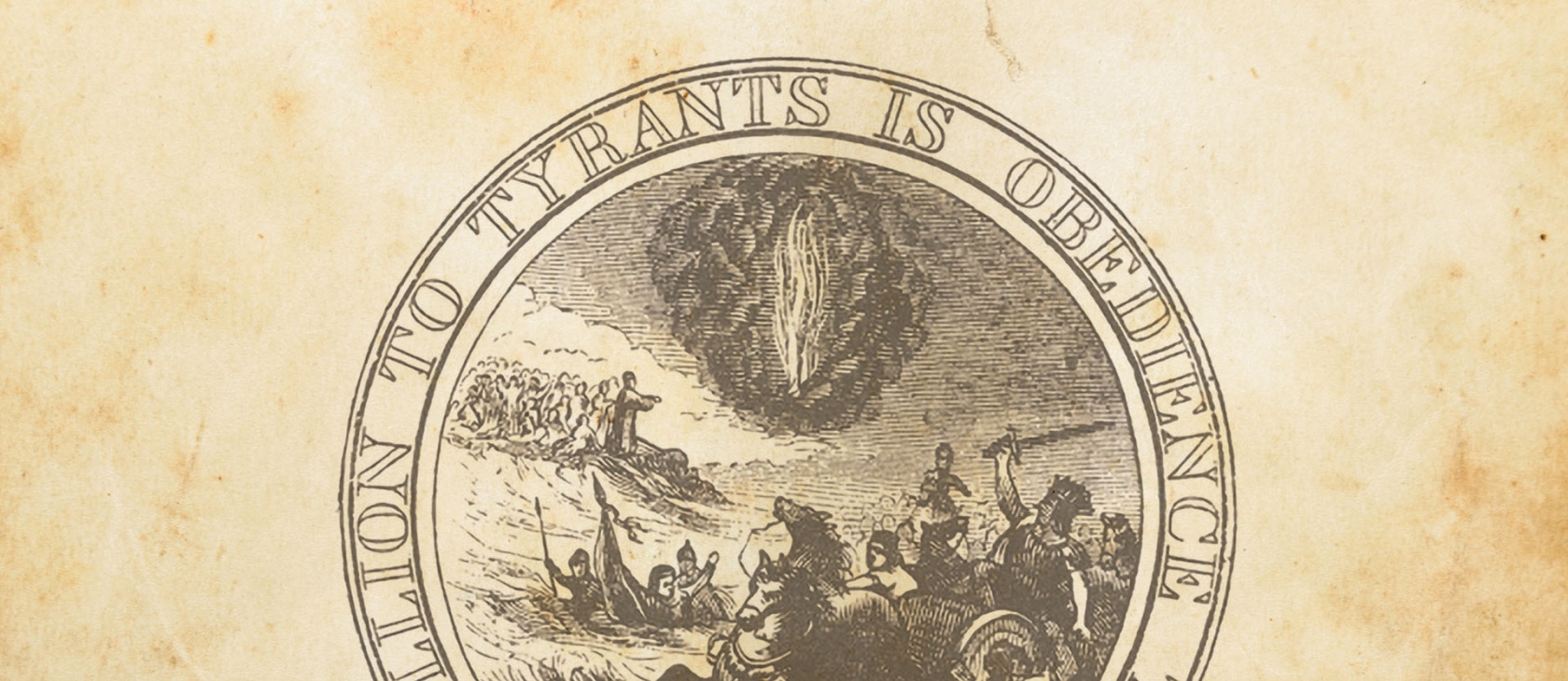
The Bible is replete with heroes. Among the many regularly referenced by presidents are Adam, Noah, Abraham, Joseph, Moses, Ruth, Solomon, Samuel, Isaiah, the Samaritan woman, and the Good Samaritan. Notably, Thomas Jefferson and Benjamin Franklin would have featured Moses on the national seal.
Historically, Christians have believed in an omniscient and omnipotent God who intervenes in the affairs of men and nations to bring about His will. This intervention is often referred to as “Providence,” a doctrine that can provide hope and comfort in good times and bad. George Washington repeatedly referenced God’s Providence, including in this 1755 letter to his brother, penned during the French and Indian War:
As I have heard, since my arrival at this place, a circumstantial account of my death and dying speech, I take this early opportunity of contradicting the first, and of assuring you that I have not, as yet, composed the latter.—But, by the All-powerful Dispensation of Providence, I have been protected beyond all human probability or expectation; for I had four Bullets through my Coat, and two horses shot under me; yet escaped unhurt, altho[ugh] Death was leveling my Companions on every side me!
Washington goes so far as to suggest that anyone who subverts either religion or morality is unpatriotic.
It is common to attribute good things to God’s Providence, but Richard gives multiple examples of presidents recognizing that sorrows come from God as well. For instance, after the Second Battle of Bull Run, President Lincoln, in “notes of private meditation, intended for his eyes only,” observed:
The will of God prevails. In great contests each party claims to act in accordance with the will of God. Both may be, and one must be, wrong. God cannot be for and against the same thing at the same time. In the present civil war it is quite possible that God's purpose is something different from the purpose of either party—and yet the human instrumentalities, working just as they do, are of the best adaptation to effect His purpose. I am almost ready to say that this is probably true—that God wills this contest, and wills that it shall not end yet. By his mere great power, on the minds of the now contestants, He could have either saved or destroyed the Union without a human contest. Yet the contest began. And, having begun He could give the final victory to either side any day. Yet the contest proceeds.
If one believes in a God who is active in the affairs of men and nations, it is only reasonable to also believe in the efficacy of prayer. Most presidents before, during, and after they were in office have professed belief in prayer. For many, the longer they were in office, the more they prayed. Then-candidate Jimmy Carter observed in 1976 that “I spent more time on my knees the four years I was governor in the seclusion of a little private room off the governor’s office than I did in all the rest of my life put together.”
Presidents pray privately and with others, and with some regularity they issue calls for prayer, encouraging citizens throughout the nation to pray on a particular day. A few (for example, Thomas Jefferson and Andrew Jackson) did not because they believed such calls violated the First and/or Tenth Amendments. James Madison issued four calls while he was president, although he later wrote in a private document that he believed such calls to be unconstitutional.
In February of 2024, Politico reporter Heidi Przybyla mocked Americans who believe rights “don’t come from Congress, they don’t come from the Supreme Court, they come from God.” In September of 2025, Virginia Senator Tim Caine doubled down on this idea, observing that the idea that rights come from the Creator is “what the Iranian government believes.” They would undoubtedly be troubled by the Declaration of Independence, drafted by future President Thomas Jefferson, which proclaims: “We hold these truths to be self-evident, that all men are created equal, that they are endowed by their Creator with certain unalienable Rights, that among these are Life, Liberty and the pursuit of Happiness.”
Presidents routinely attributed positive developments to God’s blessing His chosen nation, but also understood tragic events to be God’s punishment for the nation not living up to its mission.
From the founding era to the present day, Democratic and Republican presidents alike have declared that rights come from God. Former President Herbert Hoover, for instance, observed that classical liberalism is based on the tenet that “Liberty is an endowment from the Creator of every individual man and woman upon which no power, whether economic or political, can encroach, and that not even the government may deny.” President Truman even more specifically connected rights to the Holy Scriptures: “The fundamental basis of our Bill of Rights comes from the teachings which we get from Exodus and St. Matthew, from Isaiah and St. Paul.”
The Scriptures portray Israel as a nation chosen by God to play a role in bringing about His will on earth. Presidents have found the idea to be quite attractive, especially as applied to the United States. In his 1790 letter to the Hebrew Synagogue in Savannah, Georgia, President Washington wrote:
May the same wonder-working Deity, who long since delivering the Hebrews from their Egyptian Oppressors planted them in the promised land—whose providential agency has lately been conspicuous in establishing these United States as an independent nation—still continue to water them with the dews of Heaven and to make the inhabitants of every denomination participate in the temporal and spiritual blessings of that people whose God is Jehovah.
Most, perhaps all, presidents have agreed, often casting America as God’s agent for advancing liberty and equality around the globe. Presidents routinely attributed positive developments to God’s blessing His chosen nation, but also understood tragic events to be God’s punishment for the nation not living up to its mission. Most famously, President Lincoln understood the Civil War as punishment for both the North’s and the South’s complicity in the sins of slavery.
In crafting a national government, the Founders drew from the “new science of politics” to create a constitutional order characterized by the separation of powers and checks and balances. But virtually all of them also believed that republican government required a moral citizenry, and that religion was necessary for morality. Most famously, President Washington, in his 1796 “Farewell Address,” observed that:
Of all the dispositions and habits which lead to political prosperity, religion and morality are indispensable supports. In vain would that man claim the tribute of patriotism, who should labor to subvert these great pillars of human happiness, these firmest props of the duties of men and citizens. The mere politician, equally with the pious man, ought to respect and to cherish them. A volume could not trace all their connections with private and public felicity. Let it simply be asked: Where is the security for property, for reputation, for life, if the sense of religious obligation desert the oaths which are the instruments of investigation in courts of justice? And let us with caution indulge the supposition that morality can be maintained without religion. Whatever may be conceded to the influence of refined education on minds of peculiar structure, reason and experience both forbid us to expect that national morality can prevail in exclusion of religious principle.
So Help Us, God provides an excellent overview of how presidents have been influenced by the Bible and used it in their private and public communications.
Note that Washington goes so far as to suggest that anyone who subverts either religion or morality is unpatriotic. Toward the end of the paragraph, he acknowledged that it may be possible that someone with a “refined education” could be virtuous without being religious, but at the national level he clearly believed that religion is necessary to generate the virtues needed to make republican government possible. Washington’s assessment has been echoed by presidents from the 18th through the 21st centuries.
As noted above, Richard acknowledges that some presidents may reference Christianity and the Bible even though they privately reject aspects of orthodox Christianity or divine revelation. His penultimate chapter acknowledges that both John Adams and John Quincy Adams valued the Bible but embraced heretical views and questioned the inerrancy of Scripture. Similarly, Rutherford B. Hayes privately admitted that he rejected “most of the notion … orthodox people have of the divinity of the Bible,” and as a student at Whittier College Richard Nixon wrote that “my education has taught me that the Bible, like all other books, is the work of man and consequently has man-made mistakes.” Jefferson was “perhaps the most skeptical president concerning the Bible” even as he valued the moral teachings of Jesus.
So Help Us, God provides an excellent overview of how presidents have been influenced by the Bible and used it in their private and public communications. That presidents with unorthodox views or who questioned the Bible’s inerrancy kept their views private tells us much about American political culture from the founding era to the present day. This review has described only a tiny percentage of the thousands of examples that Richard provides to support each of his claims. The Bible has always played a central role in American politics—at least until very recently.
Richard’s book was published in 2025, but he gives literally no examples of Presidents Biden or Trump using the Bible in their political rhetoric. He notes that the former regularly attends Mass but says virtually nothing about the latter’s spiritual practices (or lack thereof). These recent presidents may well reflect the reality that fewer and fewer Americans embrace Christianity. In 2007, 16% of Americans were religiously unaffiliated; in 2023, 28% described themselves as such.
It is also the case that fewer Americans believe that the Bible is the inspired Word of God. In the late 1970s, 12% of Americans described the Bible as “fables, history, and moral precepts recorded by man,” whereas 29% described it as such in 2022. Americans today are a less religious and a less biblically centered people than they were in the past. This may help explain the increased polarization that marks contemporary politics. It may well be the case that President Washington was correct when he observed that “of all the dispositions and habits which lead to political prosperity, religion and morality are indispensable supports.”
