

Page 45 of 112
Illuminating the Word
An Interview with Makoto Fujimura Makoto Fujimura is an artist, writer, and speaker who is recognized worldwide as somebody who promotes a Christian worldview. A Presidential appointee to the National Council on the Arts from 2003-2009, Fujimura served as an international advocate for the arts, speaking with decision makers and advising governmental policies on the arts.Editor's note
In a 2013 commencement address at Messiah College in Pennsylvania, Makoto Fujimura told the graduating class, "We are to rise above the darkened realities, the confounding problems of our time." A tall order for any age, but one God has decisively overcome in Jesus Christ. Fujimura uses his talent to connect beauty with the truth of the Gospel in a culture that has largely forgotten its religious tradition and history. He makes those things fresh and visible again.Lightening our burdens
Recently, a 14-year-old in Michigan carried his younger brother on his back for 40 miles. The younger brother (Braden) is afflicted with cerebral palsy, and his big brother, Hunter, wanted to bring awareness to the disease while trying to raise money for medical research. Over the course of two days, the brothers completed their journey, which they called the "Cerebral Palsy Swagger." A cynic might look at this and say, "So what? What did the kid prove? His little brother still has cerebral palsy, and he didn't even raise that much money."Charles Malik
Lebanese academic, philosopher, theologian, and diplomat Charles Malik served as a drafter of the Universal Declaration of Human Rights and as president of the thirteenth session of the General Assembly of the United Nations.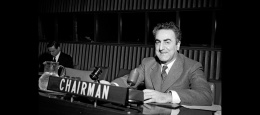
How much progress has Acton made with its capital campaign?
In the Winter 2012 issue of Religion & Liberty, I discussed Acton's decision to seek a new downtown headquarters. Our growth over the last few years has been phenomenal. In the FAQ column from 2012, I briefly mentioned our Acton@25 Capital Campaign. This initiative not only secured our move to 98 E. Fulton but allowed us to make the kind of investments that will enhance our current work while continuing to expand.Ambition meets complexity in sub-saharan Africa
Review of The Idealist: Jeffrey Sachs And the Quest to End Poverty by Nina Munk (Doubleday 2013) 272 pages; $26.95. Jeffrey Sachs, the world-renowned professor of economics and Special Advisor to the Secretary-General of the United Nations on the Millennium Development Goals, makes a bold claim: Extreme poverty can be eradicated and the means for doing so may not be as difficult as we imagine.Double-edged sword: The power of the Word - Colossians 3:1-4
Therefore if you have been raised up with Christ, keep seeking the things above, where Christ is, seated at the right hand of God. Set your mind on the things above, not on the things that are on earth. For you have died and your life is hidden with Christ in God. When Christ, who is our life, is revealed, then you also will be revealed with Him in glory. One of the greatest truths about the incarnation is that the Father looks upon us just as He looks upon His Son, Christ Jesus.A curmudgeon's counsel for the workplace and life
If you've ever wondered what a libertarian curmudgeon's guide to life, love, and making a living might look like, well look no further.John Milton on liberty, license, and virtuous self-government
The notion that genuine liberty is predicated upon virtuous self-government was an accepted ideal among many of the United States' founders. During the Founding era, this ideal was perhaps best expressed in a 1791 letter by the Irish-born British parliamentarian Edmund Burke, who wrote: "Men are qualified for civil liberty in exact proportion to their disposition to put moral chains upon their own appetites . . .Vietnam, Luther, and the doctrine of vocation
An interview with Uwe Siemon-Netto, the founder and executive director emeritus of the Center for Lutheran Theology and Public Life.Editor's note
In getting to know Uwe Siemon-Netto, I learned that one of his most admirable qualities is his willingness to speak his mind and stand clearly for truth amid a drifting and compromising culture.Reasons to celebrate
President Barack Obama has just met with Pope Francis at the Vatican. It is always an important event when the president of our nation meets with one of the most important religious leaders in the world, regardless of who occupies either office at the time of such a meeting.