Roger Kiska is a solicitor for England and Wales and a member of the Michigan State Bar. He is legal counsel for the Christian Legal Centre (London). Kiska has acted in numerous cases before the European Court of Human Rights and the Court of Justice of the European Union. He has also served as an elected member of the Advisory Panel of the European Union’s Fundamental Rights Agency. In 2012, Kiska received the prestigious Scandinavian Human Dignity Award for his legal contributions towards human rights. He is a frequent contributor to television and radio, including the BBC, Sky News, Channel 5, and ITV.

Recent Articles by Roger Kiska

  • The EU revels in its deficit of democracy

    The European Union presented itself as open to the views of average voters through an initiative process, but a new court ruling authorizes European politicians to ignore the voice of their constituents. Politicians have chosen to discard a broad-based call to bring European funding into line with the moral views of EU citizens. This calls the EU’s claim to represent its citizens into question and furthers the crisis of Euroskepticism within its member states.

    Late last month, the Advocate General delivered his highly anticipated opinion in the Grand Chamber case of Puppinck and Others v. Commission. The case involves the “One of Us” Federation and its successful European Citizens’ Initiative (ECI) calling upon the European Union to stop funding research that destroys the human embryo and to end budget expenditures which fund the practice or promotion of abortion in non-EU countries.

    (Full disclosure: I write this article both as a legal commentator and as co-counsel for the “One of Us” Federation.)

    The History of the ECI

    The ECI, as a mechanism of direct democratic participation, was born partly out of existential desperation. In 2005, French voters had rejected the European Union’s constitution by way of national referendum. A few...

  • Has Parliament forgotten 1916? The importance of subsidiarity in the Northern Ireland abortion debate

    On Tuesday, July 9, the Parliament of the United Kingdom voted to override the views of voters in Northern Ireland and legalize abortion and same-sex marriage, if a devolved government is not restored by October 21. These amendments are a naked aggression upon Northern Ireland’s sovereignty. MPs took this action despite health care being a devolved power, and despite growing signs of tension between Stormont and Westminster.

    What issue could be so important that Parliament would risk peace and maintaining the territorial integrity of the United Kingdom by passing measures which directly contravene legislative powers belonging exclusively to the Northern Ireland Assembly? The answer is political opportunism. Following the results of a UK Parliamentary inquiry by the Women and Equalities Committee calling on Westminster to liberalise the abortion law in Northern Ireland, Labour introduced amendments into the Northern Ireland (Executive Formation) Bill which would give effect to the Committee’s recommendations. Several points bear highlighting.

    First, not a single member of the Women and Equalities Committee actually serves in a Northern Irish constituency, meaning that the recommendations to abuse the devolution agreement were made exclusively by MPs in jurisdictions other than those representing the people affected by the recommendation. Second, and...

  • Book review: ‘Equality and Non-Discrimination: Catholic Roots, Current Challenges'

    Equality and Non-Discrimination: Catholic Roots, Current Challenges. Jane F. Adolphe, Robert L. Fastiggi, and Michael A. Vacca.
    Pickwick Publishers, 2019. 246 pages.

    Review by Roger Kiska.

    The ironic thing about equality laws is that they do not promote equality. Instead, by defining individuals by a single characteristic, they tend to breed division and tribalism. Rather than looking to the uniting force of our shared humanity, equality law audaciously demands that some people are created more equal than others and that we must celebrate their particular, protected characteristics, even if doing so violates our conscience.
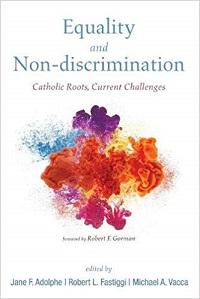
    Adolpe bookSpecial interest groups representing competing "rights holders" spend millions of dollars campaigning, and exerting immense moral and political pressure, to assure they earn a privileged spot in an "equality hierarchy." Such has been the situation time and again in every jurisdiction, nationally and intergovernmentally, where comprehensive non-discrimination laws have been passed.

    With the United States now looking to adopt its own “Equality Act,” a measure which would amend the 1964 Civil Rights Act and the 1968 Fair Housing Act to include sexual orientation and gender identity as protected classes, a comprehensive and compelling treatment of just how great a threat non-discrimination laws pose to...