Stephen F. Copp, Ph.D., is currently researching and writing a novel set in England’s Tudor era and a historical work relating to England’s maritime past; he also composes poetry and song. Formerly a legal academic, his past roles included serving as associate professor at Bournemouth University and visiting professor at St. Mary’s University, Twickenham, London. He was awarded a Ph.D. for his inter-disciplinary thesis, “The Early Development of Company Law in England and Wales: Values and Efficiency.” Hereceived a Seldon award (joint) in respect of the Hobart paperback, The Legal Foundations of Free Markets.
Faced with the rising power of the EU, many will be tempted to succumb and bow their knee to it. Yet Christian theology was forged in the furnace of the brute power of the Roman Empire. The apocalyptic writer John responded in graphic terms, seeing hope one day in a new heaven, a new earth, even a New Jerusalem – a beautiful city, shining with God’s glory, as brilliant as a precious jewel, made of pure gold – together with healing of the nations. Even in the worst of adversity, there is hope. It may be the eleventh hour, but it is not too late for Europe to turn back from the folly on which it embarked in the 1950s.
The first article in this series rejected seductive dreams of utopian visions for society. From a Judaeo-Christian theological perspective, utopia conflicts with human nature as it is: fallen. But the opposite of utopia does not have to be dystopia, “an imaginary place or society in which everything is bad.” A happy and prosperous society needs...
This is the second article in a series on "God, Brexit, and EUtopia." You may read the first part here.
The seductive power of evil and the difficulties of regaining self-determination once lost are well illustrated theologically in C.S. Lewis’s The Silver Chair. Rilian, the prince of Narnia, and the children, Eustace and Jill, are all-but-convinced through enchantment and clever argument by the Queen of Underland that the real world, the “Overworld,” is but a dream and that there was never any world but her own. Puddleglum, a humble Marsh-wiggle, who clears his thoughts with self-inflicted pain, responds with a magnificent speech:
Suppose this black pit of a kingdom of yours is the only world. Well, it strikes me as a pretty poor one. … We’re just babies making up a game, if you’re right. But four babies playing a game can make a play-world which licks your real world hollow … we’re leaving your court at once and setting out in the dark to spend our lives looking for Overland. Not that our lives will be very long, I should think; but that’s a small loss if the world’s as dull a place as you say.
On June 23, 2016, the British people voted by referendum on a simple question: “Should the United Kingdom remain a member of the European Union or leave the European Union?” A total of 17,410,742 (51.9 percent) voted “Leave” and 16,141,241 (48.1 percent) voted “Remain.” So far, the British people who voted “Leave” have little to see for that historic vote other than being bombarded near daily with arguments, threats – and insults – calculated to undermine, frustrate, and reverse that decision. Whatever the outcome of the Brexit negotiations, Brexit has profound implications for those who care about religion and liberty. This two-part article will demonstrate how Judeo-Christian theology resolves the clash between the utopian dreams for the EU and UK national self-determination, and sets out the basis for a non-utopian Christian vision of Europe.
Utopia or dystopia?
Utopia is commonly used to mean “an imagined perfect place or state of things.” Such an ideal is as old as time itself. In Judeo-Christian theology, the Garden of Eden was utopian. Adam and Eve were placed there to work it and take care of it, blissfully unself-conscious of their own nakedness. The mysterious inhabitants of the city of Babel came together...
Great Christian Jurists in English History. M. Hill, QC, and R.H. Helmholz, eds.
Cambridge: Cambridge University Press, 2017. 353 pages.
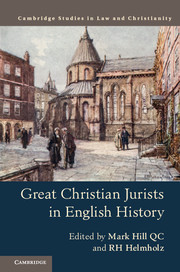
There are several reasons why a scholarly work on the formidable role of Christian jurists in English history is both valuable and timely. The English legal system and common law have long been widely admired worldwide. They are associated with justice, efficiency, fairness, and indeed with a common-sense outlook produced by a focus on real-life problems. Less well-known and appreciated is the cardinal role played by Christian beliefs and believers in their development. As this role becomes more tenuous, it is unclear whether this heralds perhaps a new direction for the common law when it will be invigorated by fresh sources of inspiration – or whether it is sailing into uncharted waters without a meaningful rudder or anchor.
This book, edited by Mark Hill QC (whose roles include being an associate or visiting professor at the Centre for Law and Religion, Cardiff University), and R.H. Helmholz (the Ruth Wyatt Rosenson Distinguished Service Professor at the University of Chicago Law School) provides a rich analysis of the part in England’s story played by Christian jurists. The authors of individual chapters...

Events of the last week – notably the general election 2017 – have produced what appears to be a seismic shift in the British political scene. As of the time I’m writing this review, I wait in fear and trepidation to see whether Theresa May’s Conservative Party will form a stable government or whether it will fall to Jeremy Corbyn’s Labour Party. Corbyn’s policies, such as the renationalisation of private railway companies, seem to take us backwards into a different era of politics – leaving a new generation to fight ideological battles that many had believed would never need to be fought again.
When engaging in philosophical fisticuffs, it is always beneficial to consult Kenneth Minogue, the exponent of a free society who taught 40 years at the London School of Economics. Minogue’s essays – some 20 in all – selected for this excellent and wide-ranging volume, offer timeless insights into the vital issue of liberty and its enemies. They explore many themes including ideology, individualism, opposition, liberalism, democracy, and totalitarianism. Written over a period running from 1961...