
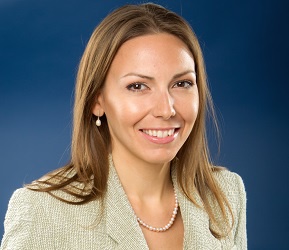
Kaetana Leontjeva-Numaviciene is currently pursuing a Ph.D. at the Department of Political Economy at King’s College, London, where she is researching fiscal illusion among UK taxpayers. From 2007 to 2015, she was a policy analyst in public finance at the Lithuanian Free Market Institute. In this capacity, she analyzed draft laws, conceptualized reforms, was member of governmental working groups to reform the tax system, and prominently wrote in and commented to the Lithuanian media. Kaetana graduated cum laude from Tufts University with a B.A. in Economics and International Relations (double major), and also holds an M.A. in Religious Studies from Vilnius University, Lithuania.
Recent Articles by Kaetana Leontjeva-Numaviciene

  • Forgotten champion of liberty: Alexander Yakovlev

    The grim centenary of Russia’s Bolshevik Revolution reminds us of the cruel experiment that left tens of millions dead, and incapacitated generations of those who lived during its reign or aftermath, leaving them without hope – or bread. Instead of focusing on those Soviet leaders who brought this about, let us remember the man who said, “We should run from such experiments as from a fire,” as he designed perestroika and led the USSR towards renewal. Alexander Yakovlev’s intellectual journey in search of truth brought him away from Marxism towards liberty and democracy, and it is providential that through his journey the Soviet Union found its way to a peaceful liberation from communism. Yet despite the communist shackles coming off, its spiritual burden remained – which is something for which Yakovlev urged all the Russians to repent. While the communist mass murderers continue to be praised by some for their “achievements,” the architect of perestroika received threats, and was vilified and dubbed a traitor up until his death in 2005. This makes celebrating his contribution all the more essential.

    Yakovlev was a man of humble origins. He was born in 1923 in a small village, Korolevo, near the city of...

  • Going beyond efficiency: How Catholic social teaching strengthens the case for trade

    Britain’s vote to leave the European Union is often portrayed as a sign of closing itself off from the rest of the world. Although there is no denying that concerns about immigration played a part in last year’s Brexit referendum, there is a danger in overlooking a crucial strand of Brexiteers’ thought: the case for a global Britain. With the UK set to have an independent trade policy following Brexit, its leaders’ staunch support for free trade should make the rest of the world optimistic and hopeful everyone else will follow.

    Launching the Institute for Free Trade a few weeks ago at the Foreign Office, Boris Johnson, the UK’s Secretary of State for Foreign and Commonwealth Affairs, set the stage for the upcoming trade talks: “The only reason it makes sense today to have this new Institute for Free Trade is that it’s only now, after 44 years, that we are finally taking back control of our tariff schedules in Geneva. … It is only now that the UK is able to resume its historic function as the world’s leading campaigner and agitator for free trade.” This point was reiterated by Liam Fox, Secretary of State for International Trade...

  • European taxpayers may have paid millions for non-existent offices

    The EU’s decision-making bodies have long been accused of a lack of transparency and being detached from their citizens. A new report has uncovered how the lack of accountability has created a new scandal. Even the means of providing a more direct link between EU citizens and their representatives has become a source of widespread abuse and potential corruption, raising a number of moral and ethical issues.

    Members of European Parliament (MEPs) receive a tax-free monthly General Expenditure Allowance of around $4,870, or $58,400 a year to maintain offices in their home nations and other expenses. Their national offices are supposed to allow their constituents to communicate with them more easily. The overall cost of the program is $44.9 million (€40 million). But one-third of MEPs’ national offices either do not exist or cannot be located, according to The MEPs Project, run by Investigative Reporting Denmark. The report revealed that 249 out of 748 current MEPs “either said they have no offices, refused to reveal their addresses, or the location of the offices could not otherwise be tracked.”

    In some cases, the addresses of the national offices were not up to date, and the European Parliament did not have information on their exact...