Andrei Rogobete is a research fellow with the Centre for Enterprise, Markets & Ethics. For more information about Andrei, please click here.

Rethinking Poverty: Income, Assets, and the Catholic Social Justice Tradition. James P. Bailey.
University of Notre Dame Press, 2010. 192 pages.
James P. Bailey is Associate Professor of Theology at Duquesne University. In his book entitled, Rethinking Poverty: Income, Assets, and the Catholic Social Justice Tradition, James Bailey explores the political, social, and economic reforms that are needed to promote the alleviation of poverty. As the title may suggest, the book also incorporates Catholic social teaching on this issue.
 Although the book shares the same title as Barry Knight’s Rethinking Poverty, Bailey’s argument takes a markedly different approach. He starts from the premise that the role of assets and asset-building has been vastly undervalued in the development of public policy on poverty and addressing the needs of the most vulnerable in society. His central argument, therefore, is that poverty “must be conceived more broadly in terms of both insufficient income and deficient assets. A robust, effective, and morally adequate response to poverty must go beyond traditional income-enhancement strategies to include complementary efforts aimed at enabling asset development in the poor” (pp. 1-2). The book is structured in five chapters, and it would be useful to touch upon some...

Economics for the Common Good. Jean Tirole.
Princeton University Press (English translation edition). 576 pages.
Economics for the Common Good is the latest publication by the 2014 Nobel Prize winner in economics, Jean Tirole. Among his numerous accolades, Tirole is currently the chairman of the Toulouse School of Economics and the Institute for Advanced Study at Toulouse 1 University Capitole. Some of his most notable books include The Theory of Corporate Finance (2005); Financial Crises, Liquidity and the International Monetary System (2010); and The Prudential Regulation of Banks (1994). Throughout his academic career Tirole specialised in macroeconomics, game theory, and methods of industrial organisation and competition policy (for which he was also awarded the Nobel Prize).
Economics for the Common Good stands out as thoroughly distinct from his previous work both in vision and content. First, the book is aimed at the general public rather than a specialised audience. Tirole is masterful in using simple language to convey highly complex issues. From climate change to competition policy, the digestible way in which Tirole presents these topics make them accessible to a much wider audience. Secondly, the book spends a good deal of time looking introspectively. It considers the role...

The End of Growth: Adapting to Our New Economic Reality. Richard Heinberg.
Clairview Books, 2011. 231 pages.
Richard Heinberg is an American journalist and author who has dedicated most of his writing career to environmental causes. His most notable works include publications like The Party's Over: Oil, War, and the Fate of Industrial Societies (2003) and Powerdown: Options and Actions for a Post-Carbon World (2004).
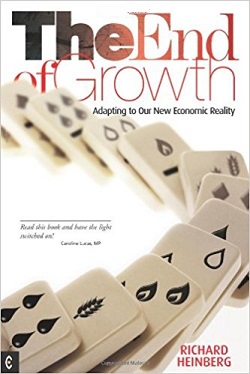 From the book titles alone, an astute reader can gain a sense of Richard Heinberg’s outlook on the environment. Indeed, there is a common thread that flows throughout his body of work, which is probably best exemplified by the book we are reviewing: The End of Growth: Adapting to Our New Economic Reality (2011).
In a nutshell, Heinberg’s thesis is this: Global economic growth, as we have become accustomed to it over the past century or so, is “over and done with” (p. 1). When talking about “growth,” Heinberg is referring to the overall size and expansion of the economy, i.e., an increase in both consumption and production (ibid.).
Why will there be no more economic growth? Throughout the book Richard Heinberg builds his argument on three main assumptions: first, the depletion of natural...

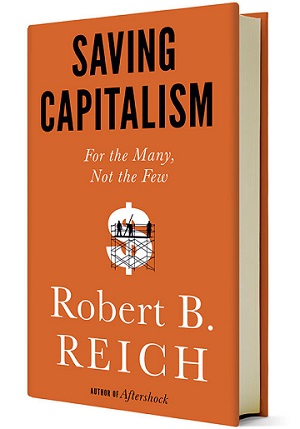
Saving Capitalism: For the Many, Not the Few. Robert Reich.
Icon Books Ltd. 2016. 279 pages.
Saving Capitalism: For the Many, Not the Few is the latest addition to Robert Reich’s cohort of publications. He is perhaps best known for his previous work The Work of Nations (1992), which raised the issue of growing inequality in the public sphere. Alongside his writing, Robert Reich is also a professor at the University of California at Berkeley and has served in various positions under the administrations of Gerald Ford and Jimmy Carter. Most notably, he was U.S. Secretary of Labor under President Bill Clinton between 1993 and 1997.
 At the age of 71, Reich brings a lifetime of experience in both academia and politics to the table. As a true social-democrat, Reich’s Saving Capitalism is a continuation of the themes he discusses in previous publications – some of which include rising inequality, the not so "free" marketplace, the over-concentration of political and economic power in the hands of a few, the disenchantment of the masses, and others.
As the title may suggest, Saving Capitalism is a critique of the free market structures and modern-day capitalism. Reich argues that decision-making power is increasingly concentrated in the hands of a...
