


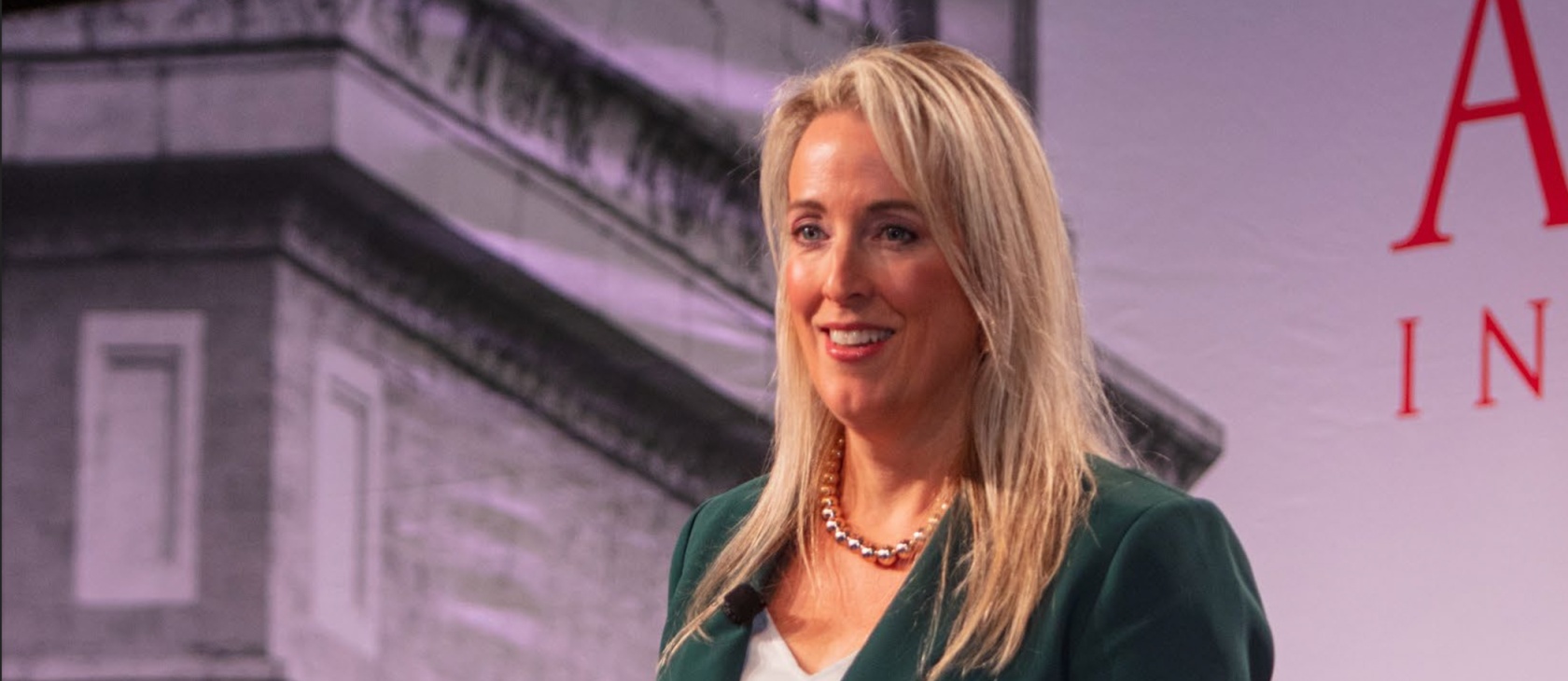
Anne Bradley's decade-long classroom use of the documentary reveals the power of changing hearts and minds
For economist Anne Bradley, the moment of truth comes not in academic journals or policy papers, but in watching her students' faces as they encounter a revolutionary idea for the first time.
"You can see the emotion in their questions," Bradley explains, describing the reaction when her students watch Poverty, Inc. in class. "They're watching it in real time, where they're getting this message that it's about incentives. It's about how we treat the poor. It's about our assumptions—the assumptions we make about who people living in poverty are, what they're capable of, and what aid is capable of."
As an affiliate scholar at the Acton Institute and economics professor at both George Mason University and the Institute of World Politics, Bradley has been using Poverty, Inc. in her classrooms for nearly a decade. Her experience offers a compelling glimpse into the documentary's enduring educational impact as it marks its 10th anniversary.
Bradley discovered early that the film addressed something missing from traditional economics education. "The narrative that students hear in mainstream classrooms is that the wealthy exploit the poor; therefore, we should be suspicious about economic growth," she notes. "And it's a zero-sum game. And thus, the only thing we can really do is just tax the wealthy a lot more and be better at redistributing income. And that's just patently false."
Poverty, Inc. becomes transformational precisely because it challenges this zero-sum thinking. "What the movie does is it says, look, these are real people. They have human dignity. They're made in the image and likeness of God. Thus, they are capable of being creative. They are capable of living out their own destiny," Bradley explains. "We need to just reject the paternalist notion that we are wealthy in the United States and other countries, and so we have to save the poor, but rather we just have to include them in markets."
Bradley particularly values the film's critique of well-intentioned aid efforts, citing the story told by Peter Greer of Hope International about an American church that "adopts" a Rwandan church, providing free eggs. "There's a person there, a small local farmer, who produces eggs. We've put this person out of business. So we've destroyed a little bit of the market economy," Bradley illustrates. "The church adopts another project the next year. So if you could guarantee free eggs for life, great. That's one less thing we have to worry about. But that's unfortunately not how it works."
This example resonates powerfully with students because it demonstrates how good intentions can produce harmful results. "Good intentions don't necessarily mean you're going to get good results," Bradley emphasizes. "What if the law of unintended consequences is so profound here that we're not knowing that we're actually hurting the people we desire to help? That gets them intellectually, emotionally, and spiritually."
The response from students has been consistently strong across Bradley's various courses. Whether teaching "Economics for Policymakers" at the Institute of World Politics or "Economics and Public Policy Problems" at George Mason, she finds that students "have never heard this before, which is really telling about how we speak about aid, both in the church, but also just in school."
What emerges from these classroom discussions is both sobering and hopeful. Students grapple with the realization that traditional aid approaches may be counterproductive, but they also discover reason for optimism. "The bottom billion can escape the poverty that ensnares them. And we're actually seeing it happen," Bradley tells them, combining the film's message with economic data and academic literature.
As the Acton Institute prepares to release a sequel focusing on domestic poverty, Bradley is eager to incorporate it into her curriculum. "I'm hopeful that some of those lessons will be there because it's the same problem in some ways. It's how do we treat the poor? Do we treat the poor as people who are capable of shaping their future, or are we treating the poor as people who just permanently need a handout?"
Bradley sees the upcoming domestic focus as equally important because "poverty in America is different than poverty in Rwanda. We have to understand the source. Is it drug addiction? Is it mental illness? Is it divorce? Is it a lost job? What is it? There's a variety of reasons. And we have to treat people as the unique, dignified human beings that they are."
For Bradley, the lasting value of Poverty, Inc. lies in its ability to change conversations rather than simply win arguments. "If we just browbeat people at USAID like, 'you're doing it wrong, you're stupid bureaucrats,' this is never going to change minds," she observes. "But if we use this film as a way to say these are real people and they have dignity and we're treating them in an undignified manner, but we think it's dignified, that kind of stops you in your tracks."
After a decade of classroom use, Bradley remains convinced that Poverty, Inc. offers something timeless. "There's a continuing relevancy in terms of the message and how we are getting aid wrong both domestically and internationally," she reflects. Through her students' transformed understanding, the documentary continues its mission of promoting both sound economics and human dignity—one classroom at a time.