


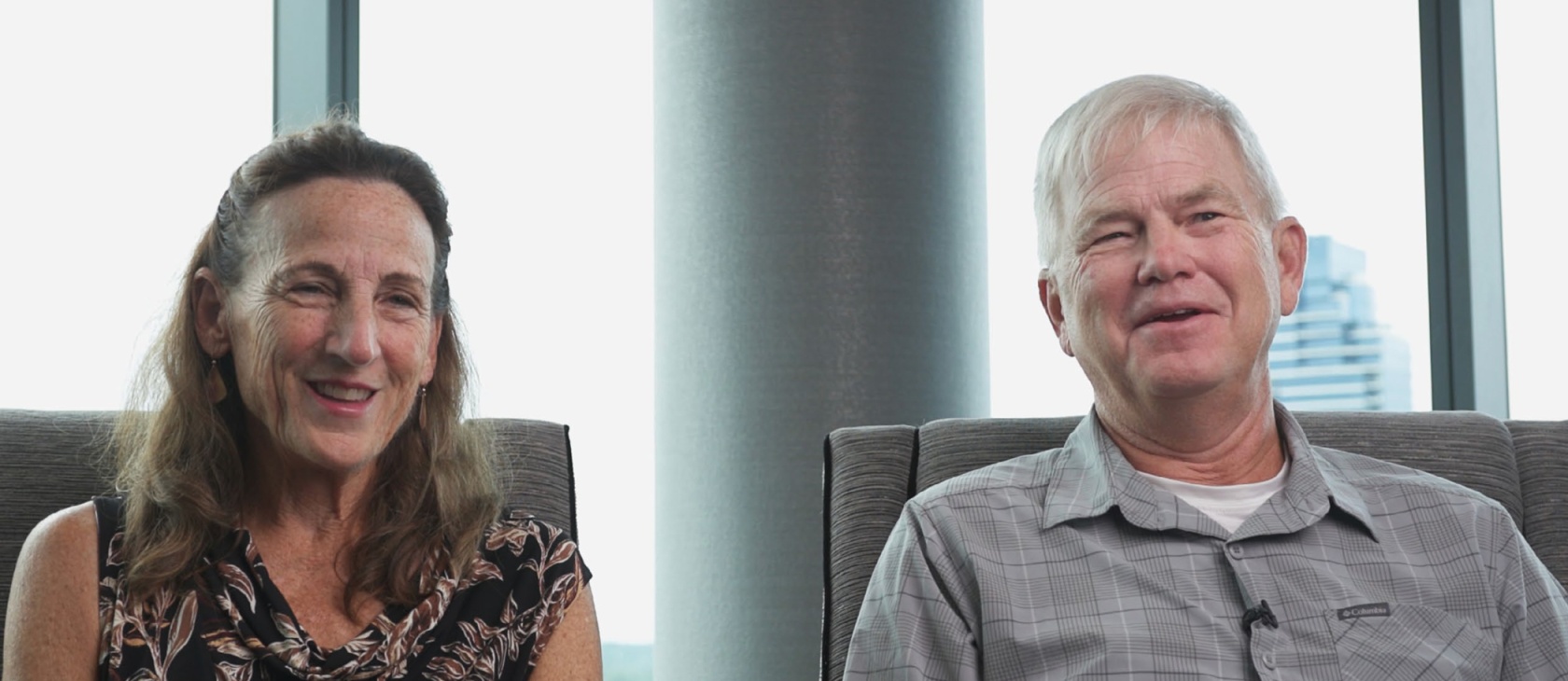
How a retired engineer and teacher are bringing Poverty, Inc. principles to small-town America
Janet Sandeen has discovered that some of life's most important conversations happen when people are pedaling at 125 RPM.
"During spin class, I control the conversation," explains Janet, who runs fitness classes from the 14 spin bikes set up in the finished room above the garage. "So I said, 'Next week, I'm going to a convention about poverty,' and they replied, 'Pottery? What?' This led to a great discussion during spin class that helped them think differently about poverty."
The Sandeens first encountered Acton's ideas through a 2017 "Rethinking Poverty" event in Bronxville, New York, which Larry and Janet attended through his participation in the Colson Fellows program. "I was blown away by the depth of the conversations and being able to see poverty from a different light," Larry recalls. "Michael Matheson Miller screened Poverty, Inc. and spent two hours going over the film, answering our questions."
For Janet and her husband Larry, a retired water and wastewater engineer, that "poverty convention" was their introduction to Acton Institute programming—and it has fundamentally changed how they approach charitable work in their small North Carolina community.
That experience launched the couple into a deeper exploration of Acton's resources. Larry discovered the "For the Life of the World" video series, which he describes as "the quirkiest little video series I've ever seen," and has shown it three times in Sunday school or small groups at their church. "It's engaging, it introduces people to this worldview, and it touches on family, it touches on economics, it touches on so many important topics."
The film Poverty, Inc. particularly resonated with Larry as he grappled with poverty in his own community—a county of 15,000 people, with the county seat of 2,400 residents and a disproportionately high number of people living in public housing. "We got to see the film, Poverty, Inc., and great ideas for world missions, but I couldn't wait for them to come out with a similar movie or study where we have actionable items for how to help folks get out of poverty in America, because it's a different model."
That difference, Larry explains, lies in the complexity of America's social safety net. While Poverty, Inc. demonstrates how a $25-50 loan and some education can help someone in Africa start a business, "that's not going to work here in America. We have a huge social safety net that precludes people from doing that, and also all the regulations for starting a business."
Larry points to what he calls "entitlement cliffs"—a graphic from Pennsylvania showing that to reach economic independence without government assistance, a person needs to earn about $69,000 annually. "In the U.S., they're getting $69,000 worth of benefits. The only way we're going to get people out of this trap is to find a way to recognize that they're made in the image of God, they have agency, and that we're never really going to be whole until we're working and doing our part in God's creation."
This understanding has shaped their volunteer work. Larry chairs a community action team, and Janet serves on the local Habitat for Humanity board, leading the client selection efforts.
The Sandeens have also begun questioning traditional charity models in their church and community. Janet manages their church's benevolence program using principles from the Chalmers Institute and has started conversations about their local food pantry. "There is a consensus that's been hidden underneath the veneer of the ministry that what they're doing isn't working," Larry notes. "The key metric is to talk about the number of meals served, not about the number of clients that have been moved out of their situation."
Through insights from the Acton Institute and their own experiences, the Sandeens have come to understand that most forms of poverty alleviation tend to treat beneficiaries as “objects of charity” rather than individuals in the image of God, with their own agency and abilities. Larry, in particular, speaks of the need to consciously avoid that condescension, admitting, “I like to solve problems. But I know I need to talk less and listen more.”
At their first Acton University, the Sandeens found practical tools to implement these insights. They were particularly excited about presentations by Ishmael Hernandez, who spoke about giving children agency by having them earn money for school backpacks rather than simply receiving them as charity. They also connected with James Whitford of True Charity, an organization that helps convert food pantries into food co-ops where recipients contribute time or attend educational programs.
"Acton University is much more serious and much more focused on application, less theoretical," Larry observes, comparing it to other conferences he's attended. It’s this practical and humble attitude—not only at Acton University but throughout the entire organization—that he most appreciates, and it has been a significant reason the Sandeens have generously supported the organization since 2017.
As they look ahead, the Sandeens hope to see Acton's influence expand, particularly among younger generations. Larry has developed a 13-week Sunday school curriculum combining Acton's "Good Society" series with other resources to communicate the importance and dignity of work as a calling. "The bad news is most of the people who attended those classes were at or near retirement," he admits. "We need to find a way to get that information to the younger generation."
For the Sandeens, Poverty, Inc. has provided more than just new perspectives on global aid—it has equipped them with tools to think differently about poverty in their own backyard, transforming everything from church benevolence to spin class conversations along the way.