


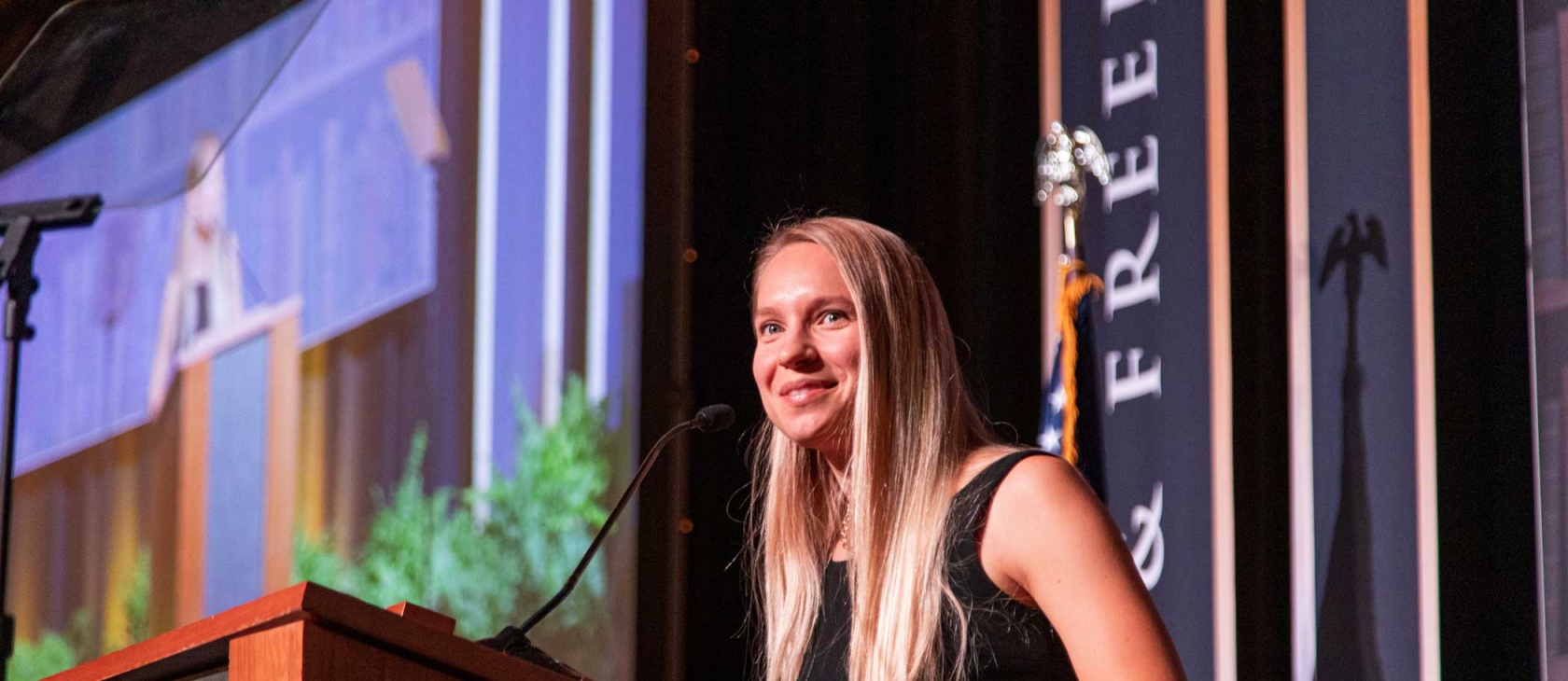
“I don’t think any other org is doing what Acton does.”
In a world where parenthood and career are often pitted against each other, Dr. Clara Piano is finding the opposite to be true at the Acton Institute. “I buy Acton onesies for all of my children,” she says, mentioning that during her 2025 appearance on Acton Line, the Institute’s official podcast, her then-one-month old son was sleeping in a stroller next to her.
Dr. Piano, currently a professor of economics at the University of Mississippi, has a relationship with Acton that stretches back more than a decade. She first encountered the Institute, and Fr. Robert Sirico, as an undergraduate student at Nebraska’s Creighton University, studying economics and marketing. For Piano, the system of thought that Sirico and Acton offered were a departure from the traditional economics course one encounters in undergrad. “If you go to the median class in economics, it’s going to be very different,” she points out. “Most people think poverty is caused by unwillingness to work or ‘we don’t grow enough food.’ Acton was making the argument that it’s policy and institutions that really matter.”
Piano had caught the vision — in 2017, she encountered Acton’s premier conference, Acton University, for the first time. She described being struck by one of the Institute’s key distinctives: fusing a robust anthropology with a serious economic argument for the public square.
“What made Acton unique was not only did it have really robust perspectives, historically and economically, but those same people can talk about why markets achieve what people value.” For Piano, that unique blend is part of what’s kept her coming back for 9 years. “I don’t think any other org is doing what Acton does,” she asserts. “Few places have that blend of understanding markets and understanding Judeo-Christian markets and morality.”
A common stereotype of economics conferences is that programming is obscure, overly technical, or limited merely to academics and inspiring academics. Yet Piano, a professor of economics and one of Acton affiliate scholars, experiences something very different walking through the halls at Acton University. “You hear people talking about Aquinas, Augustine, and Dante,” she remarks.
And those conversations certainly aren’t just coming from academics. “Acton is so intellectual, and that’s for a lot of people,” she says about her conference experiences. “I meet stay-at-home moms, I meet homeschooling parents — there’s a strong relationship that Acton has with classical education, homeschool or otherwise.” Piano notes that this relationship, while perhaps out of the ordinary for a think tank, is a crucial part of educating the rising generation of thinkers shaping the world of 2026 and beyond. “A lot of universities and schools have been watering things down. Acton’s filling an important space in that market - nothing’s off the table here. They see something in Acton that they’re not getting from other sources.”
“When you’re young you look for role models. Acton’s really good at finding charismatic role models.”
Aside from economic education, she also points out Acton’s role as an anchor for the philosophy behind the free enterprise system. “I think Acton is anchoring the conversation about what a good society looks like, especially for traditionally allied institutions.” To this end, she’s especially thankful for Acton’s willingness to give attendees role models for living out these ideas, naming Acton scholars such as Michael Matheson Miller and Anne Bradley: “When you’re young you look for role models. Acton’s really good at finding charismatic role models.”
2 years ago, Dr. Piano went from attending the conference as an observer to a speaker. She teaches two courses at Acton University: Religious Pluralism from the Economic Perspective, and The Fertility Gap: An Economic Perspective, and points out that the reaction she gets from Acton attendees are incredibly similar to questions she gets from students at Ole Miss. One common sentiment? “I didn’t know economists studied this!”
For Piano, Acton University is an opportunity to bring family economics and the intersection of religion and markets to the thousands of people who attend Acton University every year. And for her, it’s also an opportunity to bring family — she’s attended with her mom and her children during past years. “Acton is very welcoming of family obligations,” she notes about her work as an affiliate scholar with the Institute. “Acton realizes the importance of family, and celebrates it.”
For Dr. Piano and her husband Ennio (also an economics professor at Ole Miss), Acton has played such a crucial role in their intellectual life that they’ve chosen to become members of the Lord Acton Legacy Society, which includes the Institute in their estate plan. That’s a high degree of trust — and when asked about her reasoning, Dr. Piano is clear. “When it comes to economics, we have a calling from God to share truth.” To her, “Acton is the only place” that meets that standard.