


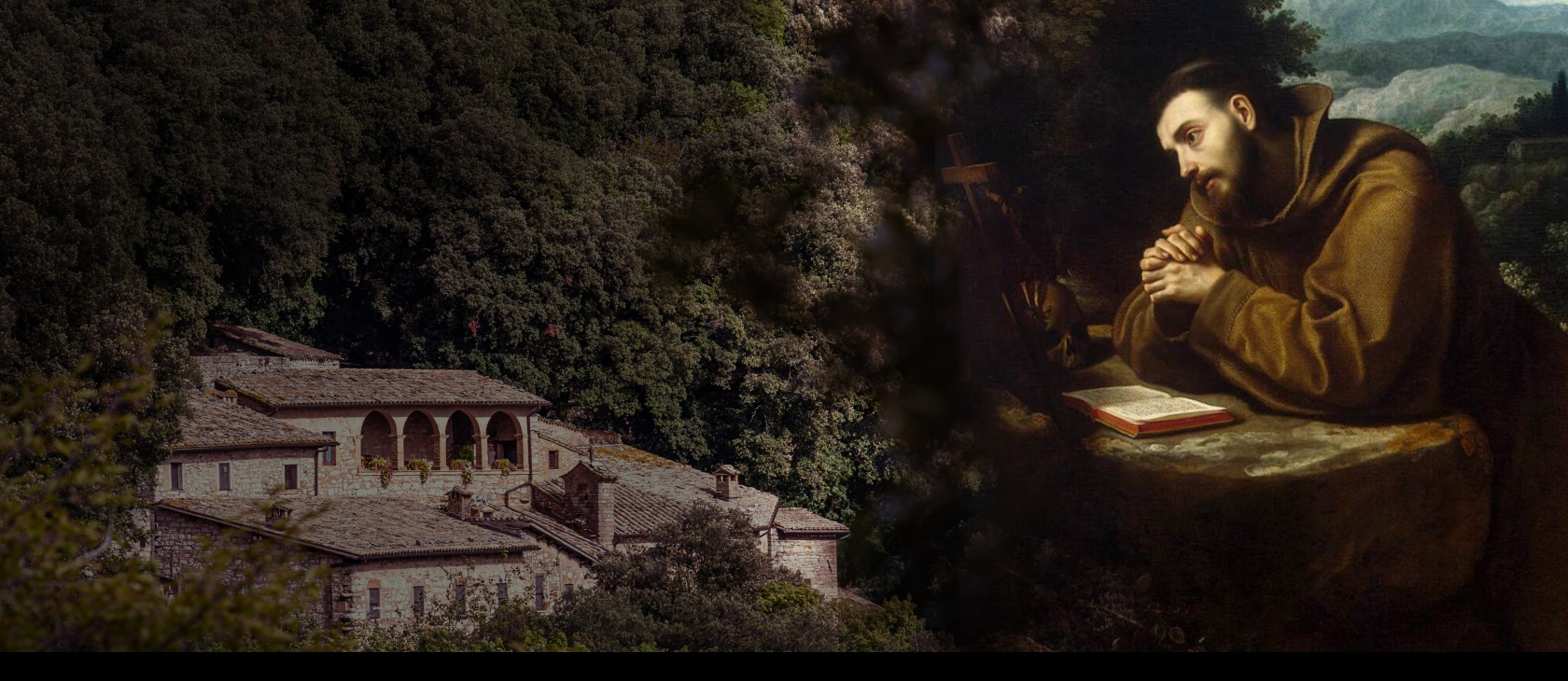
St. Francis of Assisi died 800 years ago, in his mid-40s, on the third of October 1226. He is remembered the world over as the gentle patron saint of the poor, peace, nature in general, and animals in particular. He is remembered especially by the religious orders that bear his name and by his Church, which celebrates his feast day on October 4. He is remembered well, but often poorly. G.K. Chesterton, in his concise and illuminating biography St. Francis of Assisi, wrote that “St. Francis anticipated all that is most liberal and sympathetic in the modern mood,” and yet when modern readers study his life, they find aspects of the saint “quite remote and repulsive.”
The medieval saint is as much a captive of people’s imaginations as he is of God’s undying love.
This is a key element of what Chesterton called “the problem of St. Francis,” which many moderns avoid by simply bypassing what in his life they do not like or understand. They look away from his severe medieval ascetic piety and the stigmata, the manifestation of the wounds of Christ on his body. The solution that Chesterton proposed rejected such willful blindness. He insisted on coming to an understanding of the saint on his own terms, by leading the reader from the liberal and sympathetic to an understanding of what at first glance is remote and repulsive. He does this by taking seriously the fact that all great saints are first and foremost great lovers. Lovers of God and neighbor, true, but lovers nonetheless: “For the modern reader the clue to the asceticism and all the rest can be found in the stories of lovers when they seemed to be rather like lunatics.”
Chesterton’s diagnosis of the problem was precise, his solution both elegant and convincing. The only problem was the problem, and if there is a problem with the problem, the solution’s dissolution, no matter how elegant and convincing, must be incomplete. The problem with Chesterton’s “the problem of St. Francis” is that it is not the problem of St. Francis, but a problem of St. Francis.
Eleven years before the publication of Chesterton’s St. Francis of Assisi in 1923, a small Catholic magazine in France, La Clochette, published an anonymous prayer with the title Belle prière à faire pendant la Messe (A Beautiful Prayer to Say During Mass). An abridged version of this prayer was published by the Quaker magazine Friends’ Intelligencer in 1927 with the title “A Prayer of St. Francis of Assissi” [sic]:
Lord, make me an instrument of your peace; where there is hatred, let me sow love; where there is injury, pardon; where there is discord, union; where there is doubt, faith; where there is despair, hope; where there is darkness, light; and where there is sadness, joy.
O Divine Master, grant that I may not so much seek to be consoled, as to console; to be understood, as to understand; to be loved, as to love; for it is in giving that we receive, it is in pardoning that we are pardoned, and it is in dying that we are born to eternal life. Amen.
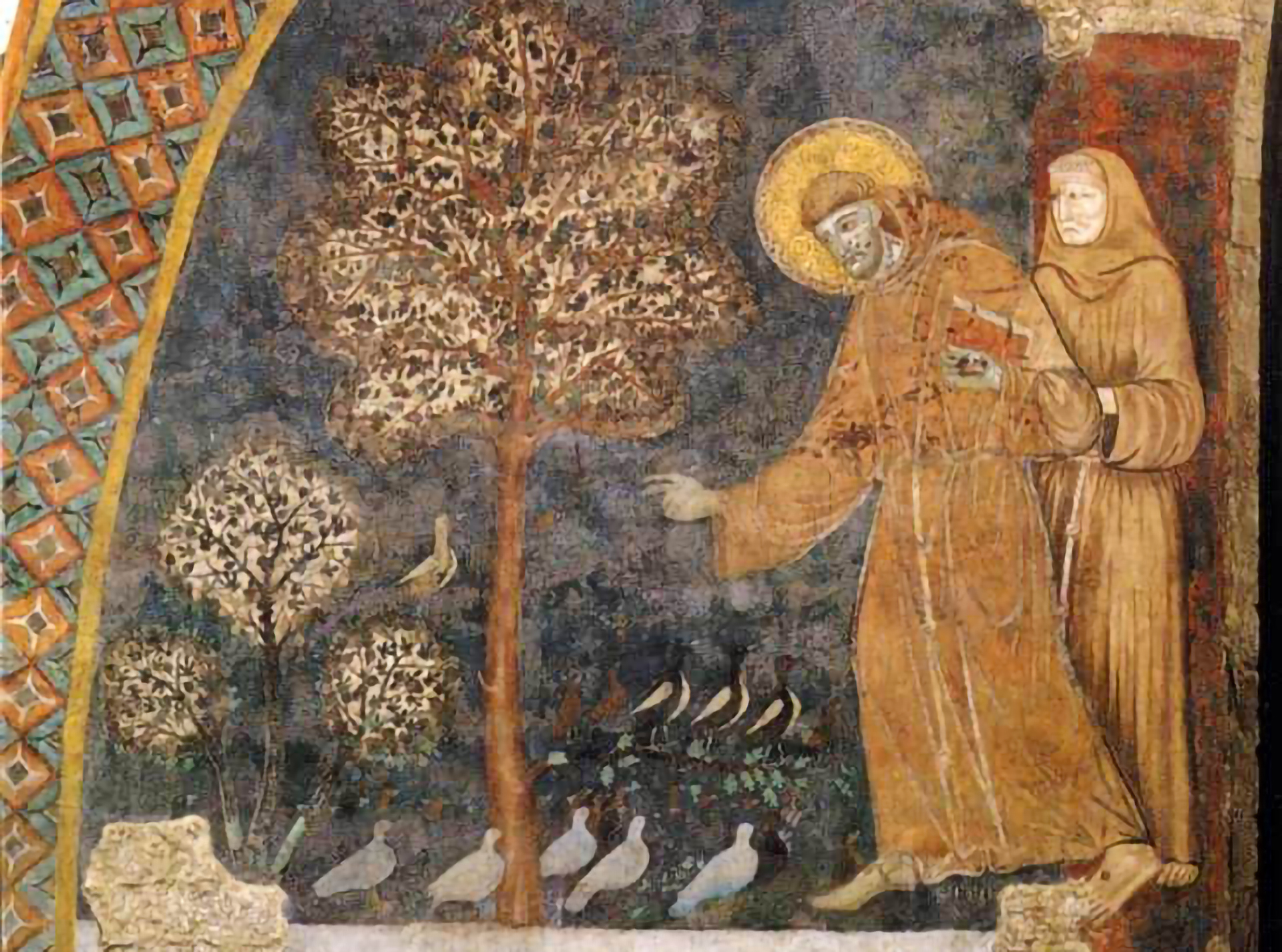
This misattribution would have consequences for the reception of St. Francis that are difficult to fully trace. In his capacity as military vicar during the second world war, Cardinal Francis Spellman would distribute millions of copies of “The Prayer of St. Francis.” The prayer would make its way through countless church bulletins, become a staple in the addiction and recovery community, and even influence non-Christian religious traditions. The Hindu teacher and translator Eknath Easwaran, who taught the first credit course on meditation at U.C. Berkeley in 1968, advised his students to begin their meditation practice with “The Prayer of St. Francis,” explaining that:
Saint Francis’s words have an almost universal appeal. Through them pulses the spiritual wisdom this gentle friar drew upon when he undertook the most awesome task a human being is capable of: the total transformation of character, conduct, and consciousness.
But the words of “the Prayer of St. Francis” are not the words of St. Francis.
The
The virtues of the great saint we celebrate today were already present in the young Francis, if yet unripe.
Mistaken attributions and pious legends loom large over our understanding, or misunderstanding, of St. Francis. The Dominican historian Augustine Thompson’s 2012 book, Francis of Assisi: A New Biography, is the surest guide we now have in sorting through the disparate elements to help us see the historical Francis. Much of what is best known and loved about St. Francis survives the most exacting historical scrutiny, present in seed form in his early life.
Francis Bernardone was born around the year 1181 in the central Italian city of Assisi, then with a population of only 2,000 to 3,000, to a family that, while not noble, was “well established money by communal standards.” As a boy he received some education: basic Latin for the maintenance of business records and some French in which he loved to sing popular songs. Both were useful as he apprenticed in his father’s trade as a merchant. “He learned to sell cloth, keep financial records, and control inventory,” writes Thompson. “Gifted with a keen mind and an engaging and expansive personality, he quickly proved himself an able salesman.”
The qualities that made Francis a success in business also made him a success in Assisi society. He was an enthusiastic member and then leader in the local societas iuvenum, a sort of “youth gang of the well-to-do.” He sang, joked, ate, and drank. He spent lavishly on himself and his friends, a generous prodigal. The young Francis liked to stand out and “added patches of old and faded cloth to the silk and fine wool of his cloaks, producing an outlandish, even clownlike effect.” He was vain and self-centered but not conspicuously immoral or dissolute.
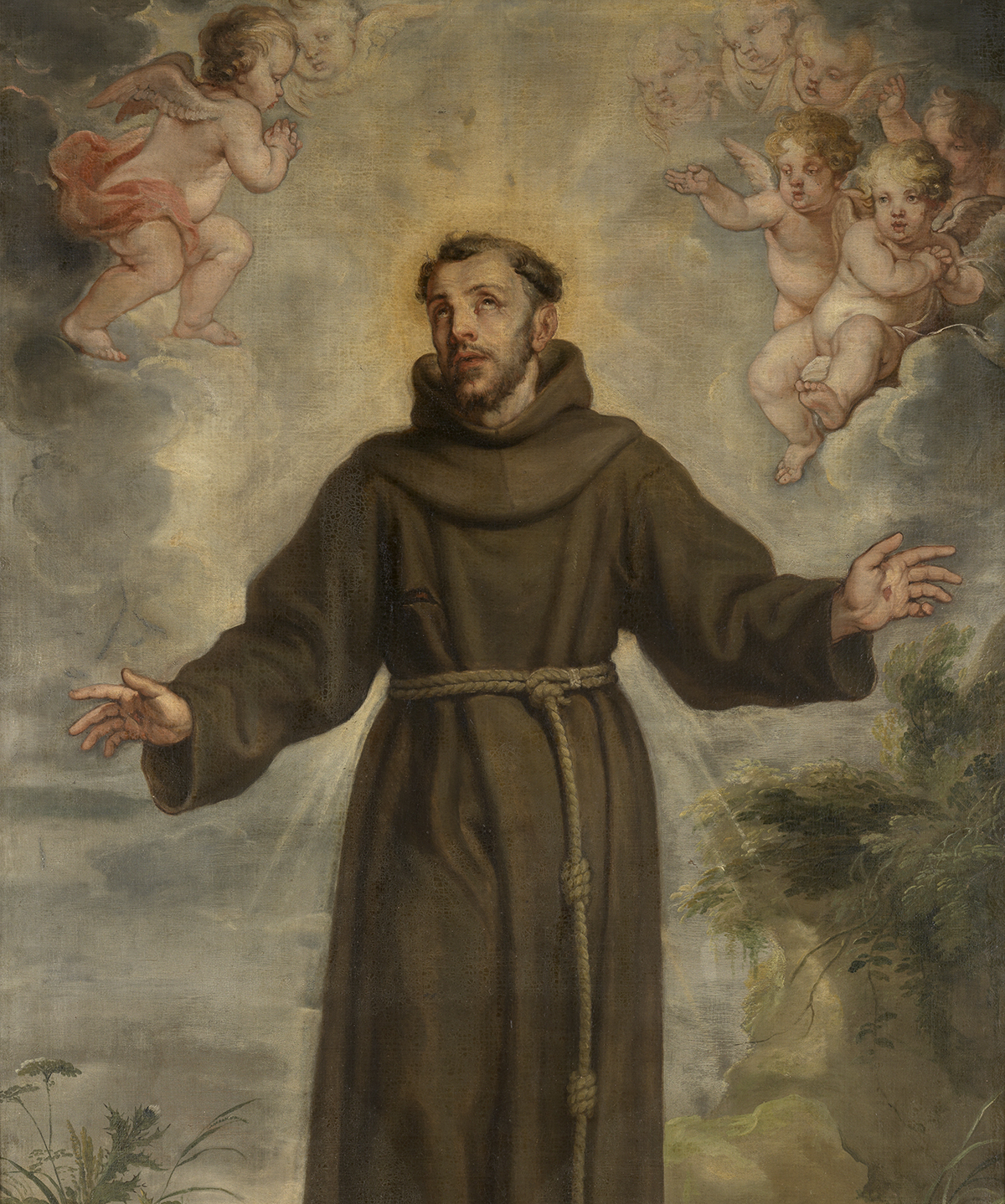
The virtues of the great saint we celebrate today were already present in the young Francis, if yet unripe. After giving the brush-off to an indigent who came to his family shop begging, he had a crisis of conscience. How could he be generous to his wealthy friends only to turn away one in dire need? “Contrite, he swore to show civility to everyone regardless of class, even beggars asking for handouts in God’s name, and ran after the man to make up for refusing him alms.”
The patron saint of peace would go to war in his youth serving in the local militia. After a disastrous defeat, Francis became a POW. Prison wore on him physically and mentally, such that the “once extroverted and cheerful young man had turned in on himself.” He suffered nightmares and flashbacks, and “he took no joy in the beauties of nature that had previously delighted him.” The Lord would restore that joy to him in time, but not until he was guided out of this crisis. Uncertain of the path God was laying before him, Francis attempted to return to war, only to turn back a day into his journey to the battlefront. He sold his horse and arms and began walking back to Assisi. Francis would spend that night in the dilapidated church of San Damiano two miles from home. When he left the church the next morning, he also left there the money from the sale of his horse and arms and “forgot about it entirely.”
Francis returned home but did not return to his shop or to his friends. He gave to all who asked, contrived anonymous donations, and worried his parents with his odd behavior. He went on a pilgrimage to Rome to the tomb of St. Peter, sought council from the bishop of Assisi, and finally found himself back before the altar at the church of San Damiano, where he poured out his heart to God: “Most high glorious God, enlighten the darkness of my heart and give me true Faith, certain Hope, and perfect Charity; give me perception and knowledge, Lord, that I might carry out your holy and true command.”
Francis prayed for divine illumination, perfection in the theological virtues, and perception and knowledge.
Francis did not pray for his shattered health to be restored, reconciliation with his family, a return to his trade or friends, or even for the nightmares to end. He prayed for divine illumination, perfection in the theological virtues, and perception and knowledge. For himself yes, but not for himself, rather so that he would be made an instrument of the Lord. Thy will be done through me. It is a terrifying prayer. It fills the average person, stuffed with attachments and aversions, likes and dislikes, with fear. Or at least it should, because prayers asked have a way of becoming prayers answered, for as the Lord tells us:
Ask, and it will be given you; search, and you will find; knock, and the door will be opened for you. For everyone who asks receives, and everyone who searches finds, and for everyone who knocks, the door will be opened. (Matt. 7:7–8)
Francis
There are hard saying in the gospels: “Whoever comes to me and does not hate father and mother, wife and children, brothers and sisters, yes, and even life itself, cannot be my disciple” (Luke 14:26), and “everyone who has left houses or brothers or sisters or father or mother or children or fields, for my name’s sake, will receive a hundredfold, and will inherit eternal life” (Matt. 19:29), which some theologians employ to contextualize the saint’s behavior. But Chesterton’s explanation, that the saint was both a captive of and had surrendered to divine love so completely that it appeared from the outside as madness, is more parsimonious than any theologian’s exegesis.

As a saint’s interior experience of divine love is inaccessible to us, the only possible vindication of their world-renouncing and norm-shattering behavior as something other than madness is to be found in its fruits. The first of these fruits is to be found in his early service to lepers, as Francis himself reports: “When I was in my sins, just to see the lepers was very bitter for me. And the Lord himself took me among them, and I showed mercy to them. And on leaving them, what seemed bitter to me had turned for me into sweetness of body and soul.”
“You shall love the Lord your God with all your heart, and with all your soul, and with all your mind” and “You shall love your neighbor as yourself” (Matt. 22:37, 39). For the rest of his life, St. Francis would practice the two commandments on which all the law and prophets hang, with the vigor that is the vocation of all saints but with an originality all his own. He would found religious orders for men and, with Clare of Assisi, for women. He would preach the gospel to Sultan Al-Kamil during the Fifth Crusade. He was to be of service to God and man, and for the last few years of his life, he would keep a secret.
On September 17, 1224, while praying at Mount Le Verna, Francis received a vision of a seraph, a six-winged angel that was both consoling and frightening. After the vision, strange marks appeared on his body. Thompson describes them:
On the palms of his hands and on the top of his feet … protruding bits of flesh that resembled nothing so much as nail heads. On the base of his feet and the backs of his hands, other outgrowths appeared resembling nail points. In his side, there appeared a wound that dripped blood.
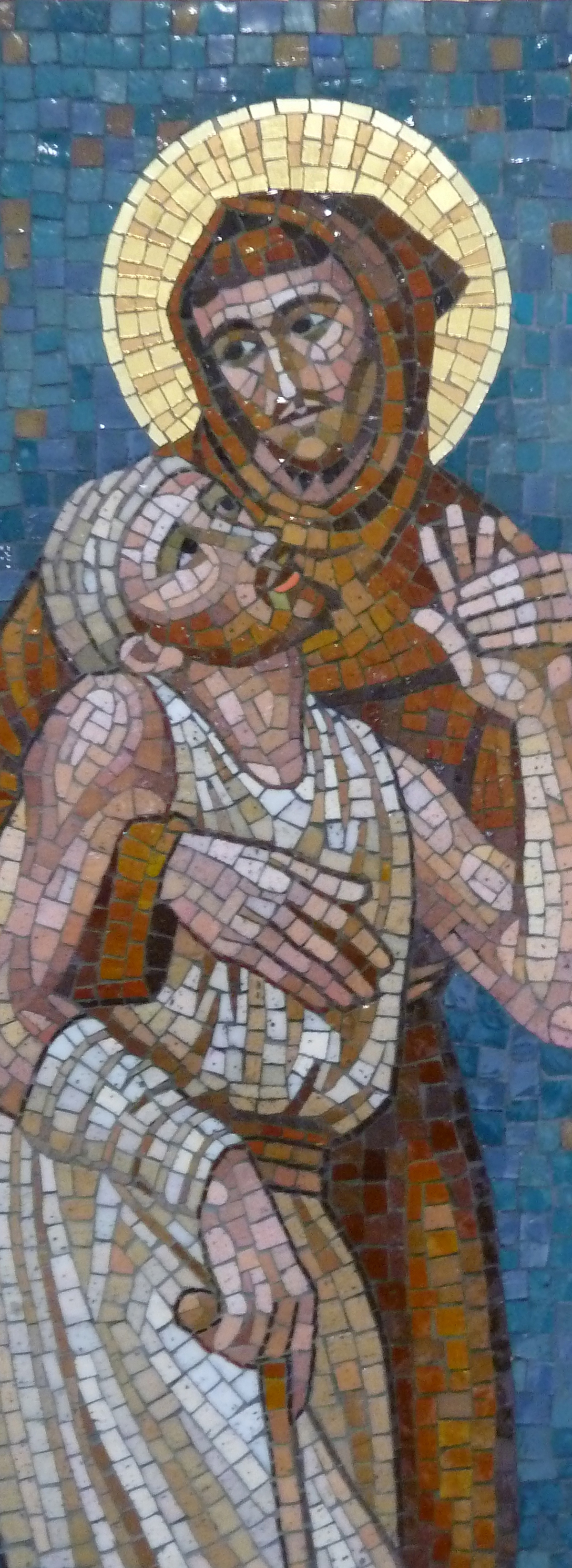
Francis did his best to conceal the marks, but a few companions during his earthly life discovered them—and kept their brother’s secret. The marks became common knowledge only after his death. “Given the reports by his companions and the testimonial document signed by a score of Assisi citizens who viewed the wounds after Francis’s death,” reports Thompson, “virtually all modern historians conclude they were real.”
If the presence of the stigmata of St. Francis are historically verifiable, their cause is not. The Hindu teacher Paramahansa Yogananda once visited the 20th-century German Catholic mystic and stigmatic Therese Neumann. He judged her stigmata genuine and explained in his Autobiography of a Yogi that he believed the stigmata to have manifested supernaturally to testify to the historical authenticity of the New Testament’s account of the life and death of Jesus Christ and to “display dramatically the ever living bond between the Galilean Master and his devotees.” So St. Francis’s stigmata would appear to be ultimate proof that his apparent madness was truly divine love. His meditation on the wounds of Christ transformed his entire being, including his body.
In
Doing the diligent historical work of sifting through fact and pious legend is an essential beginning to understanding what made Francis Bernardone a saint and to coming to terms with those modern and postmodern “problems.” It also helps immerse us in his world, the context of which can aid in the reconciliation of what is liberal and sympathetic with what appears remote and repulsive in his life. In the introduction to his biography, Thompson laments that, because of pious legend and modern appropriation, “Like Jesus, Francis belongs to everyone, and so everyone, or almost everyone, has his or her own Francis. And this is probably the way it has to be.” But there is another reason everyone has, or at least can have, Jesus and Francis in their life. The reason is that Jesus Christ is the living God and St. Francis, alive and in his presence, lives in him. The historian ultimately has no authority over the saints or God because, although both have earthly lives, their life is not merely earthly. They are not merely historical but eternal.
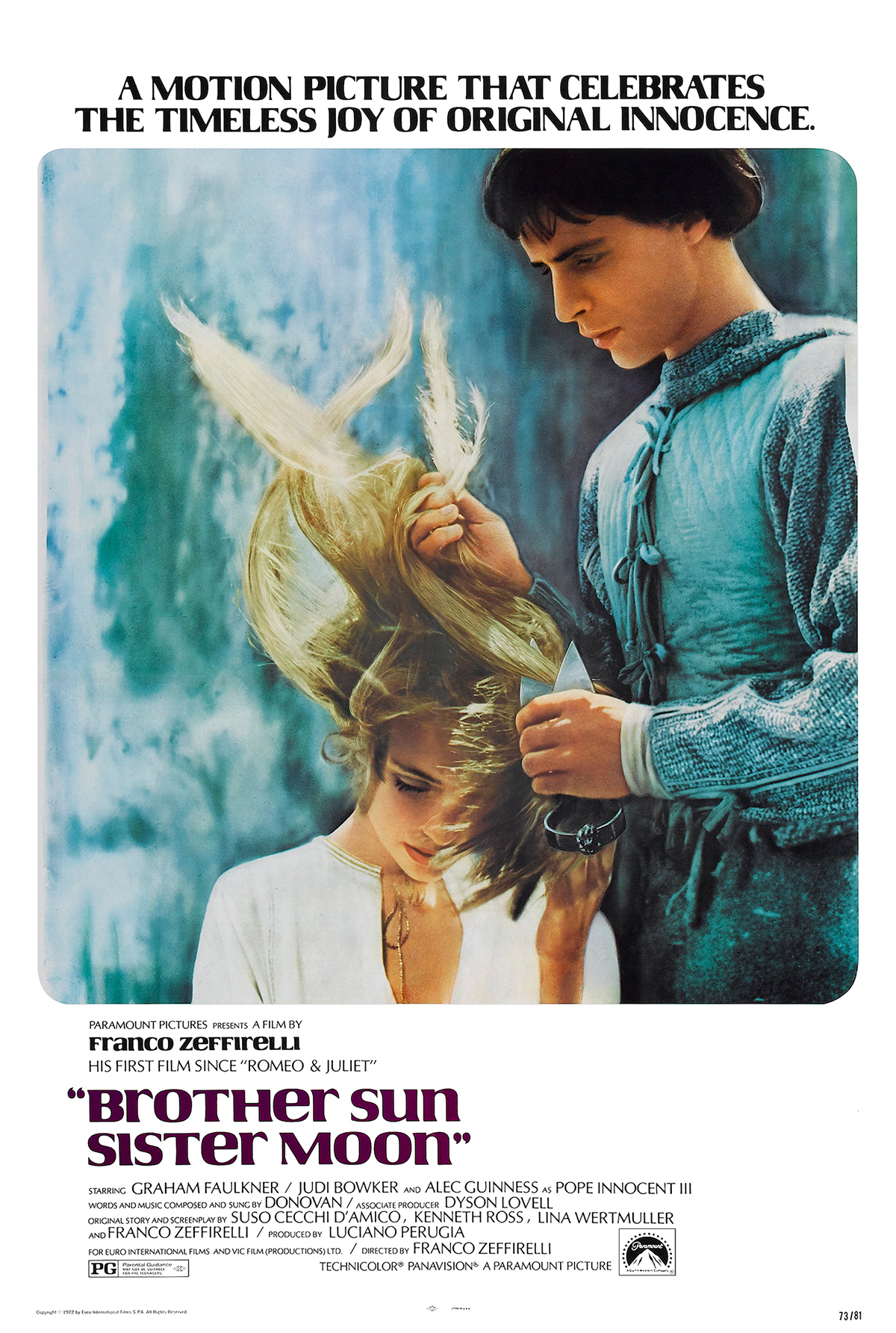
St. Francis reaches out today through the theater projecting Franco Zeffirelli’s Brother Sun, Sister Moon, across the bird bath in the garden, and in the words of the prayer that bears his name, if not authorship, at the Alcoholics Anonymous meeting. The test of genuine Franciscan inspiration is not in the archives but in the fruits the relationship bears. Does it enlighten the darkness of my heart? Give me true faith, certain hope, perfect charity, whatever my vocation—whether on Wall Street, Main Street, in the home, or on the street. Lord, like St. Francis, make me an instrument …