


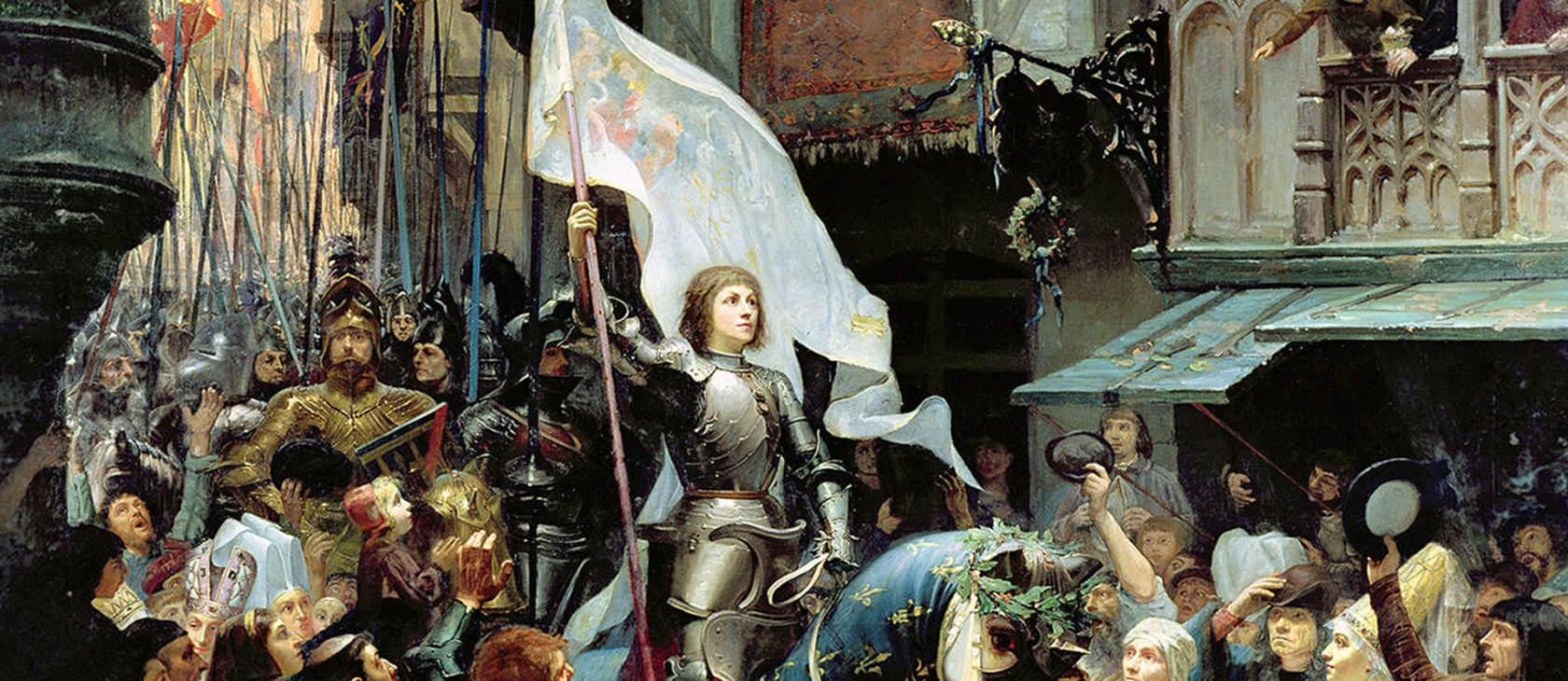
Dante had his Beatrice and Mark Twain had his Joan of Arc. Granted, they are not quite the same sort of muse, one devoted to peace and the other a famous warrior, but they may play similar roles for our great poets of comedy. Dante’s readers, perhaps not a little under the spell of Beatrice themselves, eventually called that comedy (the story has a happy end) divine; whereas Twain’s comedy is decidedly all-too-human. The difficulty is rather elsewhere: Everyone who’s heard of Dante has heard of Beatrice, but almost no one who reads Twain has read his Personal Recollections of Joan of Arc (1896, his last novel), despite his repeated statements that it was his best book, the one he most loved, and other words to that effect aimed to persuade posterity, since his contemporaries did not admire or much read the novel either.
Mark Twain’s least-read book, about the French Catholic warrior-martyr-saint, may just hold the key to understanding our 21st-century secular selves.
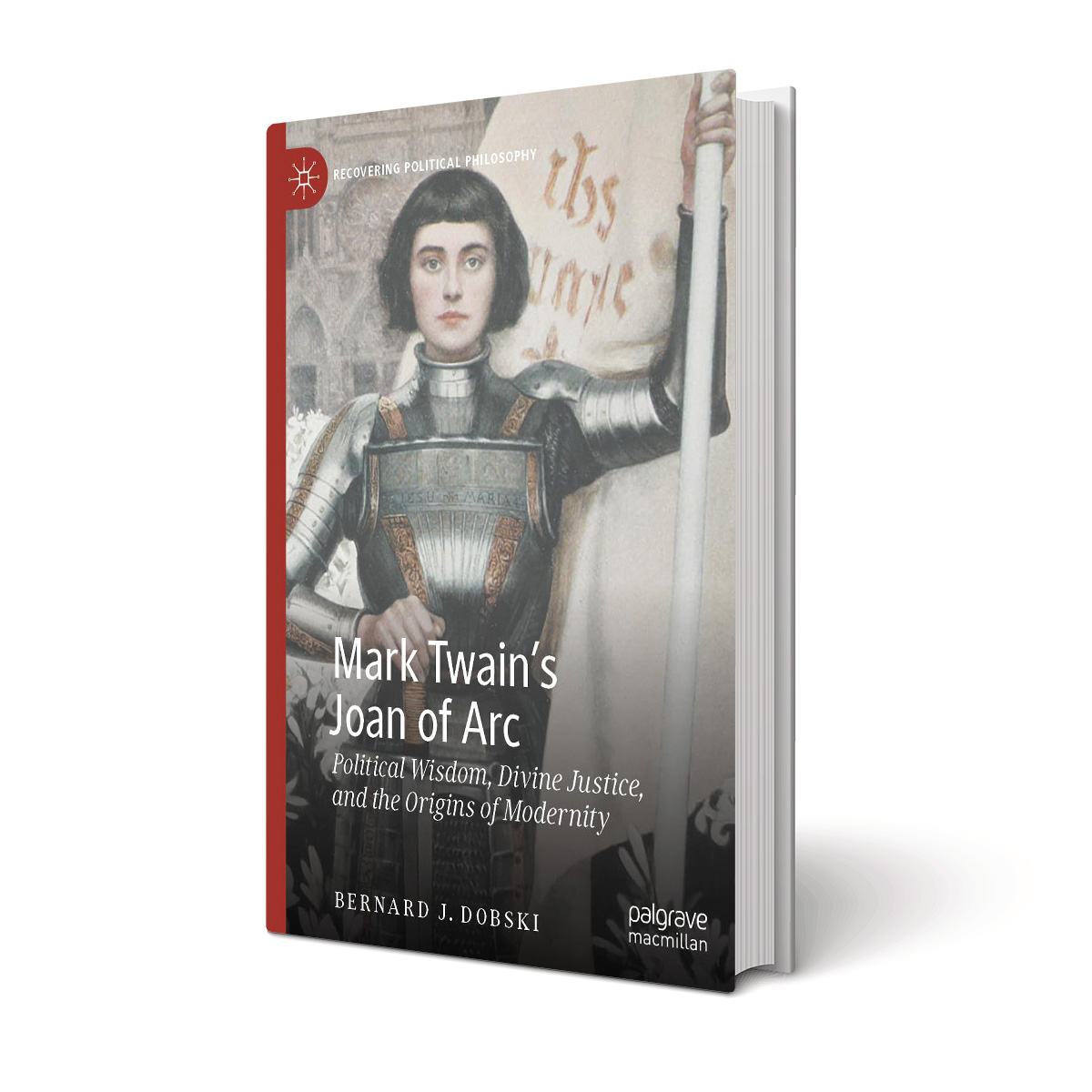
By Bernard J. Dobski
(Palgrave Macmillan, 2024)
Bernard J. Dobski, professor of political science at Assumption University, offers us a wonderful volume-length interpretation of this work in Mark Twain’s Joan of Arc: Political Wisdom, Divine Justice, and the Origins of Modernity, a good sample of what is meant by liberal education and at the same time a well-researched and footnoted scholarly work. But since he intends to vindicate Twain against his admirers, who ignore Joan, this is a rather eyebrow-raising endeavor. Dobski starts from the paradox that Twain’s admirers neglect Twain’s own judgment. Then, by a very complicated road that involves a study of Twain’s Connecticut Yankee (1889) as well as the Personal Recollections, the two novels that explicitly confront medieval and modern life; then a separate study of Twain’s own education based on his library and correspondence, which provides ample evidence of his remarkable interest in history, literature, and philosophy; and finally a study of Twain’s own intentions as an author as they emerge from his own statements and the plot of his late novels; Dobski brings us to the conclusion that Twain was quite as pleased to be misunderstood by readers, so long as he delighted them with his comic inventions, as they were to misunderstand him or ignore his philosophical interests. Twain writes for several different audiences as once with an elegance and freedom that compel Dobski to compare him to Cervantes and, indeed, Plato and Xenophon.
Twain
Yet, as Dobski says, modernity came out of the medieval world somehow—surely it’s of some importance to us to understand our origins. And whereas the more famous Connecticut Yankee Hank Morgan is a modern American in the medieval world, the less famous Joan of Arc brings modernity out of the medieval world; yet Hank fails in his attempted revolution, whereas Joan succeeds. Perhaps our self-love is misguided in preferring the former to the latter. Joan pretends to “be more Catholic than the pope,” as the saying has it, in order to be more Yankee than the Yankee. Dobski treats her astonishing ambitions at great length, but he also gives his readers an early warning, or advertisement:
Despite her outward shows of piety and her deference to customary authority, performances largely intended for the consumption of her numerous audiences, Joan is a radical iconoclast whose military and political successes challenge the sharp distinctions thought to characterize the moral, material, and religious categories of the medieval world.
We might agree that this is astonishing enough to be interesting, but what has it to do with us? Well, consider this remarkable quote by the novel’s narrator in Book 2, Chapter 16:
To the Dwarf [one of her rescued outcasts who fights and dies for her], Joan was France, the spirit of France made flesh—he never got away from that idea that he had started with; and God knows it was the true one. That was a humble eye to see so great a truth where some others failed. To me that seems quite remarkable. And yet, after all, it was, in a way, just what nations do. When they love a great and noble thing, they embody it—they want it so that they can see it with their eyes; like liberty, for instance. They are not content with the cloudy abstract idea, they make a beautiful statue of it, and then their beloved idea is substantial and they can look at it and worship it.
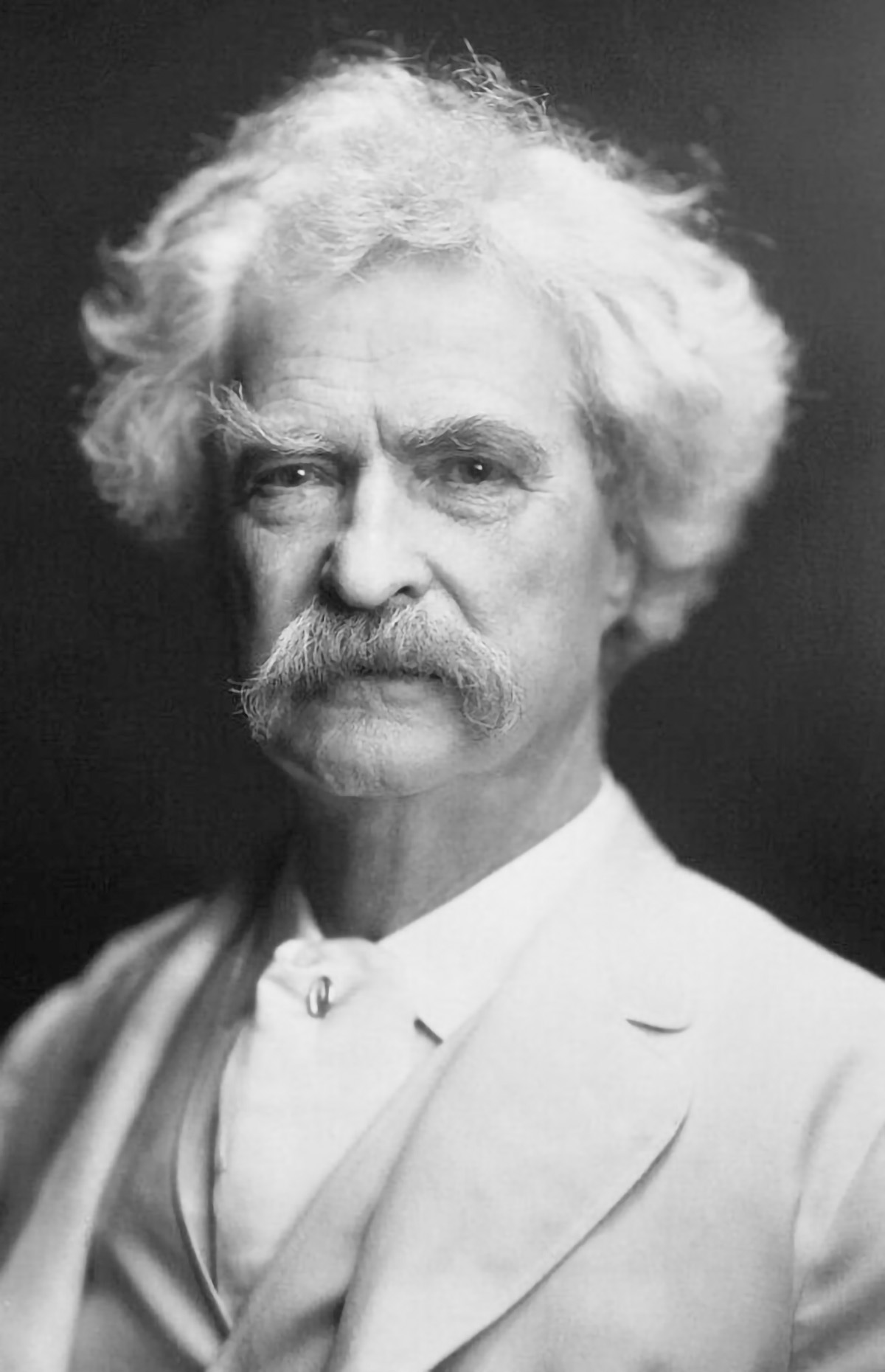
Twain was quite pleased to be misunderstood by readers, so long as he delighted them with his comic inventions.
Twain published his Joan a decade after France, properly revolutionized, on its third republic by then, made a gift of the Statue of Liberty to America, intended for the centennial anniversary in 1876 but actually dedicated in 1886 (designed by Bartholdi, made by Eiffel, who is rather more famous in Paris). Twain clearly sees a connection between the two nations, but also between modern and medieval belief. Dobski turns to this other matter when he contemplates what American exemplars could give Joan plausibility as a character: Helen Keller, who was born in 1880, and Mary Baker Eddy, who started Christian Science in 1879. Twain knew both, liked and helped the one, mercilessly satirized the other but without underrating her abilities. The one, deaf and blind, graduated Harvard-Radcliffe and became an author—surely, the peasant girl Joan could have acquired similar powers of mind. The other started a cult which is still going strong, which is also what Joan does in inspiring the narrator of the novel to become her hagiographer. Keller eventually also became a modern cultist, i.e., an activist—for example, she joined the Socialist Party of America.
Since both women succeeded in Boston, I take the liberty to attract the readers’ attention to Henry James’s The Bostonians (1886) for a view of the “atmosphere”—it independently corroborates Dobski’s thesis that Twain saw Joan as a revolutionary hell-bent on creating the modern world of humanitarianism. I take this to be the urgent appeal of Dobski’s book, the last titled chapter of which is “The Queering of Joan’s Being…” Our world is now not only aggressively feminist, but it is so ideological because empowered by law, in despite of justice or the original design of American politics, and because elite opinion is openly hateful or contemptuous of men as men. Dobski stays out of contemporary affairs—I draw the conclusions myself and absolve him of any responsibility. But I turn to him for an answer as to the cause of this humanitarianism: That’s what Mark Twain promises us in his treatment of Joan.
The
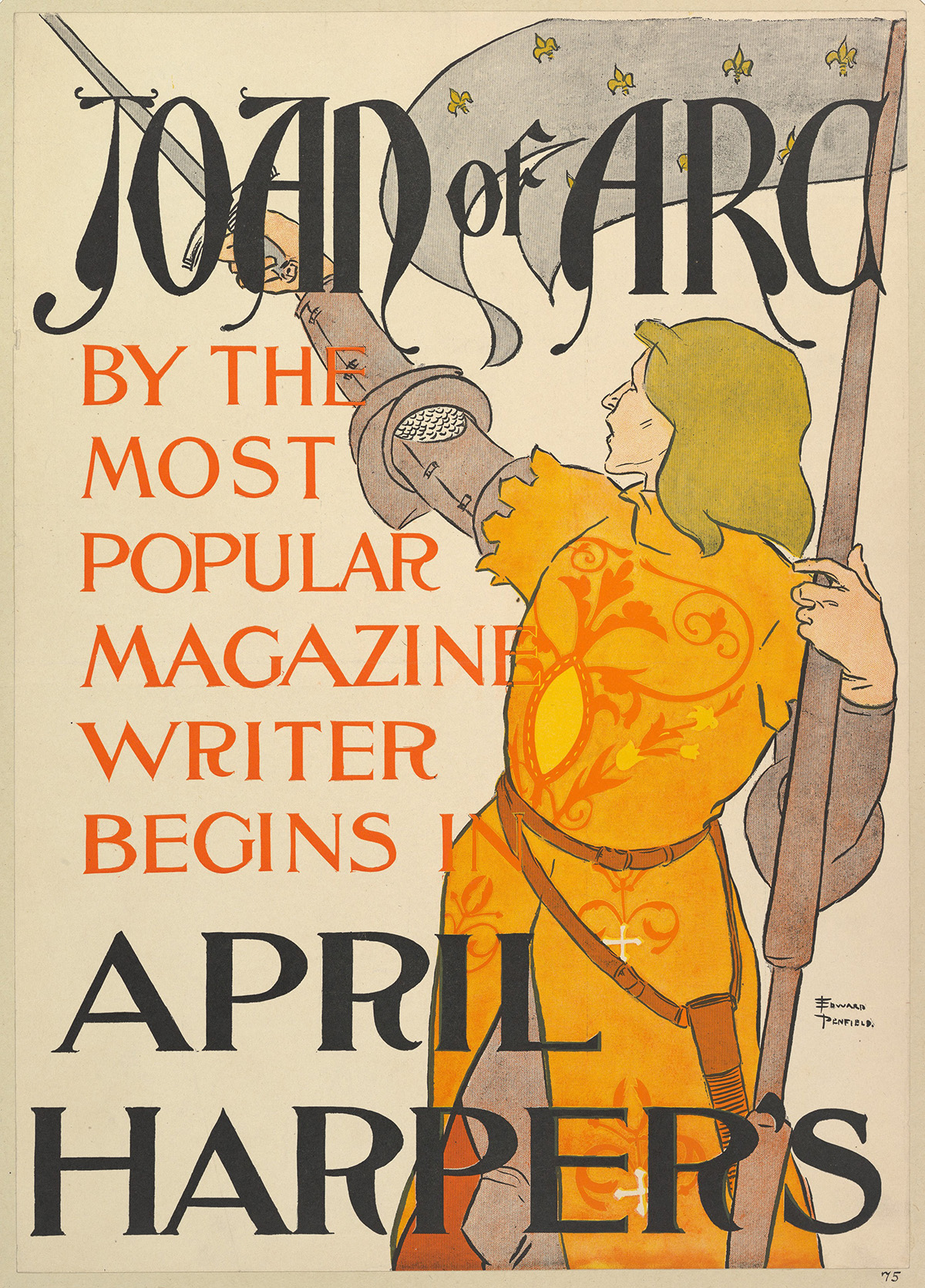
The very curious origins of this very strange girl are naturally enough Twain’s first concern. Joan grew up in a country ravaged by wars. Demoralization was the universal consequence: Warriors either were broken by defeat or they turned criminal; the uncrowned king was perhaps betrayed by his mother and perhaps himself contemplated abandoning his country; and the people were resigned to brutality. France was forgotten, having been fought over, divided, with parts ruled by foreigners for centuries—Twain makes us and the patriotic protagonists recall its greatness through an episode of music: The Song of Roland. This universal suffering calls forth Joan’s energies, but it is her learning the powers of persuasion that gives her the assurance that a new France can be made out of the wreck of the old—a militant France. Yet since the country was as it was, she grew up undiscovered, her remarkable powers a secret.
After education comes politics. Twain shows us the full range of medieval life, town and country, high and low, lay and religious. He takes us into all the events, public or private, that determined the fate of the nation, whether court intrigue or battles—night ambushes, or the campaign to relieve the siege of Orléans, the great victory at the battle of Patay, and every other exciting event, as well as the failure to take Paris. Joan gradually reveals her powers of persuasion by assuming leadership: She becomes a major diplomat as well as a general, an adviser to the dauphin she has crowned in Reims as Charles VII, and the moral reformer of the army that is not only to conquer but also to hold and remake France. In assuming leadership, she democratizes—not the aristocrats or the local loyalties of the past, but a new all-encompassing patriotism defines the army and inspires the country. How royal is a king crowned by a shepherdess, after all? Even God becomes a democratic protector of France, and Joan does not need the Church to access saints and archangels. The divine mission is hers and it becomes the people’s.
In all this spectacular achievement, it becomes obvious that Joan must die: The king cannot be king if Joan is in effect the king, so after her capture he doesn’t attempt to save her—let the English have her! The Church cannot teach morality to people if Joan does. The inquisition that follows, however, fails to discredit her—in dying, Joan becomes a martyr, one last sign of the century of suffering but also a promise for a modern future in which the people rule, liberated from both throne and altar, but led by a new imperative, to make mankind as happy in freedom as they had been miserable when oppressed, and by any means necessary. Yet what might people get up to if the successive revolutions to perfect our lives individually and collectively do not achieve the promised results?
In doing more for the people than aristocrats and priests put together had achieved, Joan repeals their authority but without any revolutionary declarations. It takes quite some subtlety to understand what she does and why and hence what Twain is trying to show us about our kinship with our medieval forebears. We have surpassed all previous political bounds, yet we are neither happy nor even content, nor do we know the future. We can no longer believe in Progress, yet cannot orient ourselves, a condition called “postmodernity” with more arrogance than honesty—Dobski suggests this is what Twain wanted to achieve for himself, to face the modern problem without succumbing to relativism, and for anyone who cares to learn.
A brief review cannot do justice to either Twain or Dobski but can only introduce the themes and treatment; to properly see the materialist implications of humanitarianism, the way personal and political liberty can be threatened by a liberationist ideology, and the dangers that come from atheism—for that we must turn to the authors. And if I have managed to say a few things about the education on offer, it comes at a price, since I cannot convey the pleasure of reading both Twain and Dobski. Let the reader follow my example and read Twain—to encourage the rediscovery of the most American writer, I am ready to announce a renaissance of Twain studies of sorts. Dobski’s fine work is part of it. There are Twain admirers already encouraging the reading public, from the novelist Walter Kirn to the scholar Ivan Kenneally. With due apologies for mentioning myself, I, too, have written to bring out the American interest of the Connecticut Yankee. We turn to Twain not only for the fun of it but also to learn about modernization and America’s destiny, with the guess that comedy may be the proper education for a democracy, since laughter can protect the people from the idols.
