

For all her undoubted wisdom, even the rich tradition of Catholic Social Teaching (CST) is not safe from the snares of logical fallacies. While the faithful owe fidelity to the teachings of the Catholic Church on matters of faith and morals, the commentaries of popes and ecclesial officials on matters of society, economy, and politics can be met with careful discernment and conscientious disagreement. One of the grounds for respectful disagreement with the reflections of a papal encyclical or the recommendations of a Vatican document is often a lack of prudence in judging the practical application of Catholic principles to concrete realities. A common culprit behind such misjudgments is the spillover fallacy, which is perhaps more influential in discussions of Catholic social thought than sometimes recognized.
The spillover fallacy assumes that competence in one area necessarily entails competence in another. As a new book on Catholic Social Teaching charitably demonstrates, this is not always the case.
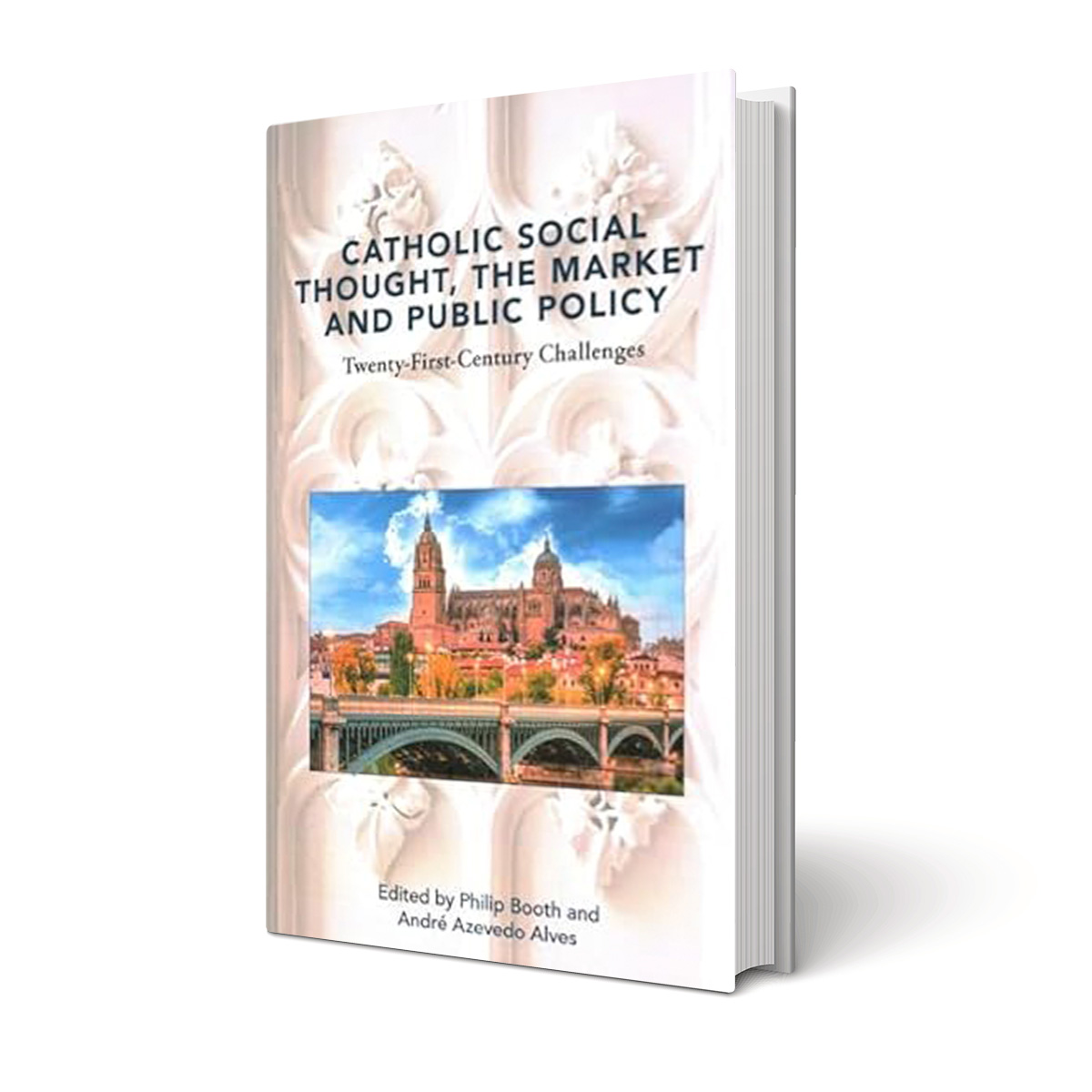
Edited by Philip Booth and André Azevedo Alves
(St. Mary’s University Press, 2024)
The spillover fallacy, otherwise known as the fallacy of the generalization of intelligence, refers to the logical error of assuming that competence in one area of expertise necessarily entails competence in another area. In the context of CST, this might involve leading churchmen and theologians relying on their genuine spiritual and moral insight to pass judgment on practical matters, such as just levels of taxation or the proper role of the state in providing environmental protections, even when such judgments are lacking in deep knowledge and understanding of concrete economic and political realities. Naturally, there is some nuance. The cognitive skills needed to develop intelligence in one field can enable a person to grasp more quickly the challenges of another field. Nonexperts may sometimes have sharper intuitions than formal experts. Nevertheless, the general point stands: Genuine subject-matter expertise counts, not least for making wise judgments in complex cases.
In the long history of the Catholic Church, the spillover fallacy has manifested in a variety of ways. From the daft political pronouncement of an overexcited parish priest to the comically disastrous mismanagement of the finances of the 19th-century Papal States, there are numerous examples of spiritual acumen running aground on the rocks of practical reasoning. Abstract moralizing and imprudent judgments have been the typical symptoms of this malaise.
More recently, the spillover fallacy can perhaps best be seen in the often fraught, and occasionally fractious, relationship between CST and the market economy. Papal encyclicals and theological documents can have a certain tendency to view the market economy with some combination of apprehension, fear, and even moral disdain. The usual accusation is that our capitalistic economic system and structures facilitate, or even encourage, selfishness, greed, and the unjust accumulation of profit at the expense of the poor. The pronouncements of Catholic Social Teaching on these matters can sometimes sound like abstract moralizing without any real understanding of practical economic realities. This undermines the credibility of important papal and ecclesial contributions in these areas, as well as potentially misdirecting the Church to the point of mismanaging her own economic life.
The spillover fallacy can best be seen in the relationship between Catholic Social Teaching and the market economy.
Remedying these ills involves the recognition of the particularity of expertise in both Catholic Social Teaching and in economics, and the fostering of mutually appreciative dialogue between these related but ultimately separate fields. A noble contribution to this important enterprise is Catholic Social Thought, the Market and Public Policy: Twenty-First-Century Challenges. Edited by Professors Philip Booth and André Azevedo Alves, the book makes a compelling case for the need for richer dialogue between the perennial wisdom of the Church and the practical knowledge of economics, politics, and cognate fields. Such dialogue is displayed across a collection of chapters from a range of expert authors, treating topics as diverse as migration, taxation, and healthcare. The book also makes a strong argument for the preferability of a well-ordered market economy in the promotion of human dignity and the common good.
Three
First, the various contributors share a positive vision of the role of business, trade, and markets in the modern world. It is repeatedly noted that recent decades have witnessed the greatest global improvement of living conditions in human history, including the dramatic reduction of poverty and inequality, which is mainly attributable to the free exchange of goods and services. In a thorough introduction, Prof. Booth notes the critical distinction between self-interest and selfishness, too often blurred in Catholic social discourse, and the importance of the former for prosperity and the common good. The longstanding importance of economic activity to Christian life is demonstrated by a couple of excellent chapters on the biblical and patristic roots of CST on business and commerce (Martin Schlag) and the influence of St. Thomas Aquinas and the late Scholastics on the tradition of CST on property and related matters (André Azevedo, et al.). The central role of a healthy and prospering economy to the common good, meaning the provision of conditions that promote human flourishing, is an unmistakable theme.

At the same time, the importance of sound ethical behavior and judgment in economic affairs is underlined by multiple authors. The complexity of ethical decisions in business—from redundancies in times of crisis to investment in nonrenewable energy sources—is afforded due sympathy. An insightful chapter by Dr. Samuel Gregg on the financial sector reveals the need for much deeper reflection within the Church on fruitful ways in which to engage with the modern financial sector and promote the upholding of human dignity and the common good, rather than simply relying on calls for tighter regulation as a proxy for ethical engagement. If the Catholic Church is to be successful in encouraging better ethical behavior in the business world, it will need to demonstrate an acute understanding of the complexities of the challenges faced by its audience.
Second, the urgent need for a renewal of civil society resounds throughout the book. Here we can see that this is more than just a compilation of chapters calling for the redemption of the market economy in Catholic Social Teaching, but a more comprehensive attempt to grapple with the right relationship between state, market, and civil society today. The crowding out of civil society, often to be replaced by the limited binary of state and market, has been critiqued by previous popes such as Pope Benedict XVI in his encyclical Caritas in Veritate. The neglect of civil society represents an undermining of the central CST principles of solidarity and subsidiarity by neglecting the critical role of families, charities, and local associations in promoting the common good based on their unique roles in society. Successive chapters on CST and healthcare (Russell Sparkes) and the role of the state in education (Leonardo Franchi) provide some perceptive and provocative coverage of the right relationship between state and civil society in these central areas of human flourishing, which supplies much food for thought on superior models of state and civil society collaboration.
Third, several authors are unafraid to highlight the deficiencies of some past contributions of Catholic Social Teaching to economic matters. Given that such matters are ultimately prudential, it is the right and responsibility of the faithful to engage critically with the interpretations and recommendations of Church documents, including the gracious contesting of questionable claims. A notable chapter in this regard is that of Jay Richards on cronyism, which charitably but comprehensively explains the ways in which well-intentioned but technically flawed attempts to avert cronyism through tighter regulation can make the problem worse. A close examination of the Catholic Church’s response to the 2008 financial crisis reveals significant errors of judgment and a worrying tendency to rely on popular perception and simple stereotypes rather than the more complex reality. Such well-meaning and well-stated critique of CST documents in these regards is a crucial contribution of this book.
A close examination of the Catholic Church's response to the 2008 financial crisis reveals significant errors of judgment
If
While the book has numerous strengths, not least the consistent quality of argument and the admirable coherency of vision despite the multiple authors, there are certain limitations in need of acknowledgement.
In the first place, and outside the remarkably balanced consideration of migration by Andrew Yuengert, there is relatively little coverage of the cultural dynamics connected with present economic trends, such as the impact of globalization on the social fabric of local communities. Given that much popular discontent with our economic system often seems to have a cultural as much as an economic quality, it would have been fruitful to consider more closely the relationship between patterns of economic activity and their social and cultural effects.
In the second place, there is a striking absence of reflection on the spiritual dangers of material wealth. While the retreat of poverty and the advance of prosperity are certainly to be welcomed, it is not self-evident that rates of economic growth and rates of heavenly salvation are positively correlated. Indeed, it used to be a hallmark of Catholic reflection, particularly in the medieval period, that the wealthy may be in even greater need of prayer and divine assistance than the poor, such is the spiritual hazard of material attachment. A rounded approach to the market economy in Catholic Social Teaching surely needs to take such spiritual concerns seriously, and perhaps some extended exploration of the economy and the politics of philanthropy may have helped to balance the books in that regard.
In the third place, it would have been excellent to see more critical engagement with the current approach of the Church and her documents to matters of inequality. When we consider the impact of the spillover fallacy on current trends in Catholic Social Thought, it should be noted that the Church does draw upon numerous external experts in the formulation of her teachings, so the limitations of such commentaries cannot solely be attributed to overly spiritualized or moralized analyses. Alongside the spillover fallacy, there seems to be an additional and no less concerning problem for the Church: that of relying on an unhelpfully narrow range of experts and/or failing to challenge certain assumptions and axioms. This seems particularly clear in the case of inequality, which is now routinely highlighted in Church documents, including the most recent papal encyclical Magnifica Humanitas, as a gross moral and social evil inextricably linked to our current economic system. However, the moral claims and economic calculus behind such critiques of inequality are far from clear and certainly worthy of further investigation, perhaps in a future revised edition.
“Today we need a maximum of specialised economic understanding, but also a maximum of ethos so that specialised economic understanding may enter the service of the right goals.” These words of Cardinal Ratzinger, published in Communio in 1986, set a challenging but important task for future generations of both Catholic theologians and public policy experts. The connection of good intentions with sound economics, to borrow a phrase, is central to the flourishing of fruitful dialogue between Catholic Social Teaching and the various actors in our market economy. In bringing together such a breadth of expertise and depth of insight, Professors Booth and Alves certainly rise to the challenge.