



Modern economics tends to understand itself as a discipline that has left behind the theological presuppositions of its own emergence. It operates in the vocabulary of models, incentives, and equilibria; its authority rests on abstraction and formalization, not revelation. And yet, as this ambitious and erudite volume demonstrates, a significant portion of what now appears as self-evidently “economic” thinking in fact rests upon a much older moral-theological tradition. A History of Christian Political Economy: From the Patristics to the Present by Jordan J. Ballor and Erik W. Matson invites a reconsideration of the standard narrative—not as the emancipation of economic reason from religion but as a transformation internal to it.
What becomes of an economy when its original moral core is hollowed out?
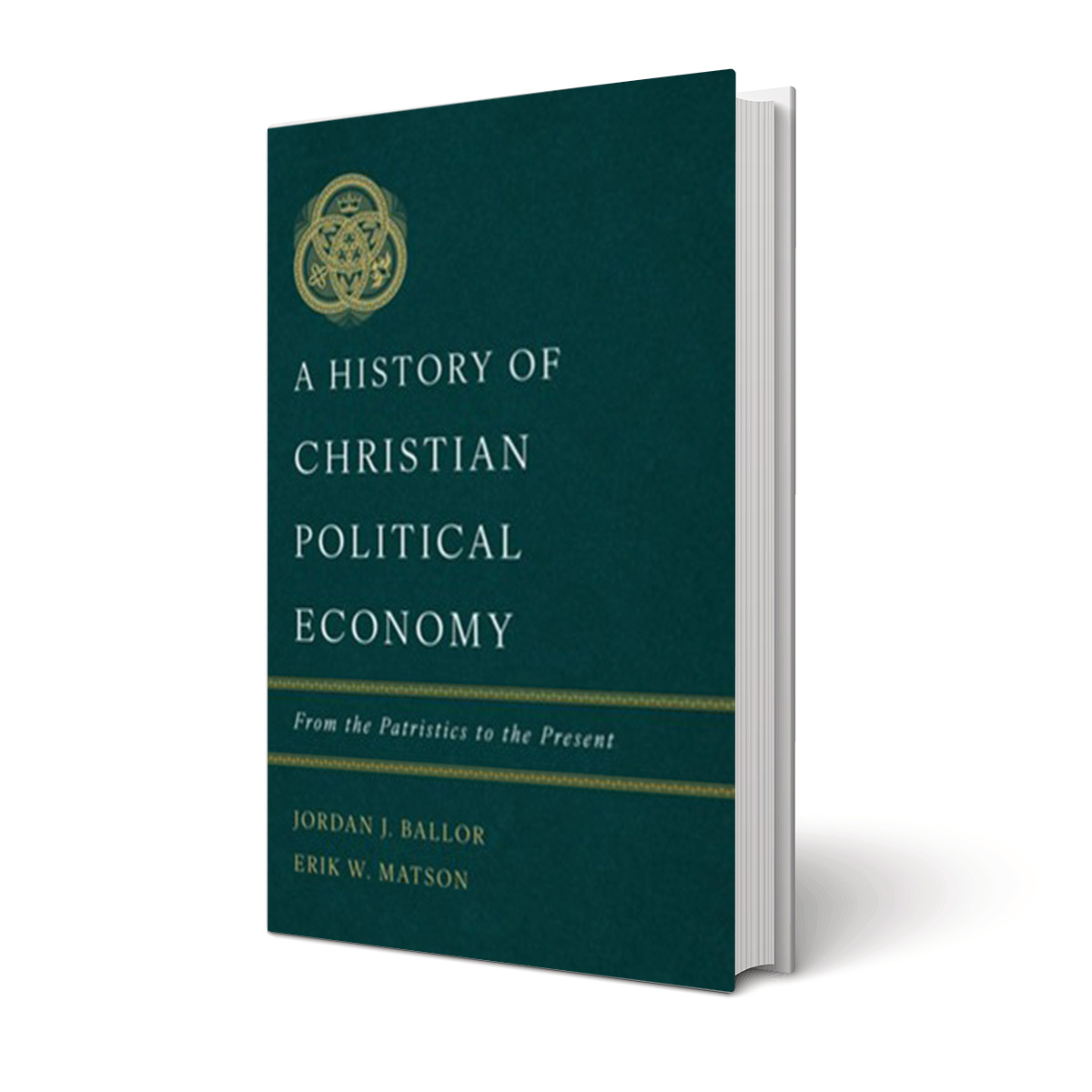
By Jordan J. Ballor and Erik W. Matson
(B&H Academic, 2026)
The book’s central claim is both simple and far-reaching: What we call political economy did not emerge in opposition to Christianity but from within it. The categories that structure modern economic reasoning—value, exchange, property, obligation—were first elaborated in theological and moral debates about sin, justice, charity, and the proper use of wealth. If the modern market appears secular, it is in large part because it has inherited a moral grammar whose original metaphysical grounding has gradually been thinned, translated, and in some cases forgotten.
Ballor and Matson develop this thesis through a wide-ranging historical narrative that stretches from the patristic period to the modern age. Their account of early Christianity is particularly attentive to the internal tensions of the tradition. Drawing on scriptural loci such as the parable of Dives and Lazarus (Luke 16), the warnings to the rich in the epistle of James, and Christ’s injunction to the rich young man, the authors show how wealth is consistently framed as a spiritually hazardous condition and not a neutral possession. Patristic writers—above all Augustine, Ambrose, and Chrysostom—intensify this suspicion, frequently portraying accumulation as a form of injustice or even implicit theft from the poor. At the same time, however, the authors highlight an important conceptual development: the increasing articulation of almsgiving in quasi-economic terms.
In Augustine, for instance, the language of thesaurizare in caelo (treasure in heaven) begins to recast the renunciation of wealth as a form of transposition rather than negation—earthly goods are not simply abandoned but converted into a higher form of value. What emerges is a structurally complex view in which wealth remains morally perilous, yet becomes susceptible to redemption through right use. The early Christian tradition thus does not eliminate economic reasoning; it reconfigures it within a soteriological horizon.
Originally theological notions were rearticulated in increasingly immanent and formal terms.
It
Here the book is at its strongest. The chapters on the medieval synthesis—especially the treatment of Aquinas, canon law, and the late Scholastics—show convincingly that the tension between wealth and virtue is not resolved but rendered conceptually tractable. Rather than abolishing economic activity or sacralizing it, Scholastic thinkers subject it to a dense network of moral distinctions. The discussion of dominium for instance, makes clear that property is not absolute in itself nor based on mere mores but grounded in natural law and ordered toward use (usus) and the common good. Similarly, the analysis of just price doctrine demonstrates that exchange is normatively constrained by considerations of fairness, equality, and social context and not left to arbitrary valuation.
The treatment of usury further reinforces this point: The prohibition is not a blanket rejection of financial activity; it is an attempt to articulate the moral limits of gain within the logic of exchange itself. What emerges across these discussions is a remarkably coherent picture in which contracts, markets, and ownership are all intelligible only within a broader moral and teleological framework. The market, in this sense, is neither autonomous nor self-justifying; it is a domain of human action embedded within and answerable to a prior order of justice.
The transition to early modern political economy, as Ballor and Matson present it, is a gradual shift in emphasis. Late Scholastic thinkers—particularly in the Salamanca tradition—develop increasingly refined analyses of price, value, and exchange, often in response to the expanding commercial world of early globalization. What changes is not so much the substance of the questions as their framing. Economic reasoning becomes more formal, more abstract, and less explicitly tied to theological premises, even as it continues to draw on categories shaped by them.

By the time we reach the Enlightenment and the classical economists, the transformation is more apparent. Figures such as Adam Smith no longer ground their analyses in a theological account of the human person, yet they retain key elements of the earlier tradition. The moral dimension of economic life is relocated—no longer anchored in charity or divine law but in sympathy, natural order, or the self-regulating tendencies of the market. The invisible hand, in this light, can be read as a distant echo of providence: a way of speaking about order without explicit reference to its source.
The cumulative force of this historical reconstruction lies in its challenge to a widely assumed narrative about the emergence of modern economic thought. The development of the modern economy cannot adequately be described as the straightforward displacement of religious categories by a purely secular rationality. Rather, the book demonstrates that many of the central concepts structuring economic reasoning are the result of a gradual process of conceptual transformation, in which originally theological notions were rearticulated in increasingly immanent and formal terms. This claim is supported by the continuity of core categories (such as dominium, just price, and obligation), their gradual detachment from an explicitly teleological framework, and their rearticulation in increasingly formal and immanent terms within early modern and later economic thought.
What persists in modern economic practices and institutions is therefore a framework that continues—often implicitly—to rely on moral assumptions whose original grounding is no longer explicitly thematized.
From
The future of the market cannot be separated from the question of moral formation.
At the same time, the book’s very strength—its historical scope and conceptual subtlety—points toward its principal limitation. The authors are careful, perhaps deliberately so, not to press their argument into a fully developed normative account. They show with great clarity where political economy comes from; they are more reticent about what follows from this genealogy. If modern economics is, in some sense, a secularized form of Christian moral reasoning, what happens when the theological horizon that once sustained that reasoning recedes entirely?
This question is only partially addressed. The narrative gestures toward a loss of teleology in modern economic thought, a thinning of moral language into procedural or instrumental terms. Yet the implications of this shift are not explored in depth. What becomes of concepts like justice, obligation, and the common good when they are detached from their original metaphysical grounding? Can they be sustained purely within an immanent framework, or do they risk becoming empty forms—retained in language but weakened in substance?
And yet perhaps this is precisely where the book’s value lies. It does not offer easy prescriptions, nor does it collapse the complexity of its subject into a simple moral lesson. Instead, it invites a reconsideration of the intellectual and spiritual conditions under which economic life becomes intelligible at all. It recalls that markets are not merely instruments for the allocation of resources, being instead embedded in a more fundamental understanding of human agency, obligation, and value.
If modern economics is, as this book suggests, what remains of Christian moral theology after its metaphysical core has been partially set aside, then the future of the market cannot be separated from the question of moral formation. The issue is not the existence of markets as such but the risk that they will come to operate without a sufficiently robust account of the goods they are meant to serve. The historical reconstruction offered here thus functions as both genealogy and a quiet provocation, pointing to the possibility that the moral coherence of economic life continues to depend on resources it no longer fully acknowledges. To recover those resources does not entail a return to premodern forms, still less a rejection of the market. It requires, rather, a renewed attentiveness to the ethical and anthropological foundations that render economic activity intelligible as a human practice. In bringing these foundations back into view, A History of Christian Political Economy performs a significant service.