


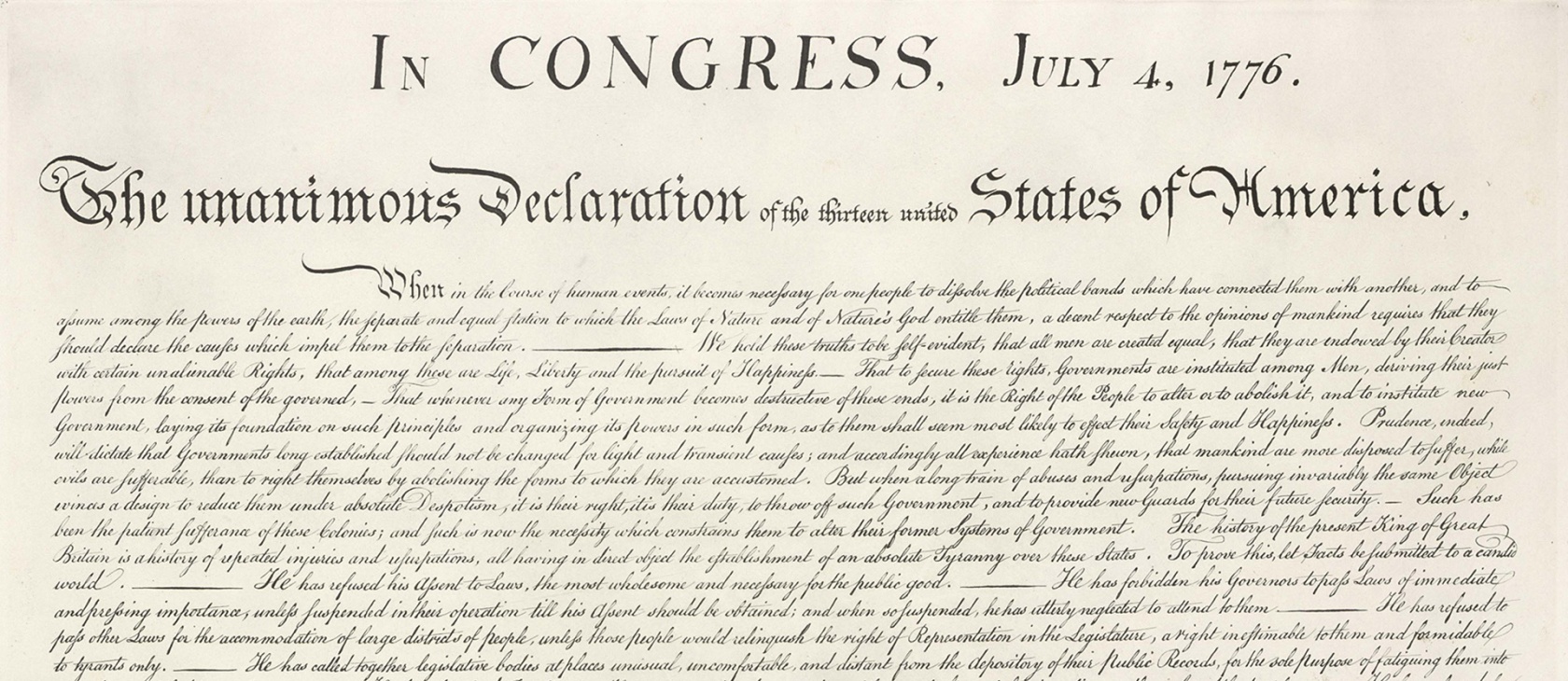
There are two tropes about the Declaration of Independence that conservatives have repeated for too many years. The first is that the Declaration is the American Creed. The second is that this creed owes its thinking to John Locke. The problem with the first idea is that too often the term “creed” is used only metaphorically, as in one does not really need to have any faith in it beyond what Americans already broadly share. The problem with the second notion is that it is simply false. As a result, the Declaration of Independence has, even for American conservatives, become an empty and fundamentally misunderstood symbol. If one adds to this how familiar the language of the Declaration has become, then it simply operates in the background of political life as a patriotic noise.
Ancient, medieval, and modern, the Declaration of Independence is greater than its influences—not to mention its modern critics.
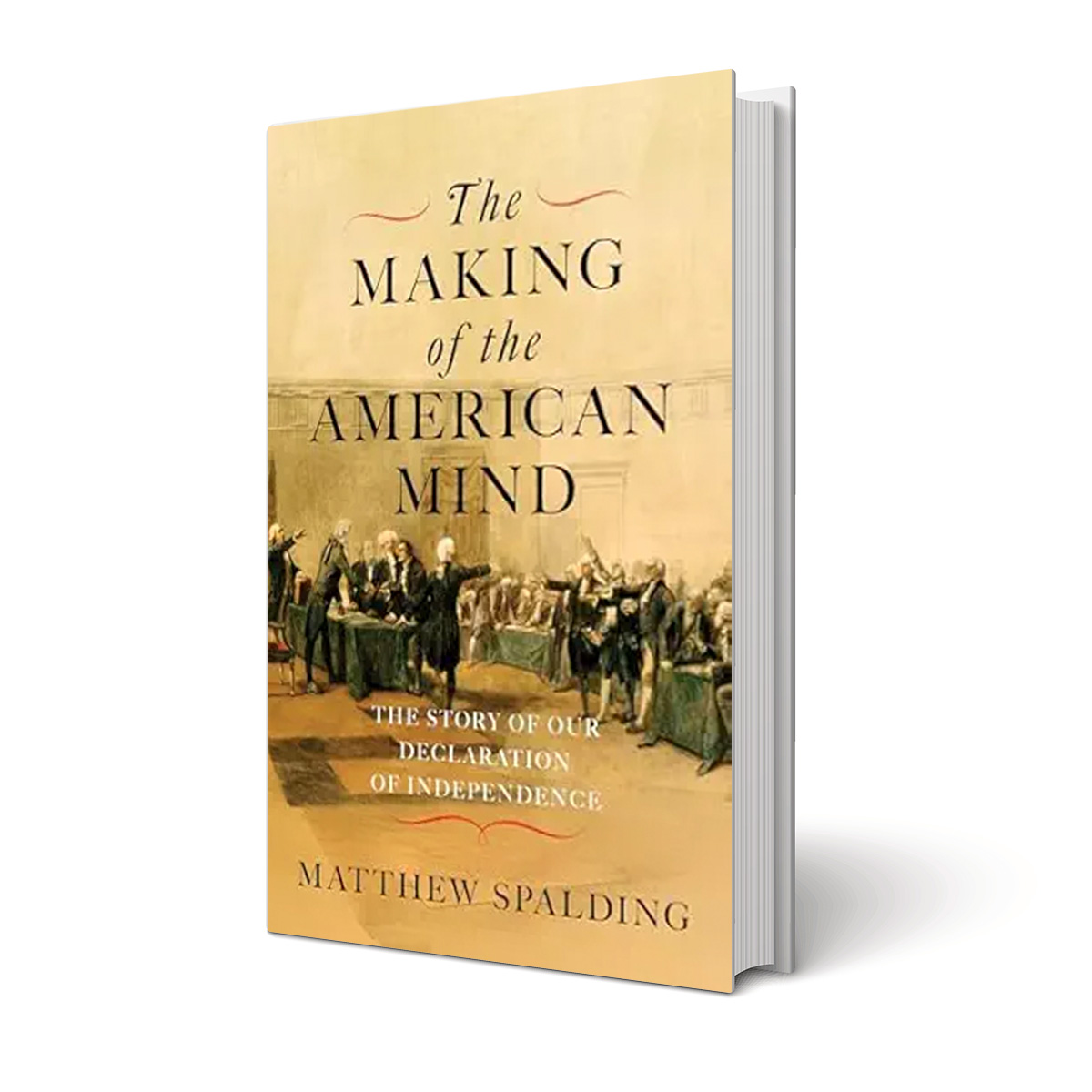
By Matthew Spalding
(Encounter Books, 2025)
Hence, Matthew Spalding’s The Making of the American Mind: The Story of Our Declaration of Independence is a badly needed book for the 250th anniversary of the Declaration of Independence. With great depth and an approachable style, Spalding addresses the shortcomings of the two platitudes mentioned above. Spalding demonstrates that the creed of the Declaration requires more of us than mere recognition of its rhetorical qualities. The principles of the Declaration of Independence have their origin in the Greek virtue of phronesis, the Roman concept of republican duty, a biblical insistence on man’s divine creation, and a modern innovation on ideas of political consent.
Spalding notes that the emphasis of the Declaration at the time of its promulgation was on the list of particulars that justified revolution; today, it is on the rationale for revolution in the first two paragraphs. The reason is that, at the time of its composition, the reason for revolution was well understood even among moderates like John Livingstone. Indeed, Livingstone had even written statements before and during the Continental Congress that aligned with the very same ideas as those in the Declaration. These ideas are literally creedal, however, as the language of “sacred and inviolable” in the original Jefferson draft became “self-evident,” here meaning that all Americans confess that “all men are created equal and endowed by the Creator with certain unalienable rights,” not because they will it but because the veracity of such a claim is obvious to a well-formed intellect.
As to the idea that the Declaration is purely Lockean, Spalding shows this view to be shallow. The Lockean reading of the Declaration was a way to contain the Declaration entirely within a specific moment in European history, when religion had lost salience and political foundations were grounded in a naturalistic account of human nature. Scholars from Danielle Allen to Michael Zuckert broadly support this understanding, and postliberals like Patrick Deneen have used it to engage in a radical critique of the entire American project. Spalding’s rich historical account jettisons the simplistic Lockean reading and replaces it with a properly multivalent set of influences on Jefferson’s composition—from quotations of St. Robert Bellarmine marked in Jefferson’s copy of Filmer’s Patriarcha to the language of the oft-forgotten Jean-Jacques Burlamaqui. Spalding also illustrates that the Declaration of Independence is not properly understood as either “ancient” or “modern” but the full expression of political traditions owing their provenance to both, as well as to the medieval mind. Indeed, the Declaration itself demands such a reading if the truths expressed in it are self-evident, since this would mean that the truth of them transcends a particular time and place.
Of particular importance for eschewing the Lockean reading of the Declaration is Spalding’s treatment of the term “happiness,” which was my favorite part of the book. Spalding carefully charts the use of the term both before and during the Declaration’s composition. Indeed, this discussion demonstrates at the same time the creedal and broadly historical claims. Here he affirms the significance of Locke but also of the “classical and Christian tradition going back to Cicero” that both Jefferson and Adams regarded as demanding a life of virtue. Hence, this artificial division between the ancient preoccupation with virtue and modern preoccupation with satisfaction often found among Straussian readings of the American founding is simply wrong. The Declaration does not frame an exclusively “modern” regime of “low but solid” liberalism but rather a proper republican regime that depends on the recognition that governments exist to defend the lives, liberties, and virtue of its citizens.
Spalding has not, however, written an academic monograph thick with footnotes and details of the academic battles I sketch here. Instead, the book is an approachable text for the average reader interested in deepening her understanding of the Declaration. To that end, Spalding has organized the book following the Declaration itself, each chapter moving through the Declaration almost word for word. In the section dedicated to the list of the Crown’s offenses, Spalding digresses to provide an excellent historical summary of the events leading up to the composition of the Declaration. Many if not most Americans are now unfamiliar with such events, making simplistic readings of the Declaration too easy to accept.
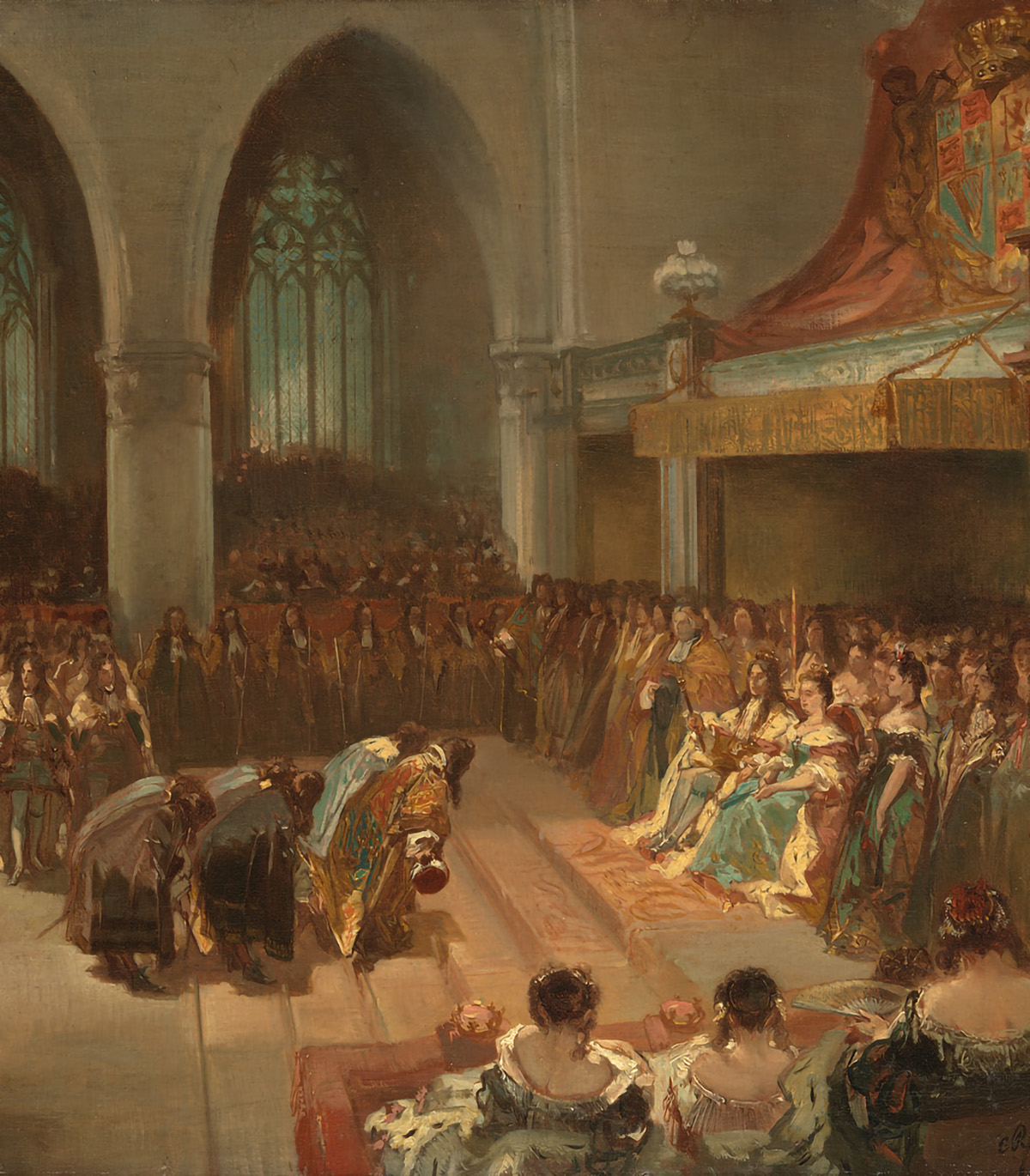
In the process, Spalding expertly reveals something that is a minor theme of the book—that the American mind expressed in the Declaration had already been formed prior to 1776. As he explains early in the text, the critical event in the development of this mind was the Glorious Revolution of 1688, in which Parliament ousted Catholic King James II and his absolutist ambitions after the birth of a Catholic male heir. His replacements, Protestants William and Mary, arrived at the behest of Parliament, and Parliament, especially the House of Commons, became sovereign. For the British, this amounted to a parliamentary usurpation of royal authority to itself, with the Crown serving as an increasingly limited executive. For the Americans, this result was a victory of republican self-government against the absolute, arbitrary government always lurking in the temptations behind monarchy.
The American mind expressed in the Declaration had already been formed prior to 1776.
Spalding’s account of the offenses against the Americans demonstrates just how vast was the difference between these two conclusions, with British parliamentary supremacy leading to the desire to reduce the colonies to servile dependencies and the Americans seeing themselves as equal subjects to the British homeland and ultimately deserving of parliamentary representation. In other words, for the British, the Glorious Revolution was old hat, but for Americans it was a pivotal moment. No wonder, then, that the Redcoats sang “Yankee Doodle” when marching through their future former colonies, as the titular character is a backward fool so out of touch that he thinks putting a feather in his hat makes him fashionable or, to use the term of the time, “macaroni.”
Alas, here is where I should summon some minor issue with the text and blow it out of proportion, but I refuse. Perhaps I am too much in agreement with Spalding to find fault with the book. The only issue I have is that I wish I had written it myself, but I would not have written a manuscript as good as this one. Instead, I will use this concluding part of the review to advise educators to consider using The Making of the American Mind. It is not too difficult for gifted high school students, but educators themselves should read the book to appreciate how tightly the Declaration is interwoven into the ideas and events of the period. It is also a great book for college professors teaching introductory courses on American government and American political thought, and it is especially valuable in the civics institutes like those at the University of Texas, Arizona State, and my own Institute of American Civics at the University of Tennessee.
The Declaration of Independence must become real to Americans again, and that requires a serious effort to recall the eternal truths expressed in its first two paragraphs and the historical knowledge about what events led to their profound expression during that hot summer of 1776. That Spalding has written the best text to serve us in that effort is one more example that Americans should continue to rely firmly “on the protection of divine Providence” such that this nation shall long endure.