



Leo Strauss once observed that “there exists a kind of Jewish glorification of every clever or brilliant Jewish mediocrity—which is as pitiable as it is laughable.” Every Jew who has received, for some long-ago birthday present, a book on great Jewish football players or a similar topic knows what he means. Strauss recalled that his distrust of this tendency was so great that he initially refused to believe reports of Einstein’s stature in science. It was only after a physicist friend reassured him that he acknowledged the achievements of the great genius.
How “Hebraic” is the American concept of liberty and equal rights? Perhaps the answer is to be found in how deeply immersed the Founding Fathers were in the Bible.
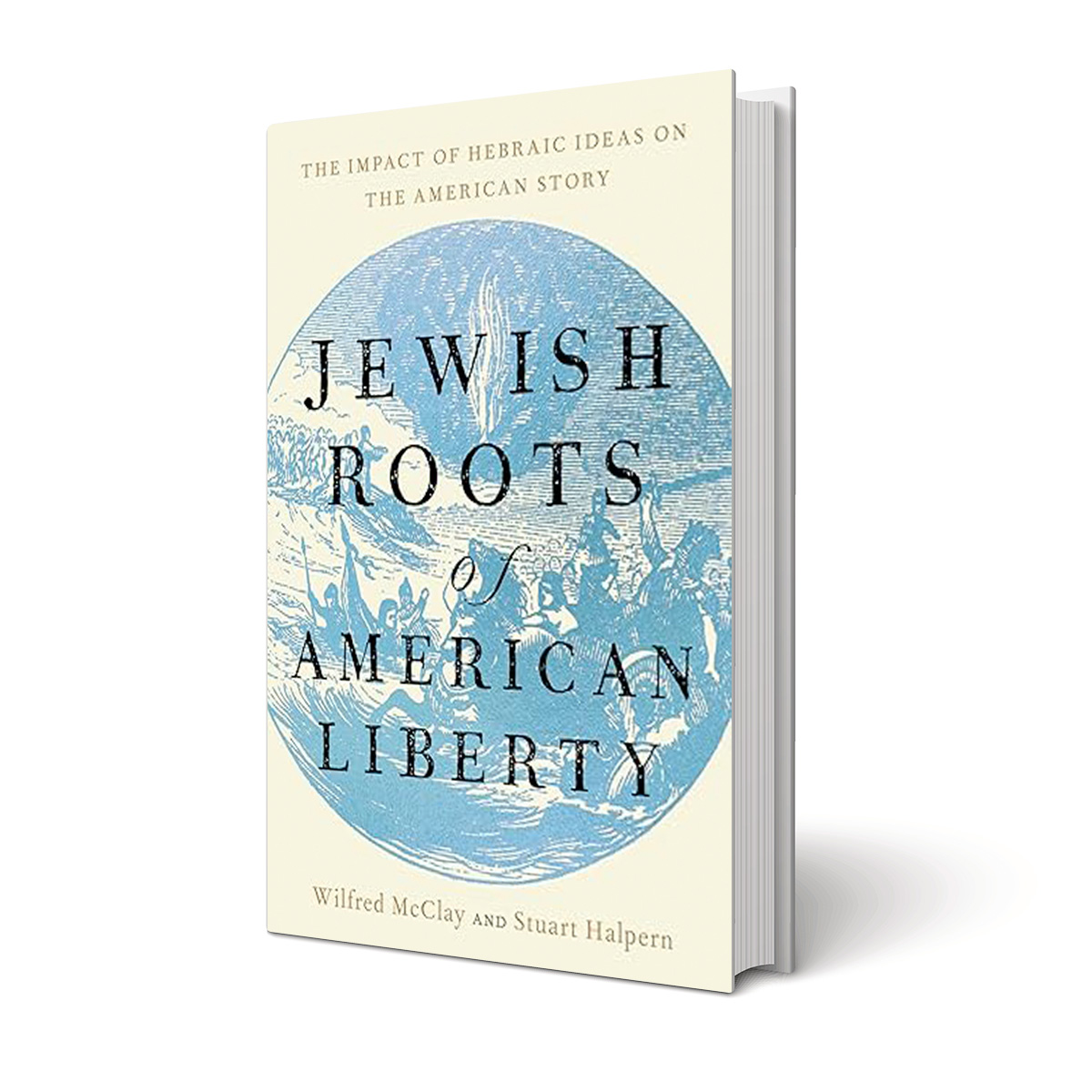
Edited by Wilfred McClay and Stuart Halpern
(Encounter Books, 2025)
A related tendency can be found in popular historiography. I have often rolled my eyes in the gift shops of museums and historic sites, which seem disproportionately stocked with works discussing Jewish contributions to American life. Jews in the military, Jews on the frontier, Jews in the petroleum industry. It doesn’t seem to matter how marginal or attenuated the connection may be. If there were any Jews to be found in some past time or distant place, they’re certain to be found in the pages of books today.
For that reason I opened Jewish Roots of American Liberty: The Impact of Hebraic Ideas on the American Story with a certain trepidation. The essays in the collection are written by leading scholars and educators and intended as a reference for teachers in faith-based schools, rather than as a souvenir for vacationers. Still, I feared the inclination toward glorification and magnification that Strauss diagnosed.
I should not have worried. The contents of Jewish Roots do not claim that Jews “invented” America or were even major players in public affairs until fairly recently. Instead, they focus on the pervasive influence of language, stories, texts, and imagery drawn from the Hebrew Bible (or, as Christians saw it, the Old Testament). This influence was particularly intense in the colonial and revolutionary periods, when narratives of exodus, tyranny, and redemption helped settlers and patriots understand and justify their struggles. But it continued into the 20th century, when the Bible remained a widely shared inspiration for aesthetic as well as political culture.
'Hebraic' does not mean quite the same thing as 'Jewish.'
These observations might not have been necessary under better educational conditions. Within living memory, Americans were much more familiar with the Bible and comfortable with its use as a repository of language, moral teaching, and historical information, as well as a source of religious authority. That sensibility was partly the result of formal instruction. In K–12 schools, biblical texts and even group prayers were still part of the curriculum. In colleges and universities, the then-lively field of American Studies documented how biblical themes infused American life and literature from the very beginnings of European settlement. These conditions help explain how Martin Luther King Jr. could speak of seeing the promised land from a mountaintop and Ronald Reagan could describe America as a city on a hill and both could expect to be understood by their fellow citizens.
That shared framework was undermined by overlapping though distinct trends in law, public policy, and culture. Among them was the emergence of strict separationism in jurisprudence following the Second World War. Guided by the aspirations of Thomas Jefferson and James Madison more than by historical practice, courts increasingly barred public authorities from appearing to enforce, favor, or honor any particular religious doctrine, text, or community. Fearing lawsuits, many schools went beyond what courts required, discouraging the assignment or even discussion of potentially sensitive materials. It was in this context, although not only for this reason, that large numbers of Protestants began to join Catholics and Jews in seeking religious alternatives to public education.
Around the same time, elite institutions began to shift from endorsing a kind of soft pluralism intended to reassure Jews and Catholics that they, too, were fully American to promoting broader and more aggressive multiculturalism that insisted that all faiths, practices, and communities were of equal importance to a nation that was defined by a cosmopolitan future rather than an allegedly oppressive past. Buttressed by a renewed wave of immigration that included many who were neither Jews nor Christians of any variety, this new perspective made it more difficult to weave together any coherent national story—let alone to “privilege” the biblical threads in the fabric.
These conditions make a sort of reeducation necessary. Matters that were once fairly uncontroversial, if not simply obvious, need to be restated. Although it was written with an eye on challenges from the secularist and universalist left, Jewish Roots also contains defenses against some recent developments on the right. The statements on assimilation, religion, and national cohesion by Presidents George Washington, Theodore Roosevelt, and Calvin Coolidge that are included in the volume are superior in reason, knowledge, and dignity to anything written in defense of currently fashionable conceptions of Christian nationalism or American heritage.
But demonstrating the historical salience of such ideas leaves important questions open. One set of issues is indicated by the tensions between the title, which speaks of “Jewish roots,” and the subtitle, which invokes “Hebraic ideas.” As historian Daniel Dreisbach emphasizes in his essay on the political culture of the founding, early Americans were
drawn to the Hebrew Bible and … interpreted it through the lens of Christian—specifically Protestant—theology, tradition, and practice, not necessarily as it was expounded in Jewish theology or rabbinic commentary. Hebraic texts and themes … were selected and adapted to serve Christian theological and cultural interests.
No modern state has ever been more welcoming to Jews [than America].
“Hebraic,” in other words, does not mean quite the same thing as “Jewish.” There may have been as few as 2,500 Jews in the newly independent states, out of a total population of more than three million. Yet the contrast between symbolic importance and demographic nullity may not be as paradoxical as it seems. The biblical Hebrews were open to American imagination and, as we now say, “appropriation,” partly because most Americans of the time had little contact with living Jews or Judaism. So how did Americans who spoke admiringly of biblical patriarchs, kings, and prophets react as they began to encounter significant numbers of real people who might not meet such elevated expectations and had their own ideas about the meaning and relevance of the biblical texts? With the exception of the presidential statements, each of which was addressed to an organized Jewish community, the book does not include much on the American encounter with actual Jews (or vice versa).
The point of asking such questions is not to insinuate that anti-Semitism was more pervasive or severe in America than it was. To the contrary, no modern state has ever been more welcoming to Jews. The “Hebraic” affinities of its originally Protestant-dominated culture is certainly among the reasons for this special relationship. Still, there is something of a lacuna in this volume that extends from about the 1840s, when Jewish immigration began in earnest, to the early 20th century, when a religiously and ethnically diverse population began to coalesce around a civic or “creedal” version of national identity that replaced more explicitly theological conceptions that were prominent earlier. A more comprehensive collection might pay greater attention to this period of transition.
Another issue has to do with the relative significance of Hebraic ideas in the American mind. Were they just one component in an eclectic synthesis that included English common law, classical republicanism, and modern philosophy? What was the weight of their influence compared to other elements—and for whom? The sources include works in several fields, including imaginative literature. One the best chapters, by Dov Lerner, traces the influence of John Milton, perhaps Americans’ favorite author in the 18th century. But the archive on which Jewish Roots leans heavily is that of political sermons, a popular and influential genre until at least the Civil War. These sermons are important documents but might also paint a skewed picture, since patriotic clergy were naturally attracted to the most religiously significant materials at their disposal.
Other cohorts and figures certainly employed Hebraic language and typology. In his chapter, Rabbi Meir Soloveichik points out that a committee including John Adams, Benjamin Franklin, and Thomas Jefferson suggested a national seal featuring an image of Moses parting the Red Sea and the phrase “Rebellion to tyrants, obedience to God.” Of the three, however, it’s likely that only Adams saw the juxtaposition as more than rhetorical. The founders were shrewd politicians and aimed to appeal to what many ordinary Americans believed, whether or not it reflected their own private convictions. Even in the 18th century, though, there may have been a gap between what Washington called “the influence of refined education on minds of peculiar structure” and popular morality.
One way in which Hebraic influence could have been more substantive than rhetorical involves natural rights.
One way in which Hebraic influence could have been more substantive than rhetorical involves natural rights, which play a distinctively large role in the American political tradition. Several contributors to Jewish Roots contend, plausibly, that the principle of inherent equality and liberty is derived from the biblical account of creation in the image of God. In his chapter, Mark David Hall distinguishes between the influence of the Judeo-Christian tradition in Anglo-America and the European enlightenment, especially with regard to religious freedom. But was the difference really so evident at the time? Locke, too, places equal creation at the foundation of his case for limited government.
Equal creation in Genesis is not the Hebrew Bible’s last word on the matter, moreover. Other sections allow, and arguably endorse, monarchy, slavery, and other practices we now regard as incompatible with American ideals. In The Civil War as a Theological Crisis, historian Mark Noll shows that appeals to biblical models were not only characteristic of those who believed that the Declaration of Independence applied to men of all conditions and races, but also of those who denied this. Were such arguments less Hebraic than the ones we now look back on with pride? Or did they draw the wrong conclusions from the right sources? In a chapter on Lincoln, America’s greatest reader of the Hebrew Bible, Dreisbach reminds us that the Second Inaugural is a powerful warning against certainty that we understand the ways of the Lord.
No book—particularly an introductory volume—can answer all the questions it provokes. Rather than a last word, Jewish Roots is what co-editor Wilfred McClay elsewhere calls an “invitation” to learn, tell, and continue the American story. In many Jewish families, the highlight of the Pesach meal is the “four questions,” when the youngest child recites a series of queries whose answers rehearse the exodus from Egypt. Jewish Roots follows in that tradition for Americans who have always seen that narrative as, in some mysterious way, almost their own.