


The essential fact about Sven Beckert’s Capitalism: A Global History is its size and scope. The book is 1,100 pages in length, it has another 150 pages of endnotes in print so small it is unreadable without a magnifying glass, and its acknowledgements run half a chapter long at 3,000-plus words. Capitalism weighs about five pounds. As for scope, it is global and covers a thousand years. As Beckert puts it in the introduction, “This book understands capitalism as, above all, a global development whose local articulations can only be understood globally” (emphasis in the original). Or, among the many restatements of this point throughout the 1,100 pages: “Capitalism cannot be understood in local, regional, or national terms; it can be understood only by focusing on the permanent combination and recombination of its fragments across the world.” If Capitalism had come out not now but perhaps several decades hence, when there are Elon Musk–style colonies in space, presumably it would insist on a universal history of capitalism, and surely the book would be even more extended for it.
Size and scope are in a cooperative relationship with each other in Capitalism, as the formal justification for the length isthe scope. Since capitalism has always been global, and since its history stretches back to about the year 1000, as the book contends, it must be massively long. And yet Capitalism also cultivates the impression that it is not the scope that dictates the size, so much as the other way around—the size dictates the scope. There are references to the author’s professorship at Harvard; the acknowledgements divulge that a “team” of research assistants and Ph.D. students is behind much of the research; we read that substantial funding came to professor, assistants, and students not only to pore over and organize the scholarly literature but also to visit archives at spots in every corner of the world; and that big names in the field saw to it that the author could proceed in his career as he saw fit.
Therefore the argument of Capitalism, that the “only” way to understand its subject is to adopt a global perspective, with the corollary that global history requires an enormous amount of research, functions to justify the unique capabilities of the author—namely the time, money, and talents that accrue to one in a well-placed academic sinecure. Capitalismpresents global history as something that inhales resources to produce.
Next in order of precedence in Capitalism is its diction. The following is a list of recurrent words, words that carry the history from the Gulf of Aden at the turn of the first millennium through the rise of slave plantations globally in the early modern era through the urbanization, warfare, and welfare state episodes of modern times. Forge (the verb), spatial, swathes, Anthropocene, Eurocentric, foregrounds, simultaneity, globality, logics, archipelago, nodes, islands (in the metaphorical sense), zones, ratchet, shape-shifting, Indigenous, privatized, totality. But the palme d’or goes to forge. It is the hero of the intellectual-jargon proletariat that the author works over the 1,100 pages, the plugger that brings this book from start to conclusion. It is, simply, everywhere.
What is advertised as a comprehensive global history of the greatest economic engine ever known proves to be little more than a tendentious exercise in ax-grinding.
By Sven Beckert
(Penguin Press, 2025)
Starting on page one, right after the opening sentence and the passive voice: “We live in a world created by capitalism. The ceaseless accumulation of capital forges the cities we inhabit.” The redoubtable forge (in noun form) was a great exemplar of capitalism in its rising season, mechanized incredibly so that a factory could whip around a steel ingot like it was a plaything and pound it into super-strong capital goods. A city is a mixture of hard and soft things, of hard buildings and hard roads, and soft plaster walls, ductwork, and the indoors, not to say parks and promenades where many people are about their business and lives. How poetic is it to say that cities come into being by the process of the forge? Not really at all. Here is one more, a passive forge: “This social prominence, largely forged by women’s labor, helped the Fuggers become the most prominent financiers to many of Europe’s leaders, including its popes.”
As for the content, which despite the tome’s bulk can get lost on account of the author’s attitude and literary preferences, the role of the first roughly 400 years (approximately A.D. 1000–1400) of Capitalism is to serve as a prop to mock Europe. Egyptian, Asian, and other global merchants crossed land and sea with goods in this era, creating the opportunity to hurl these words at comparatively less sophisticated Europe:
The Europeans who inhabited the far western and northern fringes of the Islamic trading universe were unimpressive in terms of agriculture or manufacturing. European traders were late bloomers compared with their Middle Eastern or Asian counterparts, their trading prowess, institutional infrastructure, and urban life no match. European cities were minor affairs next to Baghdad, Aden, Cairo, Hangzhou, and Cambay.
Europe remained a relative backwater of the global economy. Arab merchants did not even bother distinguishing between the various people living on the fringes of their world. … The European traders’ position was so weak that they had to accept inferior goods in exchanges with their Eastern counterparts. Even as their economy commercialized, Europeans looked in awe at the Islamic world.
A few pages later: “The trade networks these African merchants built were sophisticated.”
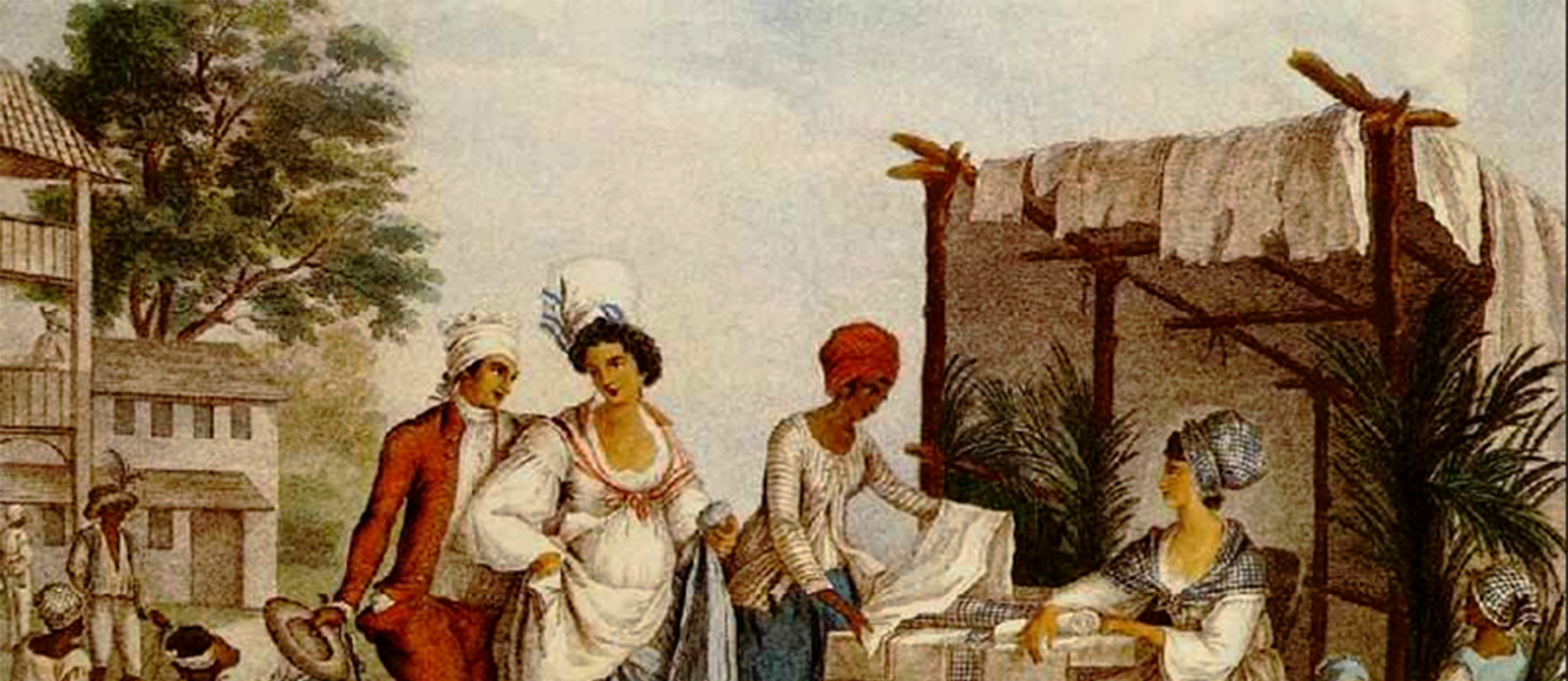
Is it useful to have a rehearsal of non-European economic vitality from 600 to 800 years ago? Perhaps, but Beckert’s tone in treating this subject is so consistently respectful and flattering that the reader begins to suspect that what is in store in Capitalism is not so much history but the arranging of history to fit a particular opinion about history. After 150 pages, the real prize emerges. The heart of the book, the topic in which the author luxuriates, is the history of the slave economies of the early modern period that Europeans started and led. England’s Barbados, Spain’s silver domains in the Andes, Dutch exploits in Indonesia, and France’s St.-Domingue (Haiti) have top billings in Capitalism. A repeat of the book’s thesis introduces a reflection on early modern slavery: “Capitalism has just one history—a world history, with one of its key sparks in the forests, barrens, and swamps of the Caribbean islands and the American mainland.”
Most important, plantations demonstrated how capital could dominate and control land and labor, putting them into the vanguard of a new kind of production. As the Americas became critical to the forging [sic] of a world economy, they demonstrated that creating the new order—a world in which markets dominate almost everything, where almost anything could be bought and sold—took great effort, energy, creativity, and coercion. … In Barbados … capitalism rested on enormous violence, massive dispossessions, and coerced labor that let capital owners to “solve” the problem of production by reinventing social structures from scratch. This was possible because … capital owners distant from their homelands could step outside the established order to extract unprecedented riches.
Here is a subsidiary thesis of Capitalism: The West became sufficiently materially comfortable so that it could sponsor its vaunted civilization by means of faraway exploitation of people and environments of the most intense degree. “While war capitalism flourished often on an attempted tabula rasa of a completely remade society, the lawless ‘outside’ provided the foundation for the emergence of what would become, eventually, remarkably liberal and orderly states on war capitalism’s ‘inside.’”
The reader begins to suspect that what is in store in Capitalism is not is much history but the arranging of history so that it fits a particular opinion about history.
Without question the slave islands of the 1600s and 1700s produced goods, such as sugar, of distinct value for the metropolitan center over the sea. And clearly these places were in many examples quite fearsome. Yet the development of civilization in 18th-century St.-Domingue, to take that rock of this book’s “outside,” is a subject well known to French and Haitian memory, not to mention formal scholarship. We miss in Capitalism the rich historiography on comparative slavery. It is distinctly concerning that we hear nothing credible about the impress of religion on American slavery. Capitalism explicitly equates religion with “ideology,” an expedient that results in an incompleteness to its history of especially this topic. The connection of Islamic intermediaries to Atlantic slavery is not a significant subject in Capitalism; nor is the slavers’ attempt to evade Rome’s insistence on sacramental marriage by importing exclusively males from Africa, making reproduction impossible and the demand for new slave shipments sharp; nor is the development of Catholic culture in the slave areas, much at the hands of the Jesuits, that not least in St-Domingue brought about a sense of communitarianism as well as a growing clarity on the advisability of just wages. What is this about a “tabula rasa”?
Perhaps fearing being Eurocentric, Capitalism treats just the fringes of the biggest country in Europe of the early modern period, the Polish-Lithuanian Republic. It confines its discussion to how Dutch merchants set up in Danzig such that “by the seventeenth century, eastern European grainlands were practically a Dutch economic colony.” The incredible agricultural productivity within comparatively peaceable Poland-Lithuania during the long era of religious warfare in central Europe that began with the Reformation and culminated in the monstrous Thirty Years War (1618–48) is becoming increasingly clear in scholarship, and was both a vindication of the Noble Republic’s principle of religious toleration and the goad that forced England to engage in the agricultural revolution. Wheat cascaded into markets from eastern points on the northern seas, and England realized it had to match the price and quality of the agricultural trade goods to keep pace.
Yet we get only superficialities in Capitalism on this agricultural revolution, that essential prerequisite to urban industrial society. Because of “superior agricultural techniques of new farmers, productivity improved” in England as of 1740 is about it. And in keeping with the axiomatic downgrading of religion, the immense migration of European Jewry into Poland-Lithuania in this period is a non-topic. There is almost no Jewish history in this book—on the history of capitalism.
Capitalism loses steam as it enters into industrial society, and deteriorates in attentiveness, over hundreds of pages, through to the end. Once the slave islands of the Caribbean recede into the past, the high dudgeon that sustained the book becomes out of place, and the narrative becomes odd. The Metropolitan Museum of Art in New York failed in its civilizing mission because it was closed on Sundays, the day workers across the city had off. We hear at length about the Röchling industrial establishment in late 19th- and early 20th-century Germany. There are many examples of surpassingly successful big firms in this era. This is the one that gets the deep dive, perhaps because Röchling gets very involved with Hitler and commits sins in World War II. The large number of more-than-comparable American firms that produced prodigious amounts of industrial goods, including huge hauls sent to thwart the Wehrmacht on the Eastern Front, would appear to be examples at least as worthy as Röchling of what capitalism was up to through the early 1940s.
Capitalism extols only one period—that of the post–World War II welfare state. It delves into a sole example, that of Sweden, which mandated paid vacation, provided government housing, and built up its pension system, among other reforms. The results were beautiful prosperity across the population. “The extensive welfare state radically improved the lives of Swedes.” The socialist party in Sweden, the SAP, was responsible for the win. “Since the 1930s, the SAP had called social policy a ‘productive investment,’ meaning that society was made more efficient when citizens could rely on security provisions. And the SAP was right.” Was Labour also right in the United Kingdom as the government, starting in 1945, comprehensively nationalized British industry and the country was the growth laggard in Europe through the 1960s?
The connection of Islamic intermediaries to Atlantic slavery is not a significant subject in Capitalism; nor is the slavers’ attempt to evade Rome’s insistence on sacramental marriage by importing exclusively males from Africa.
The central concern of the last chapter, which covers 1973 to the present, is the “neoliberal” intellectual movement urging free markets and the dismantling of the welfare state. In choosing this emphasis, Capitalism neglects the principal structural development of this period, the rise of the entrepreneurial firm at the expense of the received corporate structure of big, old, large-employer companies. But according to Beckert, the big news beginning in the 1970s was that “intellectuals such as Friedrich Hayek, Milton Friedman, and Ludwig von Mises rose to prominence. Despite their differences, they were all utopian thinkers with almost religious belief in markets” (and yet Capitalism distinguishes itself by refusing to comprehend religion). Jeff Bezos’s building of Amazon from scratch gets half a sentence. With some other companies, it “arrived on the scene.” We hear nothing of the new low-tax environment that enabled engineering talent to break away from legacy firms and create new enterprises that toppled old ones. This was the actual drama of capitalism in real life in the 1970s, 1980s, and 1990s. Instead of recounting such rich history, Capitalism gives us barbs about free-market theorists, which is to say merely an attempt at point-scoring in a professorial rivalry.
Western Marxism of the post–World War II variety bleeds off every page of Capitalism. “Totality” was a central Marxist concept in the midcentury. Marxists aspired to explain everything—the economy, the world, society, culture—through one interpretive framework: their own. Capitalism tries to construct a global totality from scratch and say the assemblage is everything. It picks a million particulars from a thousand years of global history and says, in effect, “disprove the total pattern (or come up with an alternative million particulars that fit your pattern, if you have the time and resources to do it).” Western Marxism’s agit-prop, even in a scholarly guise, was tiresome in the 1950s. To encounter it in the 2020s is anachronistic. Capitalism does take swipes at Marx here and there, but it cannot throw readers off the scent. The grand irony of the book’s worldview owes itself exclusively to European culture, to the Marxist counter-dynamic within that culture and whose relevance at present in any place around the world is not at all clear.