


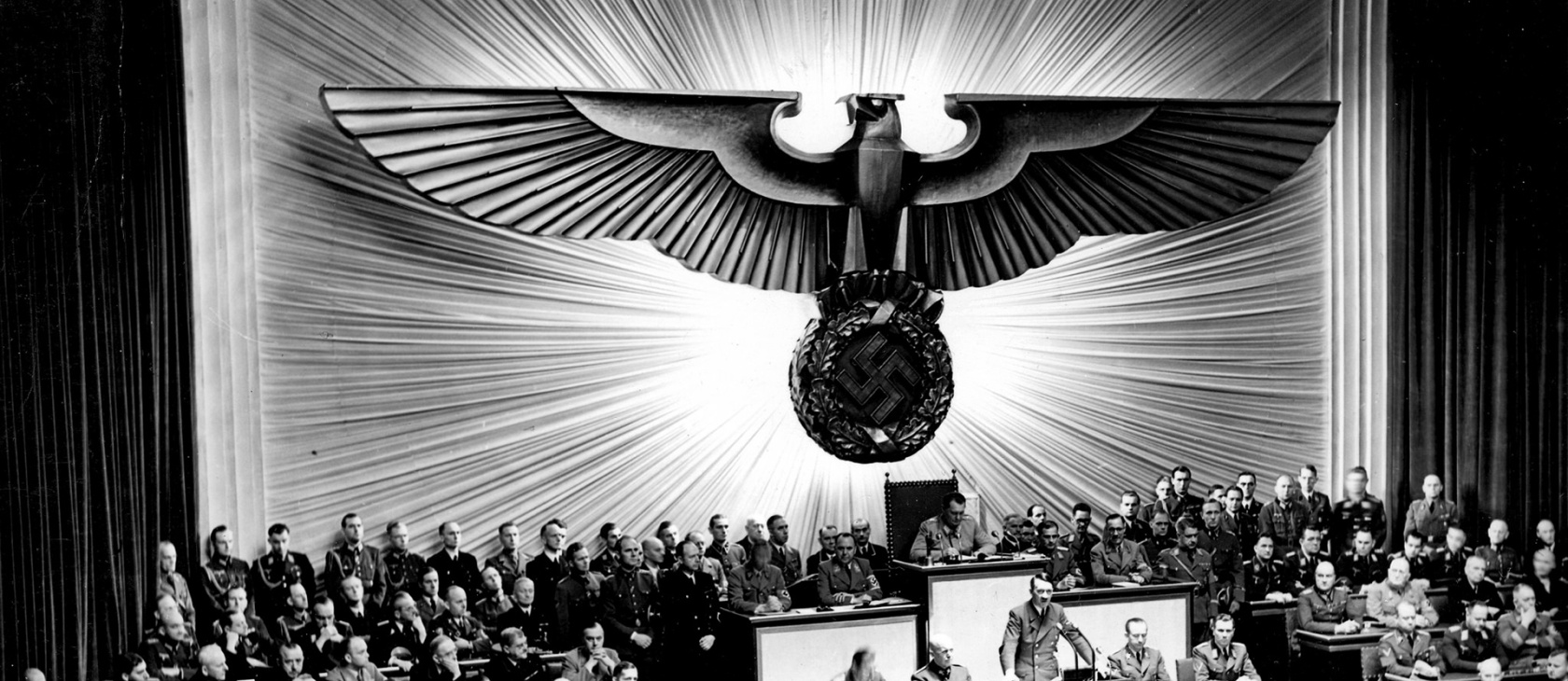
Alec Ryrie, professor of the history of Christianity at Durham University, admits that, as a Reformation scholar, he “has no business straying into modern times.” Like a good academic, however, he has done so anyway. The result is The Age of Hitler and How We Will Survive It. What does Ryrie mean by this provocative title?
Once upon a time, everything was measured by whether it resembled Nazism, the worst thing one could think of. Now more and more wonder whether it was really so bad. How did we get here? And can we forge another, better cultural myth?
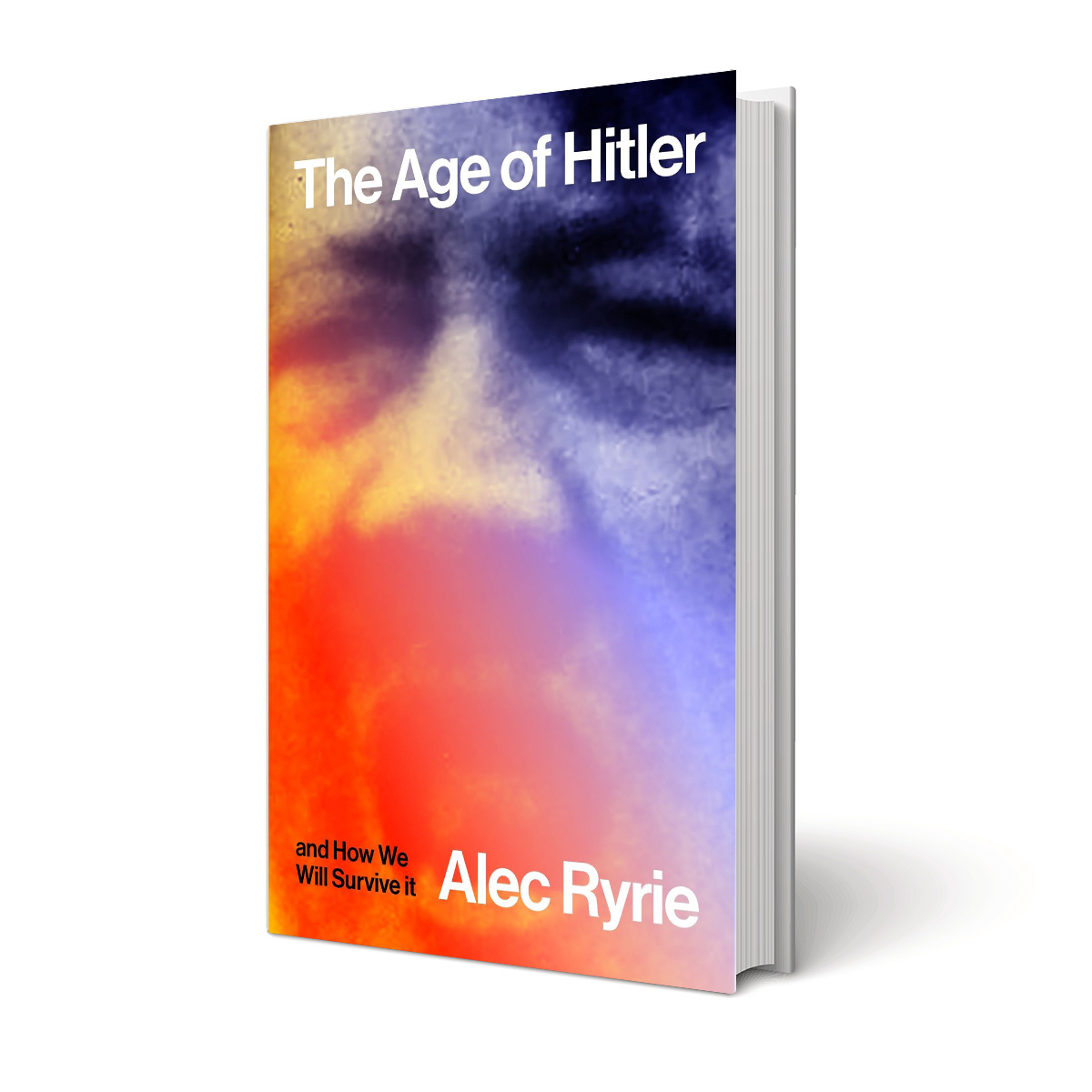
By Alec Ryrie
(Reaktion Books, 2025)
The book is “not really about Hitler” or “even a book of history.” Rather, The Age of Hitler argues that the Nazi atrocities of World War II replaced the story of Jesus Christ as the foundational cultural myth by which Western civilization lives. It is both our Trojan War and our Paradise Lost, the most important source of our shared values. And for Ryrie this is visceral, subjective, and personal: “I feel in my bones that Nazism is the embodiment of evil.”
Ryrie asserts that whereas the story of Christ once moved people emotionally as a tale of heroic love, it no longer has as strong an effect on him as do stories of Dunkirk and D-Day. He thinks this is true for most people, making World War II “our culture’s true religion.” Thus, since 1945 we have been living in the “age of Hitler.”
Wars always produce propaganda and usually involve the dehumanization of one’s enemies. In the case of WWII, however, the Allies’ insistence on the evil of the enemy turned out to be true—and worse. The wartime propaganda against Germany fell so far short of the horrible reality that even the battle-hardened Allied troops who liberated the concentration camps were shocked.
The Allies entered the war to save what President Franklin D. Roosevelt called “Judeo-Christian civilization.” Afterward, they wanted to safeguard their victory against fascism by creating a postwar order in which fascism’s evils could never recur. So ever since, “our public morals have come to be defined with reference to the Nazis.” As Ryrie puts it, while most consider Jesus to be good, they do not believe this “with the same fervour and conviction that we believe Nazism is evil.”
In Ryrie's telling, 'older crimes' have weakened the hold of Nazi atrocities on the moral imagination.
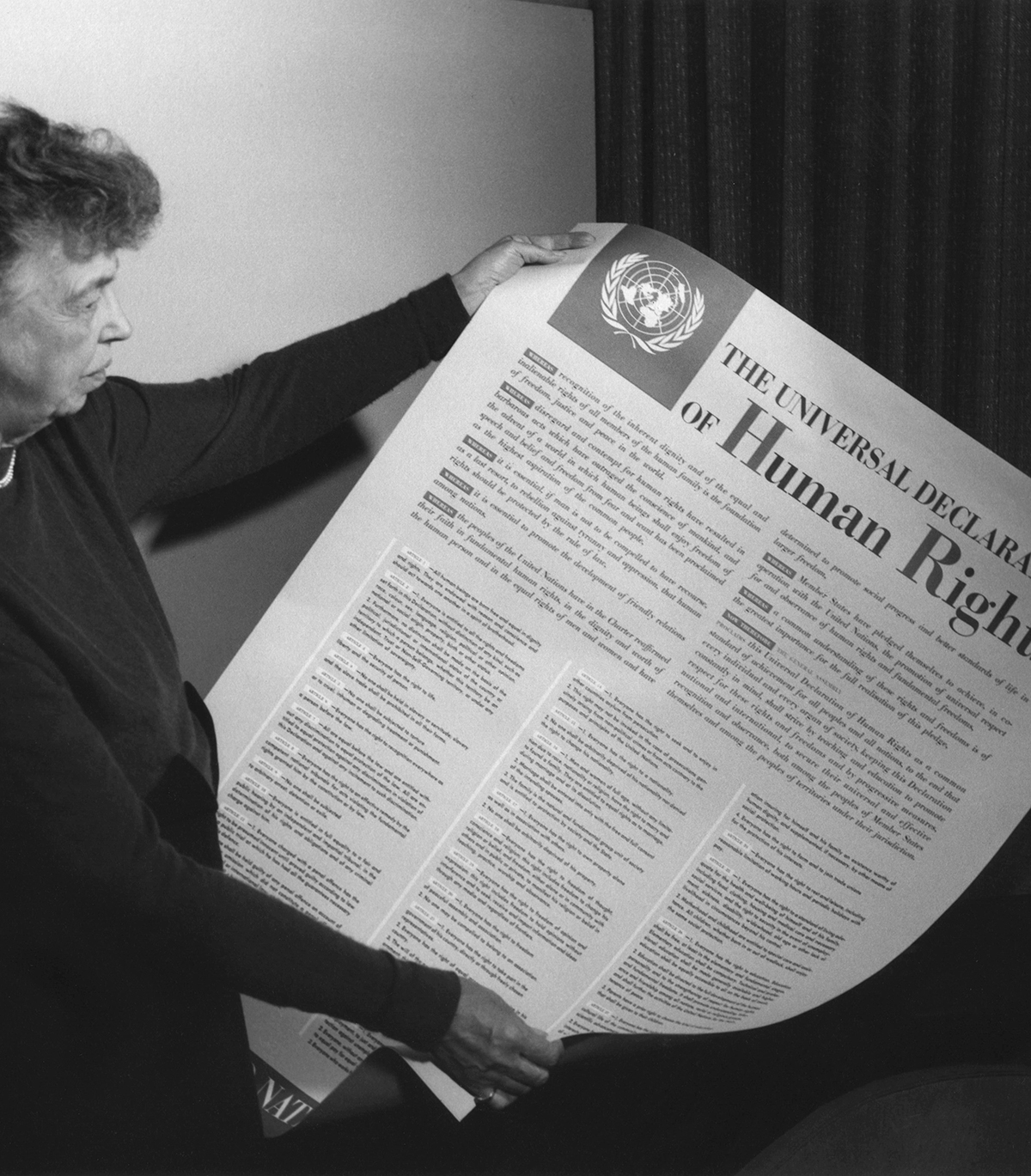
This sentiment, though historically conditioned by World War II, is what led the victors in the war to proclaim the universality of their values in the 1948 Universal Declaration of Human Rights (UDHR). There was a problem, however. The UDHR was a compromise document, and as such it lacked a philosophical or theological foundation for the principle of dignity. As Jacques Maritain, who had participated in the writing of the UDHR, quipped at the time, “We agree about the rights, so long as no one asks us why.”
When
Because of the lack of a real anthropological foundation, the UDHR proved malleable for those wanting to manufacture new rights, the so-called human rights that really are entitlements without duties to the common good. Some of these, like abortion, are matters of life and death. Pope Benedict XVI recognized the danger when he warned that “it is a mistake to fall back on a pragmatic approach, limited to determining ‘common ground,’ minimal in content and weak in its effect.”
There are no universal human rights, Ryrie says, and certainly not “self-evident” ones. “Nazism is our chief and perhaps our only absolute. In a relativist, pluralist age, it is our one fixed reference point.” The problem is that “a value system based around rejection of Nazism ... was never quite up to bearing the weight placed on it and it is cracking under the strain”—so much so that Ryrie’s purpose in writing The Age of Hitler is to declare that the age is fast coming to an end.

After World War II, one was free to promote all manner of kooky conspiracy theories, wear a T-shirt with the image of the murderer Ernesto “Che” Guevara on it, or even sport hammer-and-sickle jewelry and tattoos. One could even praise Stalin’s architectural tastes or Mao Zedong’s intention to help Chinese peasants make a Great Leap Forward. But denying the Holocaust or praising Hitler was off the table, the “modern equivalent of blasphemy.” No longer. Anti-Semitism is back in vogue on both the political left and the political right, in Europe and in the United States.
In Ryrie’s telling, “older crimes” have weakened the hold of Nazi atrocities on the moral imagination. Chief among the older crimes is the Atlantic slave trade. It is when Ryrie wades into history that he gets into trouble. For instance, in one of several generalizations, Ryrie simplistically says that the Confederacy “fought for slavery” during the American Civil War. True, sort of, but the war and its causes were complex. After all, Maryland, Delaware, and (some of) Kentucky also fought for slavery, though they did so for the Union. The same goes for Abraham Lincoln, at least between 1861 and 1863.
Next in the reduction of history into easy moral categories or equivalencies comes the Cold War, which, in Ryrie’s view, saw the United States support awful regimes as long as they were anti-communist. But it is really race that is at the center of Ryrie’s history. He concludes that one nail in the coffin of the “age of Hitler” has been the realization that “Nazism now appears simply as an extreme example of a long, continuous history of racial persecution and genocide.”
So
Ryrie wants a “rooted civilization,” but rooted in what, he cannot say. Indeed, in an unintentional mimicry of Dwight Eisenhower’s praise of religion, Ryrie says “it does not matter very much what your roots are. It matters very much that you have some.” Here, one ought to consult the Parable of the Sower.
Truth matters because, as Thomas Aquinas wrote, it is the conforming of our minds to reality. This does not mean all are in agreement about what constitutes reality. Allan Bloom thought the academy was the best home for this kind of debate. Universities can be communities where diversity is a foregone conclusion and civil disagreement is common, but only if all are seeking the truth of things and not merely social harmony. “The real community of man,” wrote Bloom in The Closing of the American Mind, “is the community of those who seek the truth.” This is an admittedly small group. It includes only “true friends, as Plato was to Aristotle at the very moment they were disagreeing about the nature of the good. Their common concern for the good linked them; their disagreement about it proved they needed one another to understand it.”
Along with its epistemological skepticism, another failing of this book is that it calls T.S. Eliot’s suggestion of a renewed Christian civilization “sinister.” Apparently, some roots are indeed worse than others, and the Christian roots of the West are the worst of all. Ryrie could have learned a valuable lesson from Eliot if only he had understood him better. He equates Eliot’s Christian culture idea, however, with an ill-defined “Christian nationalism.” This is an unfair reading of Eliot.
In 1931, Eliot warned that the
World is trying the experiment of attempting to form a civilized but non-Christian mentality. The experiment will fail; but we must be very patient in awaiting its collapse; meanwhile redeeming the time: so that the faith may be preserved alive through the dark ages before us; to renew and rebuild civilization and save the World from suicide.
Recognizing the role of Christianity in the formation of Western culture as a means of redeeming it is hardly “sinister.” The historian Christopher Dawson, though he disagreed with Eliot on the relationship of culture to religion, had a similar project. Each knew that the West was operating on the intellectual and moral fumes of Christendom, and each wanted somehow to preserve the truths about the human person in that tradition.
Nazi atrocities of World War II replaced the story of Jesus Christ as our foundational cultural myth.
Ryrie does not think there is anthropological truth about human dignity that is knowable and therefore compelling enough to be believed by all people. The problem is not, as Ryrie thinks, that humanity has become mankind’s common faith. Rather, the problem is the primacy of a false understanding of who the human person is. Specifically, Ryrie accords great weight to a “plastic anthropology,” one of what my Acton Institute colleague Michael Matheson Miller calls the five false anthropologies.
“These visions of the human person,” Miller argues, “dominate much of our discourse and are creating anxiety, loneliness, cultural and social disorder, contribut[ing] to the decline of Christian belief, and ultimately to a culture of death.” This is particularly true of a “plastic anthropology” that sees the human person as malleable. It is this plastic anthropology, says Miller, that led to the weaponization of the UDHR’s cause of human dignity.
And as Pope Francis argues in Laudato Si’, a false view of the human person leads inevitably to environmental degradation because it is rooted in the same willfulness when it comes to creation. “The acceptance of our bodies as God’s gift is vital for welcoming and accepting the entire world as a gift from the Father and our common home, whereas in thinking that we enjoy absolute power over our own bodies turns, often subtly, into thinking that we enjoy absolute power over creation.”
The best part of The Age of Hitler is Ryrie’s encouragement that we ought to talk to one another.
Ryrie
Ryrie’s WWII is one that doesn’t include the Pacific Theater and the Empire of Japan. For many people, including Americans, World War II was not only about defeating the great evil of Hitler and Nazism. The 1.4 billion Chinese do not live in an “Age of Hitler.” Indeed, it was not long ago that Chinese demonstrated outside the Japanese embassy in Beijing to protest the interpretation of World War II found in Japanese schoolbooks.
Neither do the citizens of Pakistan, India, and Bangladesh find themselves in the age of Hitler. Each of these nations owes its independence in part to the demise of the British Empire following World War II.
But never mind. We are talking about a mere 3.5 billion people.
The best part of The Age of Hitler is Ryrie’s encouragement that we ought to talk to one another. He has a chapter in which he tells progressives what they should do, and another in which he tells conservatives what they should do. True, his solution is a watered-down via media where conservatives and progressives hold hands while agreeing that they don’t really believe in anything other than getting along and being “rooted.” But at least Ryrie is proposing (though he doesn’t use these terms) that we act with virtues like magnanimity and temperance when we engage those with whom we disagree.
The Age of Hitler reads like one side of a late-night conversation over a few drinks. That’s a compliment. It’s interesting and occasionally provocative in the best sense. Unfortunately, it is also filled with historical generalities that wash over the complexity of human events. In the end we are left with a recommendation for a synthesis on how to get along that amounts to agreeing to disagree, because we can’t know the truth anyway. If that’s the case, perhaps the age of Hitler wasn’t so bad after all.
