



One of the striking facts of the 21st century is that J.R.R. Tolkien’s stories became blockbuster movies and pretentious TV soap operas, even as the primary use of his more famous symbols was to bless or brand the major technological corporations of our time. The latest is Durin, a mining company founded in 2024, which fittingly uses a dwarfish name. In 2023, Valar started building nuclear reactors, named for an angelic race. Back in 2017, Anduril was founded to create new weapons systems, labeled after a legendary sword. But before all these, in 2003, when The Lord of the Rings trilogy was completed, Palantir was founded to solve intelligence problems, whence the reference to a seeing stone.
Is the solution to an increasingly consumerist and ideologically conformist culture rule by a technocratic elite?
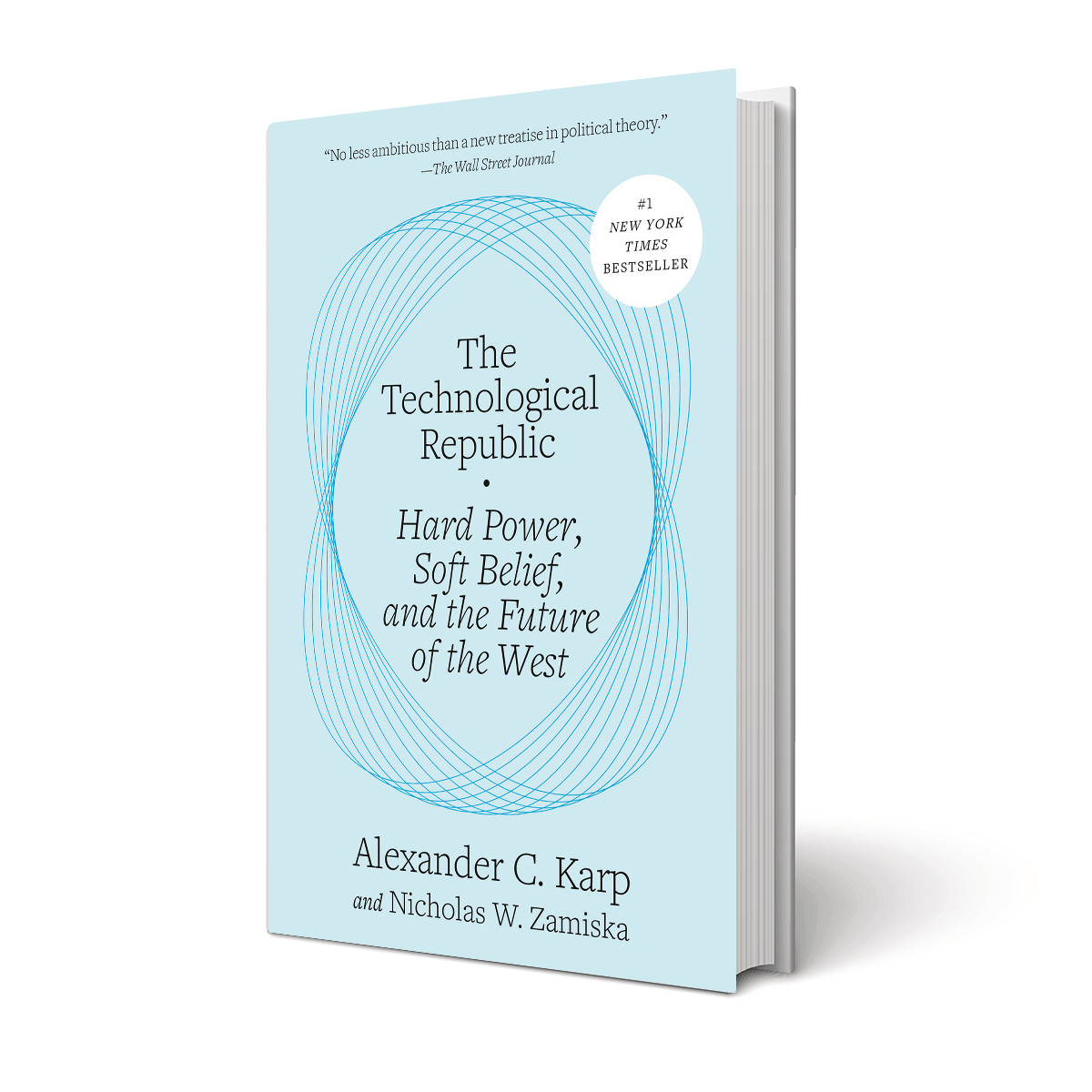
By Alexander C. Karp and Nicholas W. Zamiska
(Crown Currency, 2025)
The thought comes to mind that technology replaces magic as part of the larger phenomenon of disenchantment, to use Max Weber’s word from a century ago. There is considerable ambiguity in this naming. On the one hand, the magical powers in Tolkien’s stories are admirable, though not without danger; on the other, Tolkien never reconciled himself to industry or corporations—instead, he wished to remind his readers of an older world that’s somehow more natural. Those fictional powers are now interpreted as moral powers, primarily because these technological corporations are serving patriotic purposes, aiming at peace and prosperity by way of war and labor.
Even if it is worth entertaining these thoughts, one might still dismiss the phenomenon as a cynical exercise in advertising after condemning it as bragging. Yet one cannot reasonably hurry to such conclusions without first considering the implicit argument of these various enterprises: that in 21st-century America, as in The Lord of the Rings, our confidence in humanity has been broken, and it is necessary now to restore it if we are to defend ourselves, that we need inspiration to take tools and weapons to hand.
To entertain seriously the promise held out by these enterprises, let us turn to the only major statement they have offered the reading public by way of a justification, Alexander C. Karp and Nicholas W. Zamiska’s The Technological Republic: Hard Power, Soft Belief, and the Future of the West. Karp is the CEO and one of the founders of Palantir, alongside Peter Thiel, the major writer among our techno-lords, and Joe Lonsdale, another techno-lord and one of the founders of an already famous yet brand-new academic enterprise, the University of Austin, Texas. Moreover, Karp is, unlike most figures in tech, a man with an education, having graduated Stanford Law and earned a Ph.D. in social science at Goethe University in Frankfurt, Germany. His coauthor, Zamiska, is Palantir’s head of corporate affairs and legal counsel to the office of the CEO.
Karp and Zamiska call their work a “political treatise,” which falls into four parts comprising 18 chapters. The major themes are obvious from the titles of the four parts: “The Software Century,” “The Hollowing Out of the American Mind,” “The Engineering Mindset,” and “Rebuilding the Technological Republic.” I will focus on the second part in this review, since it is, properly speaking, the intellectual part. But first I will try to establish the context.

The major claim of the work is the prediction that AI technology will transform life to such an extent that it is already necessary to rethink our principles and our organization. Everything will have to change in order for everything to stay the same, to recall the famous phrase from Giuseppe Lampedusa’s The Leopard. Prosperity and peace—recall the Declaration’s ends of just government: safety and happiness—are both dependent on technological innovation, but now, for the first time in our history, the two are very close to convergence. The difference between weapons and other tools has largely disappeared in the era of “dual use” technology, as the difference between peace and war is harder and harder to detect when we talk about digital attacks on digital property. We must make a digital America in order to defend America. As the authors write: “The ability of free and democratic societies to prevail requires something more than moral appeal. It requires hard power, and hard power in this century will be built on software.”
Some change in our virtues is also needed. Since the man of peace and the man of war are increasingly hard to distinguish—for example, we can have children pilot drones in battle like in the novel Ender’s Game—we have to focus on one kind of man, the engineer, that is, the software engineer, who will digitize America. He will be held accountable by popular demands expressed in political choices but will also hold to account the politicians, media, and academics of America as culpably negligent. Witness such works as The Technological Republic:
Indeed, the legitimacy of the American government and democratic regimes around the world will require an increase in economic and technical output that can be achieved only through the more efficient adoption of technology and software. The public will forgive many failures and sins of the political class. But the electorate will not overlook a systemic inability to harness technology for the purpose of effectively delivering the goods and services that are essential to our lives.
Ours is an age of mistrust in elite institutions, public and private. The people are blaming the elites for our recent failures. Karp and Zamiska focus that blame on the core of our regime, which is the higher education system. Hence the allusion to Allan Bloom’s The Closing of the American Mind in the title of part 2 of the “political treatise.” The purpose of the argument laid out over five chapters is to explain the unusual combination of conformism and entertainment that has made for a brainless society in the 21st century, one now vulnerable to systemic crises in national security, global finance, etc.
The design of The Technological Republic is largely historical, looking at the transformations of academia and of elite opinion since the 1960s, with a focus on the collapse of that opinion as it once informed engineering, education, and entertainment. The America that won WWII, the subject of the first part of the essay, was forced to face certain contradictions in victory, because the demands of a Cold War abroad and of freedom at home were in tension—what kind of victory leads to the threat of nuclear annihilation? A loss of confidence in science among liberals, a loss of confidence in industry and technology, and a loss of innocence about mankind all occurred together. American elites lost their innocence once the enormity of the world war dawned on them.
The difference between weapons and other tools has largely disappeared in the era of 'dual use' technology.
Chapters 5, “The Abandonment of Belief,” and 7, “A Balloon Cut Loose,” deal with this civilizational problem in terms of freedom of speech and academic freedom of inquiry, respectively, and they have the very unusual character of focusing on problems of belief. The authors’ academic culprits are figures like Edward Said, whose Orientalism (1978) is shown to have been a match in a powder keg of extraordinary resentment against “Western Civ.” A full-scale attack on Enlightenment, from the putative point of view of “the Other,” was mounted from the very precincts of Enlightenment. A “free speech” liberalism that had previously understood itself as superior to and victorious over Nazism turned incredibly censorious and punitive,—indeed, self-destructive. In short, belief in Progress, and hence in the superiority of Western Civ over other ways of life, collapsed.
Karp and Zamiska detail the abandonment of rationalism in academia and among the liberal elites it fosters because they are interested in the project of liberal individualism. The authors are extremely sensitive to shifts in rhetoric and association among liberal elites because they are outsiders looking for ways to protect people like themselves from ideological corruption or punishment. And so they propose a return to the Enlightenment project, which allows quite a bit of eccentricity to unusual men so long as they prove themselves in practical or technical ways to be reliable and useful to the majority—a majority that is itself unlikely to be punitive or overly censorious so long as it enjoys a decent and pleasant way of life. Such unusual men can even become leaders and prove their patriotism in serving the country in moments of crisis, when ordinary opinion is suspended by natural necessities, opening the way to innovation and even offering celebrity to the intelligent among us (think Oppenheimer and Einstein in days of yore).
Chapters 6, “Technological Agnostics,” and 8, “Flawed Systems,” spell out the consequences for technology of that abandonment of principle, whether philosophic or patriotic. The authors fear a certain kind of market worship among technologists, because it implies something deeply unnatural: the focus of incredible intellectual powers on satisfying the most demeaning desires of the largest numbers of people, putting together software and popularity to create mindless entertainments. That way lies stagnation and decadence, consequent to the collapse of Enlightenment, which left clever people nothing but money and popularity to pursue, instead of national projects or inventions that hold the promise of improvement to our way of life. In short, the distinction between the trivial and the important, or between humanity and nothingness, is frittered away in endless plebiscites on what’s new and exciting.
The most interesting or distinctive part of Karp and Zamiska’s argument is their explanation of the consumer internet as a consequence of the anti-patriotic ideology of the 1960s. They make a persuasive historical and psychological case that the great technological founders, including Steve Jobs, and their apostles were too often mired in a skepticism of the state, if not outright hostility, which left them only one way to prove helpful to the American people, or the world as a whole: the satisfaction of private concerns through ever more exquisite consumer identities organized around corporate brands and ecosystems. People who could no longer believe in American exceptionalism turned to a more individualized form of exceptionalism, somewhere between conspicuous consumption and a new oligarchy bent on imposing its tastes on the world, whether as founders or early adopters, through designing the digital experiences available to us all. The Great Society liberals who wanted to control the state were replaced by engineers who wanted to control the “users,” albeit with more subtlety, but at the same time at a much more intimate level, again, making it harder and harder for interesting individuals to emerge.
Technical rationality and patriotism are the cures Karp proposes for the limits of markets and the narcissism that describes most of the software economy.
Finally, chapter 9, “Lost in Toyland,” offers a thematic criticism of the market, focusing on the dotcom bubble, described as the epitome of ’90s nihilism: lots of money chasing bubblegum ideas and ways of life. “The market” is blameworthy because it prefers entertainment to serious endeavors, thus raising flatterers above patriots. True, the bidding competitions that make up voluntary exchange are a great invention of modern liberalism and are at the basis of our peaceful prosperity. Nevertheless the market still poses a threat to self-interest rightly understood, since both the power of getting what you want through expenditure of money and the competition for power with other spenders can derail the original purpose of distributing needful things that are somehow scarce. That’s a failure of patriotism, which then leads to the twin evils of major corporations getting in bed with, among others, China, which is in effect, if not intention, tantamount to treason. Moreover, market speculation on frivolous things distracts attention from and disheartens the few innovators actually trying to offer Americans a better life.
Technical rationality and patriotism are the cures Karp and Zamiska propose for both the limits of markets and the narcissism that describes most of the software economy. The former is proved in the creation of products ratified as useful and therefore valuable by the markets—it is only the making and designing of products that is supposed to be judged by serious people, engineers. The latter is primarily a matter of public figures disputing vigorously the options for improving the lives of most Americans such that the people may finally decide for themselves instead of having their lives managed by media, academia, and regulations.
Academic Enlightenment is thus to be replaced by technical enlightenment. The former is oriented to Progress understood as the promise of perpetual peace, which has turned out to mean stagnation, an end to science, and eventually a tyranny over thought itself—that is, ideological conformity. The latter involves the emergence of a new kind of rationalist, one who reminds us of the origins of modernity, indeed a new kind of ruler, the techno-founder, surrounded by the engineers who work on urgent problems to the satisfaction of the people. Thus, the contours of a new mixed regime emerge, with one, few, and many balanced against each other. One would want to reread Bacon and Descartes to consider whether their revolutionary scientific project can be restarted four centuries later.
As a political treatise, the major thing missing in The Technological Republic is religion; somehow it is involved in both the insistence on belief and the criticism of market worship and the confidence in popular opinion, but it is not discussed thematically. A sequel to the work would have to show how Christian faith can measure up against the challenge of an AI society. So also an analysis of this human type, the engineer, would have to include religion. An explanation is necessary of engineering philanthropy, literally love of human beings, as a motive, as well as the soul as a power of withstanding or opposing conformism and decadence. Moreover, since the politics under discussion is American, that religion will be Christianity as the religion of the majority.
