

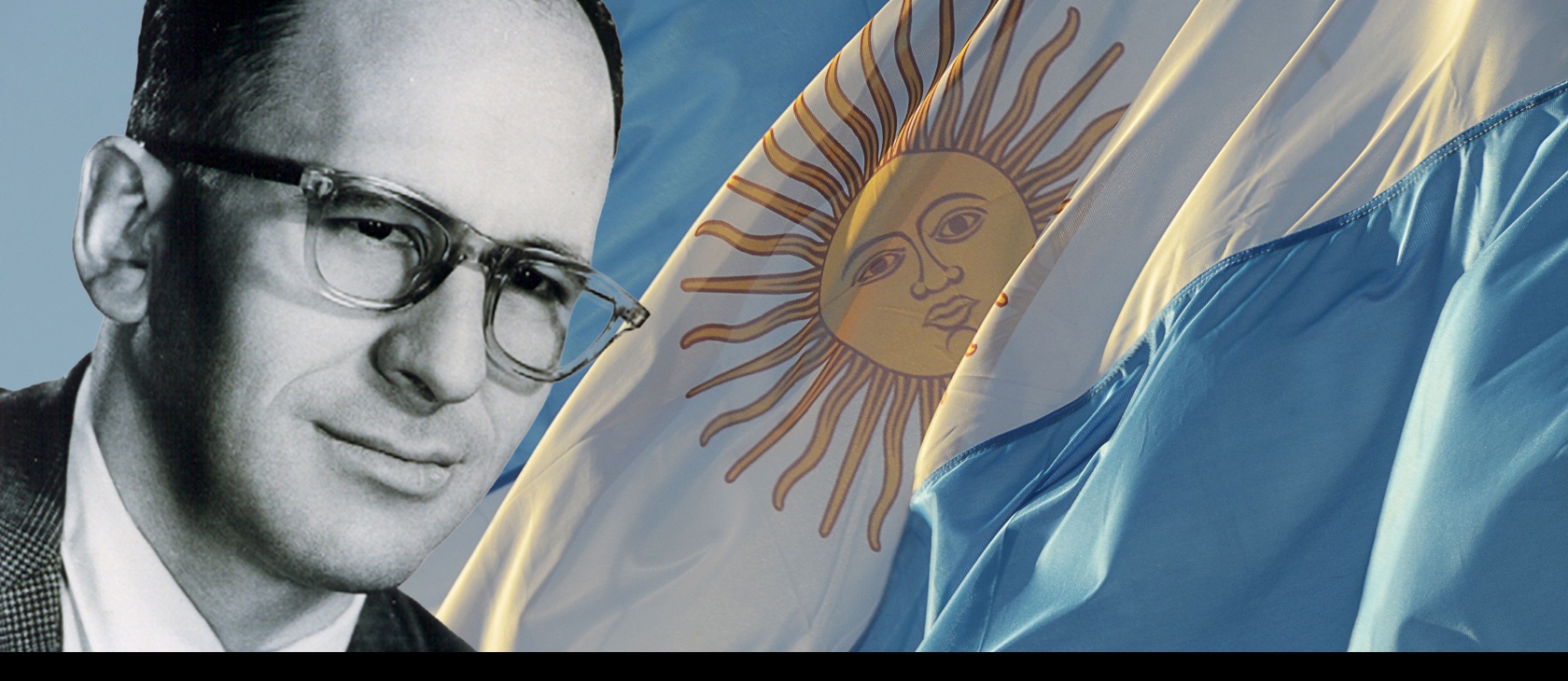
On December 18, 2025, Pope Leo XIV signed the authorization for the beatification cause of the notable Argentine businessman Enrique Shaw (1921–1962). In the event Shaw continues his path to the altars, he would be the first businessman saint in the history of the Catholic Church. To support this beatification process, testimonies were heard from people who knew him as he lived out his various vocations during difficult times: from business colleagues and employees, to family, friends, and the faithful who trust in his intercession. We believe that in addition to this important recognition of his path of holiness, Shaw’s life and work provide much instruction for Catholics and non-Catholics alike today.
Shaw received a careful Catholic education at the special request of his mother, Sara Tornquist Altgelt, when she was near death (she passed away when he was only four years old). After finishing school, Shaw decided on a naval career, ignoring the expectation that he would dedicate himself to the management of some of the numerous family businesses. At the Naval Academy and in his first responsibilities as an officer, he soon stood out for his high qualifications and leadership skills. Through his visible concerns for his subordinates and colleagues, it became evident that, despite coming from a prominent social position, Shaw always had a singular empathy for those who were in a different condition, a sensitivity inclined toward fraternity and helping others, which was clearly associated with a deep Christian conviction.
Toward the end of the Second World War, Shaw was sent by the Argentine navy to Chicago State University to study meteorology. Despite this somewhat narrow academic focus, Shaw was a man of vast culture and extensive readings and reflections, including in Catholic Social Doctrine, all of which he recorded in notebooks (now archived at the Catholic University of Argentina). Despite his college major, he thought about becoming a factory worker so he could spread the faith among other laborers. But Monsignor Reynold Hillenbrand, pastor of Sacred Heart Church in Hubbard Woods, Illinois, suggested that the place to best develop his vocation was in one of the companies to which members of Shaw’s family frequently invited him to join. He finally decided to accept one of these offers, resigned from the navy, and returned to Buenos Aires to work in the Rigolleau glassworks, a company founded by an uncle of his wife, Cecilia Bunge, whom he married in 1943.
Shaw worked intensely for the glassworks company, holding several positions until he became its CEO; in addition, he created or helped found other businesses and became a member of the boards of directors of many others. Through all these responsibilities, Shaw strove to create a community between owners, managers, and employees and was driven by ideas and experiences broadly in line with postwar Christian humanism, such as the democratic neo-Thomism of Jaques Maritain and the concept of the social market economy, which combined free market capitalism with a socially conscious welfare state.
He was able to combine business efficiency—through innovation and technological advances—with concern for the well-being of workers and their families.
This meant, in a way advanced for his time, promoting workers and supporting them to grow in autonomy. In this way he was able to combine business efficiency—through innovation and technological advances—with concern for the well-being of workers and their families. As just two examples: He created a pension fund and a healthcare plan to provide medical services and financial support in the event workers experienced severe illness or enjoyed the birth of children. And in several cases he promoted the creation of new businesses for workers who were destined to become unemployed due to Rigolleau restructuring. Thanks to Shaw’s support, these new firms grew to become new suppliers for the glassworks company, creating in the course of time a cluster of vibrant businesses in the area where the main plant was located in Buenos Aires.
And
This naturally created tensions and conflicts within the companies Shaw was associated with as well. One of Shaw’s biographers, Ambrosio Romero Carranza, quotes from Shaw’s notes at the time: “How lonely I found myself then in my work as a company leader, I felt alone, misunderstood.”
This goal to bring together, despite contrasting views, the members of the company to fulfill a joint mission was also by Shaw’s lights a contribution to the common good of the nation. In this regard, Shaw advanced the cause of what today we would call “corporate social responsibility”—improved consumer service, healthy but fair competition, and good treatment of employees. In addition, he tried to collaborate with civil society and to improve Argentina’s institutions within a subsidiary vision of the state. To cite some examples, he actively participated in the Argentine Industrial Union (UIA), was the main promoter of the Family Wage Law, collaborated in the creation of the Catholic University of Argentina (as its first treasurer), and was founder of the Christian Association of Business Leaders of Argentina (ACDE).
Shaw advanced the cause of what today we would call "corporate social responsibility."
While pursuing these manifold tasks, to which he dedicated his short and fruitful life, Shaw faced down all obstacles and challenges. As mentioned above, the Rigolleau glass products company underwent a major restructuring. The measure was considered necessary to come to terms with a major shift in the business—the movement away from glass and to plastics. The reconversion plan (or what we could call “downsizing”) meant the dismissal of a significant portion of the workers. What no one knew at the time was that Shaw was battling cancer. Yet despite this, he traveled to the United States to meet with majority partners such as the Corning Glass company to persuade them of an alternative to letting workers go. Unfortunately he died before he was able to put his plan into action. He was 41.
Enrique Shaw left us the example of a man of action, founded on prudence and wisdom, deep prayer and assiduous religious practice. A businessman who sought efficiency, innovation, and fair remuneration among all participants in the company, but always with an eye toward the eternal and oriented to the common good. It should be noted that when his cancer became common knowledge, the number of workers who lined up to donate blood astounded medical workers! Whether or not he is finally declared a saint, Enrique Shaw remains a model for anyone seeking both to do good and to do well.