



“I have been on paid staff at three Baptist churches,” writes Ryan P. Burge in his latest book, The Vanishing Church: How the Hollowing Out of Moderate Congregations Is Hurting Democracy, Faith, and Us. “At this moment,” he continues, “two of the three [churches] have closed their doors and the third is about 80 percent smaller than when I was attending services there two decades ago.” As a seasoned social scientist and former pastor, Burge has spent his career analyzing the critical state of the church in America. But this has been no mere academic exercise; Burge’s work has been part of his personal journey. Many pastors can identify with his struggles. Across America, a great ecclesial restructuring is happening as older mainline congregations are dying and evangelicals are sorting themselves into churches that share their personal convictions. “American religion,” Burge argues, “has become an ‘all or none’ proposition—conservative evangelical religion or none at all.” This zero-sum conservative religious turn has, in his view, pressed evangelical churches to the fringes, leaving “tens of millions of theological and political moderates with no place to find community and spiritual edification, or to work collectively to solve societal problems.”
The mainline churches are collapsing and evangelical churches are splitting, ostensibly because of politics. The moderates all seem to have fled. Can those churches win them back? But weren’t they part of the problem to begin with?
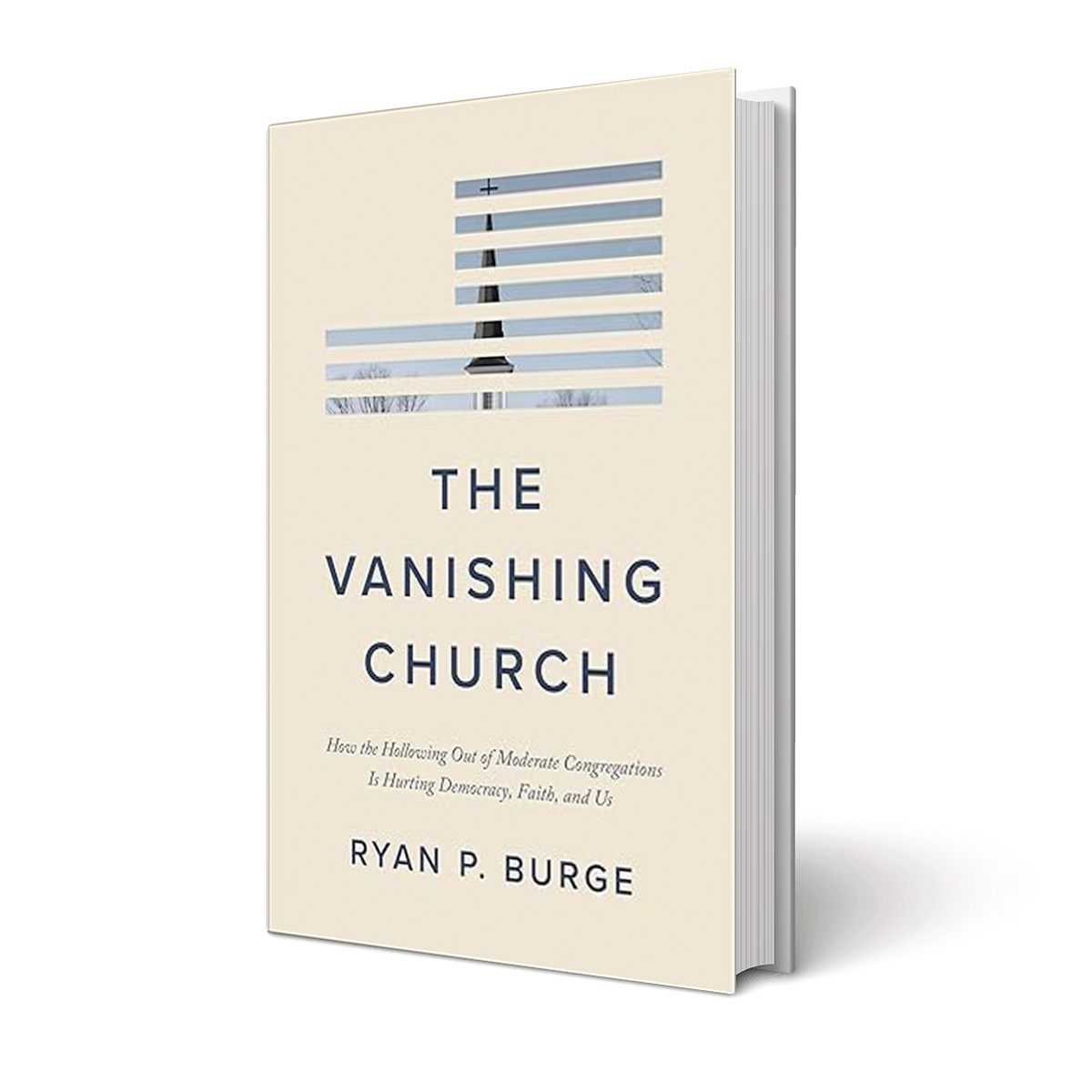
By Ryan P. Burge
(Brazos Press, 2026)
As a former pastor among mainline communities, Burge is nostalgic for this vision of the church that was open and welcoming of diverse views. The churches where he served always emphasized “the middle path,” one that refused to take strong positions on ecclesiology or controversial social issues. In the mainlines, every believer got to “make up their own mind about how to interpret the Bible” and appreciated that it was not the pastor’s job “to tell them what to think.” The mainline moderates were “sensible, pragmatic, and unifying,” the place where reasonable people held positions of ecclesial and political influence. Among the mainline, “pastors didn’t yell about eternal damnation every Sunday but instead focused on encouraging congregants to love their neighbors and make the world a bit better for those around them.”
But Burge recognizes that in today’s cultural climate, the “ideological diversity” of the mainline has left its denominations on the verge of collapse. The dramatic decline of the mainline churches is remarkable. In 1987 the “seven sisters,” as Burge terms the seven denominations that make up the mainline, were 24 million strong; as of 2022, only 13.2 million remain. There are no signs that these mainline churches will be able to recover in any meaningful way. He acknowledges that these denominations accelerated their own death by charting the very middle path he speaks of, by “trying to reject the extremes of evangelical Christianity on the one hand while also resisting the pull toward no religion on the other.” The center, even in the mainline, could not hold. “Striving for a tradition that welcomes all viewpoints and political proclivities may represent a deeply held conviction for many proud members of the mainline,” Burge writes, “but it has not proven to be a viable pathway for organizational vitality.”
Meanwhile
In one important section, Burge discusses the differences between religious “belief, behavior, and belonging.” Though religious behavior and belonging have fallen in recent years, religious belief is still pervasive, which means that “for an increasing number of Americans, religion seems to operate as little more than a tribal identity.” He also points to statistics that indicate that weekly worship attendance among evangelicals has dropped in recent years, which signals the rise of the “non-churchgoing evangelical.” There are even some statistics that show a growing number of people in many different religious traditions who identify as “evangelical.” All these studies suggest that the term “evangelical” is becoming more of “a shorthand for people of all faith groups to say, ‘I’m a political conservative.’” If Burge’s assessment is right, this would indicate a growing cultural Christianity among conservatives whose religious commitments are secondary to their political views.
‘For an increasing number of Americans, religion seems to operate as little more than a tribal identity.’
Burge finds the same conservative turn among American Catholics as weekly Mass attendance has declined, an indicator of a fall in religious commitment among Catholic congregants. While the 1970s was the golden age for American Catholicism in terms of Mass attendance (a contention that will baffle many traditional Catholics, who tend to regard the 1950s as the peak of American Catholicism), by 1990 weekly Mass attendance had dropped below 40%, and by 2022 it was sitting at 23%. But this collapse has not stopped the “growing number of very conservative Catholics [from] seeking to push the church to the right on theological and social issues.” Burge notes that the U.S. Conference of Catholic Bishops has made it clear where it believes its members stand on issues related to politics (read: abortion): “Catholicism is going the way of evangelical Christianity—to the right.”
The
Burge suggests that the reason for the rise of the nones is political; the “nones” are coming from the population that identifies as “moderate or liberal.” These political moderates and liberals eventually had no home because conservatives chose political affiliation over religious commitments and church membership. “In essence,” he writes, “the public is sorting itself into camps based not on theological convictions but on partisan affiliation.” The “nones,” then, “feel cast off by the increasing conservatism of American religion.” Burge argues that the church’s ecclesial sorting originates from the work of the Religious Right that “led to a surge in the share of Americans who aligned with an evangelical tradition,” while at the same time “a rapid weakening of other major Protestant denominations … pushed a growing number of Americans, especially young adults, to no longer align with any religious traditional at all.”
Burge does not spend much time reflecting on why the mainline traditions failed. He argues against the “stereotypes of ultraprogressivism” and paints a portrait of the mainline as a “politically diverse religious tradition, with Republicans and Democrats sitting side by side on Sunday morning.” His only substantive assessment for why those denominations failed was that “mainline churches tend to elevate concepts like openness, toleration, and diversity as opposed to narrow dogmas and uniformity,” so they “made it incredibly easy for many members to ‘free ride.’” Conservatives, on the other hand, stressed “strictness” and expected more from their people as a way to screen out “those free riders.”
In
Burge fears that if trends hold, polarization will become more entrenched and moderates will increasingly be pressed to adopt a conservative political viewpoint or abandon the church altogether. He uses the illustration of a high school evangelical who sits next to one student in class that identifies as bisexual and another who is going through a gender transition. As Burge sees it, the only two options for the Christian is to “leave the faith behind entirely” or “dig in your heels and become more steadfast in your resolve to defend your religion to your peers.” Most Americans, according to Burge, exist between the “remnant of religious people” and the “increasing number of zealous nonreligious Americans,” or the nones, and they “don’t fit neatly into either camp.” So Burge calls the modern American moderates to action, encouraging them to learn to “spot fringe beliefs” and to go to church even among those people with whom they have sincere disagreements. He does not, however, make any appeals to moderates to help resurrect the mainline denominations, nor does he challenge the progressives to appreciate the perspectives of conservatives.
Above all, Burge asks his readers to stop dehumanizing one another as they learn to worship alongside all kinds of people. “The pursuit of the ideal church is an exercise in futility,” Burge reminds his readers, as the church is the place where we should gather with people who have a range of political viewpoints. He believes that the average American is often more pragmatic, sensible, and open-minded and that “most religious people are proponents of religious diversity,” so churches that are sensitive to this political diversity will be poised to maintain social stability. If the moderates can rise, perhaps the vanishing church will reappear.
I have followed Burge’s work for many years and always appreciated his analysis. His constant output of charts and graphs provides rich opportunities for reflection on the state of the church in America. Burge’s work, on one hand, serves as a warning about a growing cultural Christianity that adopts conservative political positions without the theological and moral framework for principled reasoning through the practical realities of those positions. Even among conservatives there are prudential disagreements on a host of political issues and Christians should turn back to catechesis so that our theological and moral commitments are shaping our political postures. A mere cultural Christianity also lacks the regular church involvement in the liturgical life of the church that sustains the worshipping community, reinforces the mores that guide the spiritual lives of Christians, and promotes healthy visions of citizenship.
Pastors should not be focused on maintaining political diversity but leading their congregations in accordance with the Scriptures.
On the other hand, Burge’s call for the church to embrace a patent political moderation is not really a helpful perspective either. For all of Burge’s nostalgia, we are living in the world created by the moderates whom Burge laments: They were once the elites who held positions of cultural prominence. As he himself admits, “The mainline used to be the loudest and most influential voice in American Protestant Christianity,” but now “that voice has largely been silenced.” Burge argues that the church is too political—but only in the conservative direction. There is no call for the remaining mainline churches to consider how they might steer their congregations away from “fringe” beliefs to salvage what few churches remain, nor any discussion of the way that progressive views have contributed to the polarization.
The larger issue is that true religious pluralism and social unity cannot be found in shedding our sincerely held religious beliefs but in learning to cooperate with all people and perspectives and seeking solidarity through and with those very theological and moral convictions. I pray for more catechesis, not less, and more Christians active in the public square, always seeking to love their neighbors and investing in their communities and institutions in ways that promote civility.
Nowhere in the book does Burge take issue with any progressive Christian leaders, but he reserves special critiques for conservatives who have failed to promote an openness to a range of political viewpoints in their congregations. Members of evangelical and Catholic clergy “have staked out increasingly conservative positions,” which has pushed out the average moderate American. But pastors should not be focused on maintaining political diversity but on leading their congregations in accordance with the Scriptures and the church’s teaching. In this regard, the tone of the book feels odd; a social scientist with a pastoral background admits that he might be “the least successful Baptist pastor in history,” but then proceeds to offer advice with a “pastoral tone” to help readers grasp how they can “tangibly respond to the concerning trends.” If Burge is offering pastoral counsel, one would expect some appeal to Scripture and the Christian tradition for a way forward, yet I found only one Bible verse in the whole book and little to no reflection on the history of Christian political thought. Any pastors facing their congregation are accountable to God and must appeal to other sources of authority besides social scientific data. The charts and numbers can be a helpful resource to diagnose some cultural trends, but any vision-casting for the people of God needs faithful Christian clergy who lead through the Scriptures with humility and conviction.
Burge’s book reflects the work of a seasoned political scientist trying to grapple with the dramatic shifts in the religious temperament of the country. Things have changed fast. The mainline denominations are dying, evangelicals and Catholics are sorting, and the nones continue to opt out of any ecclesial commitments. I’m not sure where this story goes, but Burge’s book provides a helpful analysis of these important social trends. Whatever happens, I pray that the church can remain faithful to the Scriptures and that the citizens of the city of God living in the city of man can pursue the welfare of the city by building coalitions and seeking solidarity wherever possible … as their theological and moral vision guides them.
