

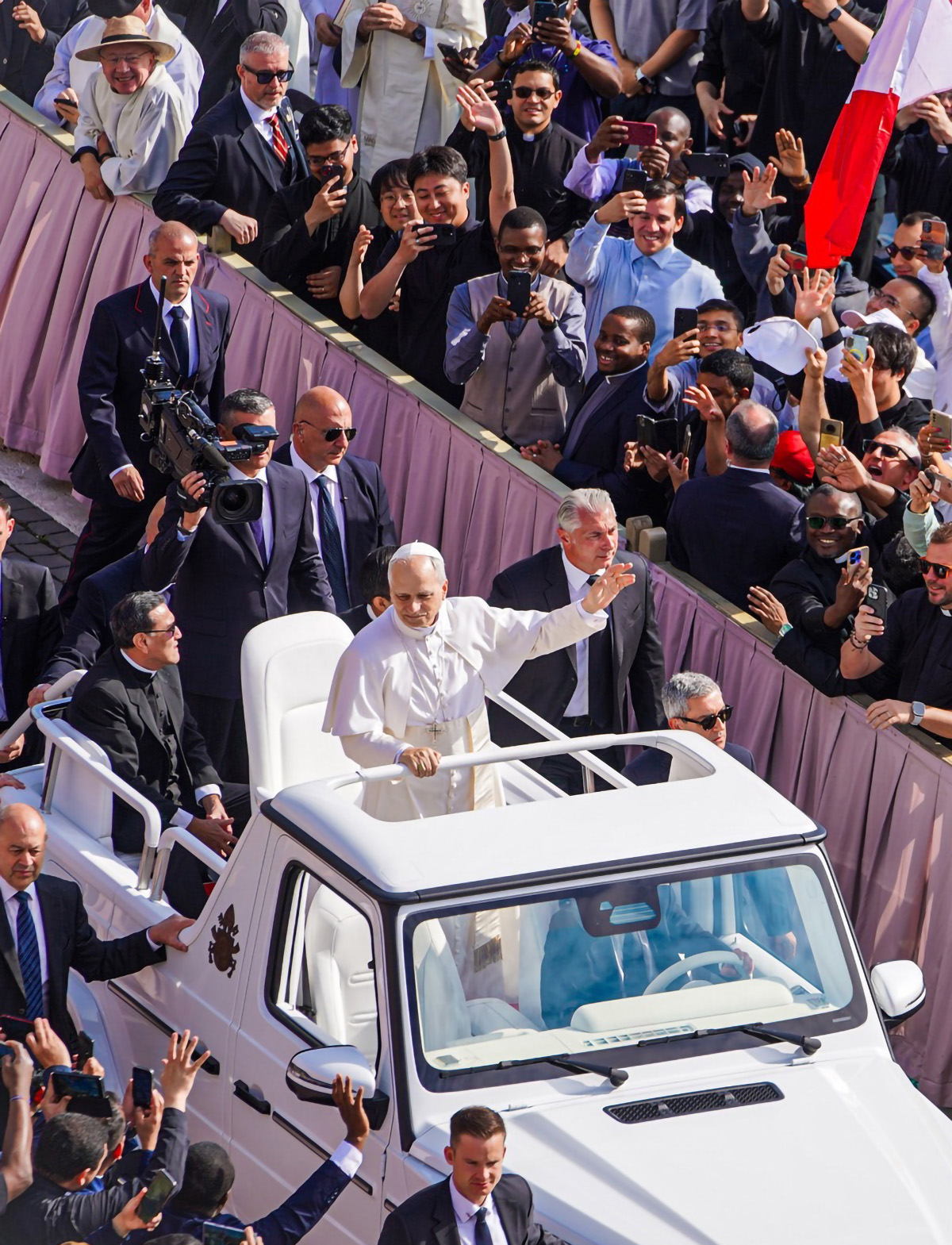
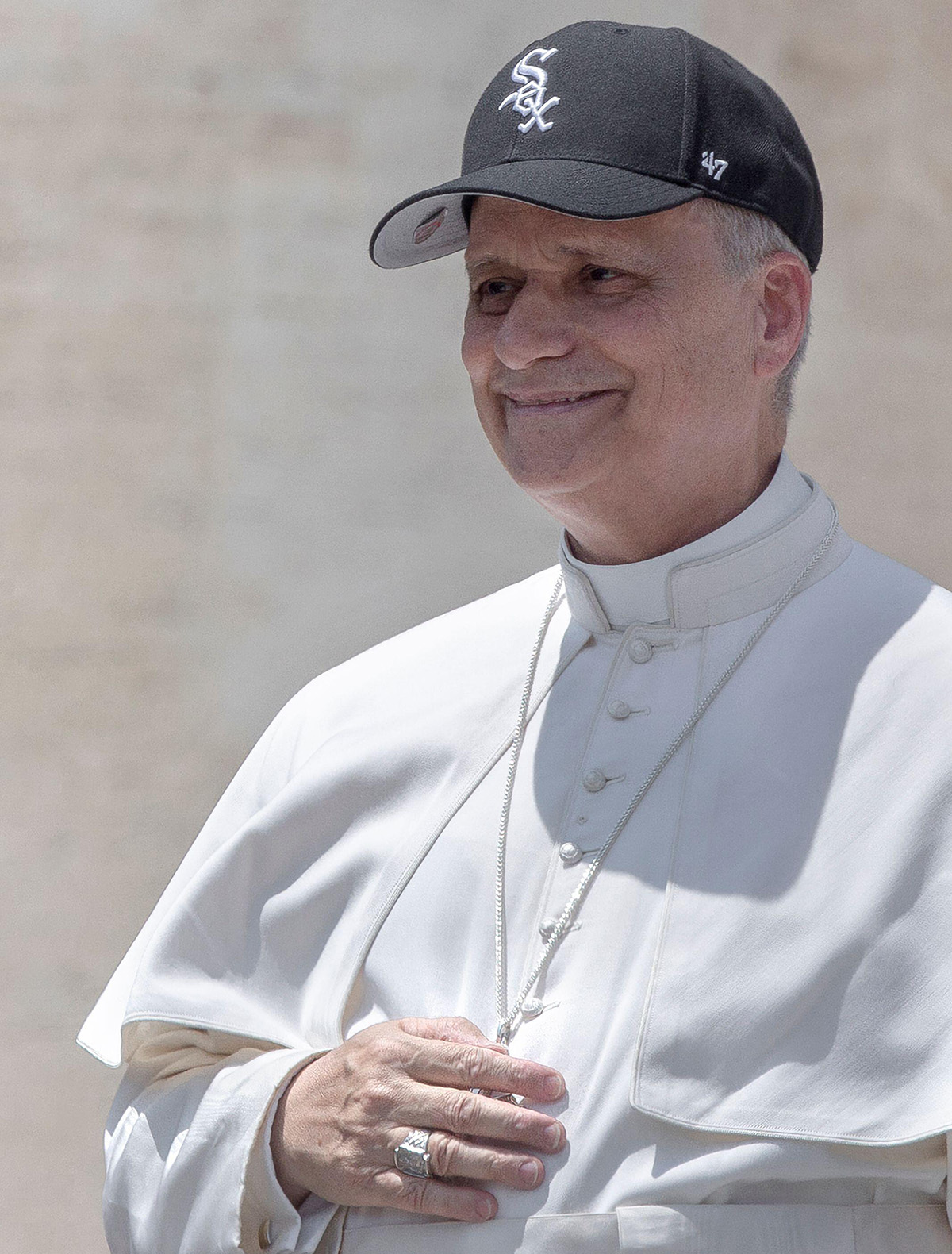
The election of Cardinal Robert Francis Prevost, who took the name Leo XIV, on May 8, 2025, was greeted the world over with nearly universal acclaim. Pope Leo XIV, born on Chicago’s South Side, is the Church’s first American pope and has since greeted delighted crowds by wearing a Chicago White Sox cap to an audience and signed baseballs for the faithful. It is not unusual for a pope to be popular, as he is, according to the Church’s own understanding, “the perpetual and visible principle and foundation of unity of both the bishops and of the faithful” (Lumen Gentium §23).
Pope Leo XIV took the name of a 19th-century predecessor much more sensitive to the nuances of the social sciences of his own day than Pope Francis was to those of our own. This is cause for optimism.
Pope Leo XIV’s immediate predecessor, Pope Francis, was also popular. A few months before his passing on April 21, 2025, the Pew Research Center found that 78% of American Catholics expressed a positive view of Pope Francis; such high favorability ratings are the envy of temporal authorities. Yet Pope Francis had many critics, as did his predecessors—and as will his successor Pope Leo XIV. Toward the end of his earthly life, Pope Francis suffered from ill health and endured several surgeries and hospitalizations. In the months after an intestinal surgery in 2021, Pope Francis visited with some Slovakian Jesuits. One priest asked how he was feeling, and Pope Francis replied, “Still alive, even though some wanted me dead.”
How to reconcile these contraries? The papacy has been seen throughout its nearly two millennia history as not only a visible principle of unity by some but also a visible principle of tyranny by others, either politically, spiritually, or intellectually.
In the late 19th century, as just one example, the pope’s temporal authority over the Papal States in what is now central Italy caused a crisis for many Catholics who felt as Lord Acton describes:
The union of the temporal and of the spiritual authority in the same hand is a bond of union between the enemies of each. That combination of political and religious animosity—of the hatred which is inspired by a legitimate sovereign with the hatred which is felt for the head of the Catholic Church—is the special character of the present movement. As the motives of attack are twofold, so also are the grounds of the defence. The movement cannot be successfully met where its real character is not understood. A religious interest is at stake, but also a political principle. It is the peculiar nature of the crisis that many Catholics are revolutionary, whilst the revolution itself is directed against Catholicism. The opposition offered to the Church on religious grounds has given place to a more vigorous opposition on political grounds. The religious element in a movement originally political is a very significant circumstance, and it is a new one.
The Roman question was settled when the temporal power of Pope Pius IX was removed by force of arms and the Papal States dissolved in 1870. The temporal power of the pope was restored, however, by the 1929 Lateran Treaty, which established Vatican City—a scant 0.17 of a square mile. Only the oddest of oddballs and conspiracy theorists view the pope today as a political tyrant. Popes whose reigns began after the fall of the Papal States, from Leo XIII to Leo XIV, have enjoyed greater esteem as spiritual leaders consequently, and have since sought to influence world affairs by moral force and social teaching rather than force of arms.
While the view of the pope as a political tyrant has been consigned by history to the domain of cranks, the image of the pope as spiritual tyrant lives on both outside and inside the Church. The papacy is at the very heart of the enduring schisms between the Roman Catholic Church and the Orthodox and Protestant churches. The section on the papacy in Martin Luther’s Smalcald Articles is an extreme but not unique, and thus illustrative, example of just how heated these polemics were, and in some more sectarian churches still are: “The Pope is the very Antichrist, who has exalted himself above and opposed himself against Christ because he will not permit Christians to be saved without his power, which, nevertheless, is nothing, and is neither ordained nor commanded by God.”
Thankfully there has been some progress made since the 16th century! Pope St. John XXIII sent invitations to Orthodox and Protestant churches to send observers to the Second Vatican Council. In 1965, Pope St. Paul VI and Ecumenical Patriarch Athenagoras withdrew the exchange of excommunications between earlier churchmen in the Catholic Church and the Ecumenical Patriarchate of Constantinople. During the papacy of Pope St. John Paul II, the Pontifical Council for Promoting Christian Unity and the Lutheran World Federation published the Joint Declaration on the Doctrine of Justification, outlining “a common understanding of our justification by God’s grace through faith in Christ.”
Pope Francis continued and deepened the recent trend in several important ways. On April 11, 2015, he proclaimed St. Gregory of Narek a Doctor of the Church. Doctors of the Church are saints recognized for their immense learning and contributions to the Church’s theology. Pope St. John Paul II, in his 1987 encyclical Redemptoris Mater, praised St. Gregory as “one of the outstanding glories of Armenia,” and Pope Francis hoped to bring more attention to the poet and theologian’s contributions by making him a Doctor of the Church. St. Gregory of Narek is the first and currently only doctor who was never in communion with Rome during his lifetime, as he was a member of the Armenian Apostolic Church. Like other Oriental Orthodox Churches, the Armenian Apostolic Church recognizes only the first three ecumenical councils. In making St. Gregory of Narek a Doctor of the Church, Pope Francis cemented the understanding reached in the 1996 common declaration of Pope St. John Paul II and His Holiness Karekin I, then Supreme Patriarch and Catholicos of All Armenians, that “because of the fundamental common faith in God and in Jesus Christ, the controversies and unhappy divisions which sometimes have followed upon the divergent ways in expressing it, as a result of the present declaration, should not continue to influence the life and witness of the Church today.”
Pope Francis’s commemoration of the 500th anniversary of the Reformation was similarly groundbreaking. This involved a series of events centered on prayer and dialogue. At an event with the moderator and a delegation from the presbyterian Church of Scotland, Pope Francis said:
The past cannot be changed, yet today we at last see one another as God sees us. We are first and foremost his children, reborn in Christ through one baptism, and therefore brothers and sisters. For so long, we regarded one another from afar, all too humanly, harboring suspicion, dwelling on differences and errors, and with hearts intent on recrimination for past wrongs.
The Vatican Philatelic Office went so far as to release a postage stamp commemorating the 500th anniversary of the Protestant Reformation featuring the Lutheran reformers Martin Luther and Philipp Melanchthon kneeling before Christ crucified. During an in-flight press conference, when asked about the planned commemoration, Pope Francis said:
I think that the intentions of Martin Luther were not mistaken. He was a reformer. Perhaps some methods were not correct. But in that time … the Church was not exactly a model to imitate. There was corruption in the Church, there was worldliness, attachment to money, to power ... and this he protested.… Today Lutherans and Catholics, Protestants, all of us agree on the doctrine of justification. On this point, which is very important, he did not err. He made a medicine for the Church.
Nearly 500 years after Martin Luther declared the pope to be “the very Antichrist,” the pope declared Luther to have “made a medicine for the Church”!
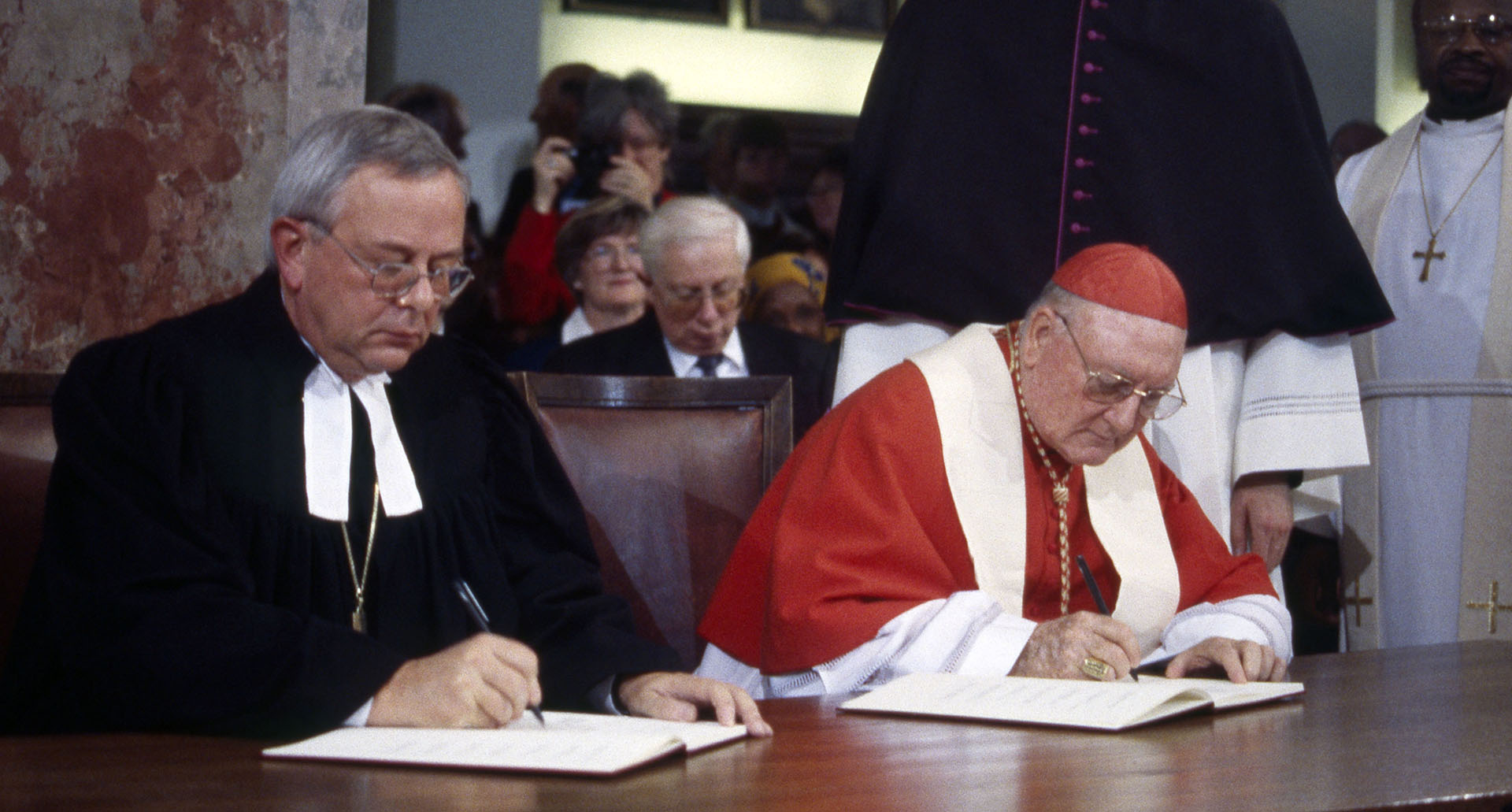
Jointly issued by the Lutheran World Federation and the Pontifical Council for Promoting Christian Unity, the report From Conflict to Communion: Lutheran-Catholic Common Commemoration of the Reformation in 2017 places great stress on the fact that what is remembered of the past and how it is remembered can change. It points to how historical scholarship on the Reformation, by both Protestant and Catholic academics, can serve to give present-day Catholics and Protestants more clarity on the conflict and overcome historic misunderstandings of each other’s divergent ways of expressing faith in Christ. Whether those differences should continue to influence the life and witness of the Church today is still an open question, but Pope Francis created new possibilities for reconciliation.
While Pope Francis commendably modeled a spirit of openness and sought to serve as a visible principle of unity to Christians outside communion with Rome, some within the Church found him less open to Catholic conservatives and traditionalists. The 2016 apostolic exhortation Amoris Laetitia allowed that some civilly divorced and remarried Catholics could receive Holy Communion on a case-by-case basis. When four cardinals submitted a letter containing five questions, dubia (“doubts”), worded to require yes or no responses from the pope, answers were not forthcoming. Pope Francis’s 2021 motu proprio Traditionis Custodes restricted significantly the celebration of the Traditional Latin Mass, which his predecessor Pope Benedict XVI had allowed wider celebration of in his 2007 apostolic letter Summorum Pontificum. Vibrant Catholic communities that had grown in the aftermath of Summorum Pontificum were thrown into uncertainty by Traditionis Custodes, with little or no dialogue prior to its implementation in widely different ways across different dioceses. The 2023 declaration Fiducia Supplicans allowing for Catholic priests to bless couples who are not married according to church teaching, including same-sex couples, polarized the Church along the lines of entire national bishops’ conferences. By the end of his pontificate, many theologically conservative Catholics felt Pope Francis had not provided needed doctrinal clarity, and many Catholic traditionalists felt their own religious communities to be under siege.
Pope Leo XIV will have to deal with both Pope Francis’s positive ecumenical legacy, which left other churches seeing the papacy as more of visible principle of unity, and his negative legacy, which too often left conservative and traditionalist communities experiencing the papacy as a spiritual tyranny rather than a support.
Nearly 500 years after Martin Luther declared the pope to be "the very Antichrist," the pope declared Luther to have "made a medicine for the Church."
In July 2025, Pope Leo XIV met with Orthodox and Catholic clergy from the United States at Castel Gandolfo. Addressing the ecumenical audience, he declared, “Rome, Constantinople and all the other Sees are not called to vie for primacy, lest we risk finding ourselves like the disciples who along the way, even as Jesus was announcing his coming passion, argued about which of them was the greatest.”
Just days after his election, Pope Leo XIV addressed the participants in the Jubilee of Oriental Churches, telling them:
The Church needs you. The contribution that the Christian East can offer us today is immense! We have great need to recover the sense of mystery that remains alive in your liturgies, liturgies that engage the human person in his or her entirety, that sing of the beauty of salvation and evoke a sense of wonder at how God’s majesty embraces our human frailty! It is likewise important to rediscover, especially in the Christian West, a sense of the primacy of God, the importance of mystagogy and the values so typical of Eastern spirituality: constant intercession, penance, fasting, and weeping for one’s own sins and for those of all humanity (penthos)! It is vital, then, that you preserve your traditions without attenuating them, for the sake perhaps of practicality or convenience, lest they be corrupted by the mentality of consumerism and utilitarianism.
Pope Leo XIV’s love and affection for Eastern Rite Catholics and acknowledgment of their unique spirituality’s contribution to the life of the Church should be an encouragement to traditionalists. The pope’s wearing of the mozzetta(a red shoulder cape) and Latin chanting signal also an openness to more traditional elements of the Church’s Latin Rite tradition. While it is early days yet in terms of papacies, Pope Leo XIV nevertheless appears poised to continue and extend the ecumenical orientation of the Church to other Christians while at the same time exercising caring for the Church’s own theological and liturgical heritage.
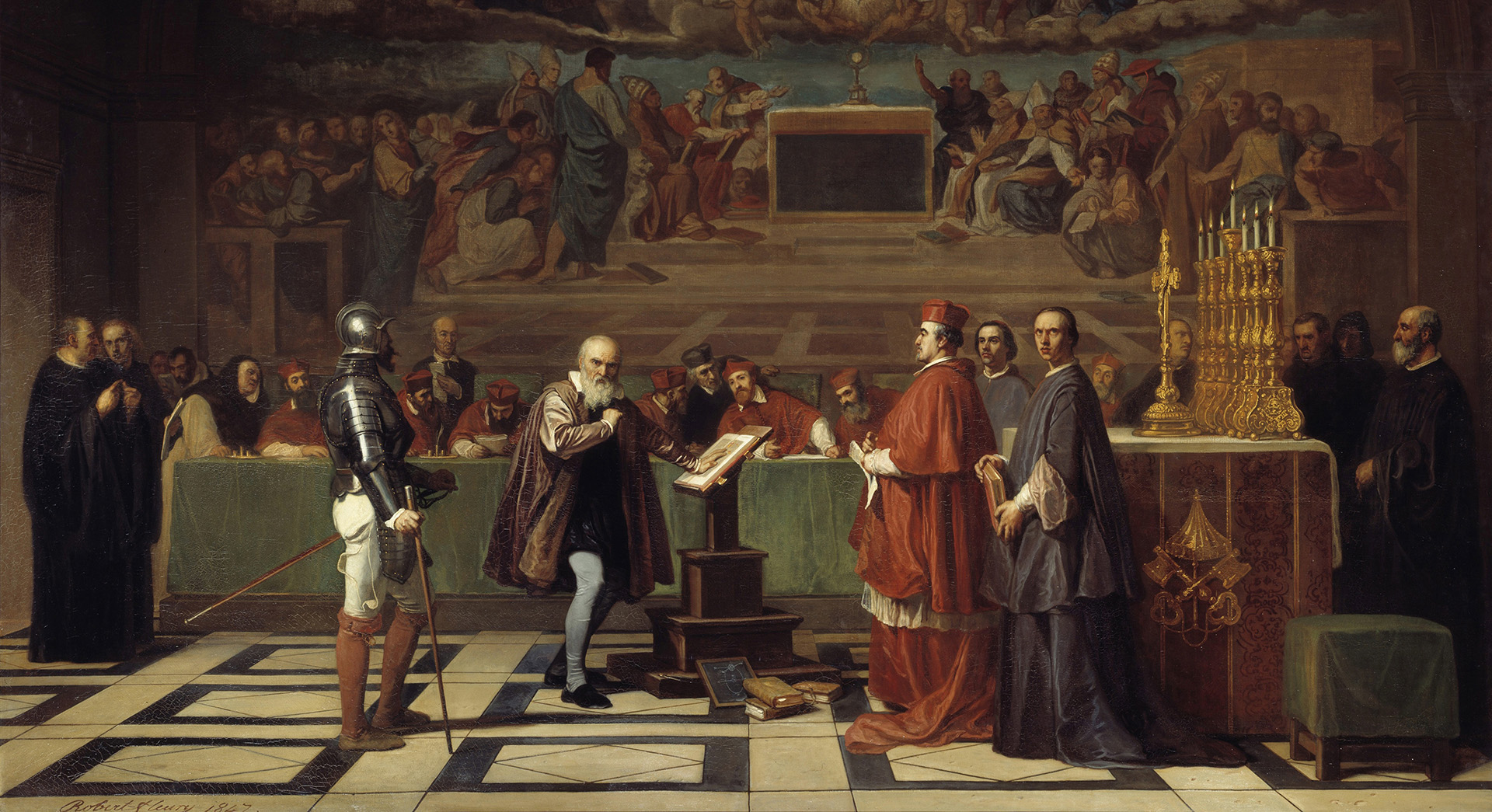
The papacy’s contributions to the intellectual life of the West and the world are staggering. Its cultivation of the arts and sciences is not, however, without blemish. The Galileo affair and the Index Librorum Prohibitorum (Index of Forbidden Books) still loom large in the public imagination, if not in the life of the Church today. Pope St. John Paul II wished to make amends for the actions of his predecessors’ handling of Galileo, arguing:
Thanks to his intuition as a brilliant physicist and by relying on different arguments, Galileo, who practically invented the experimental method, understood why only the sun could function as the centre of the world, as it was then known, that is to say, as a planetary system. The error of the theologians of the time, when they maintained the centrality of the Earth, was to think that our understanding of the physical world’s structure was, in some way, imposed by the literal sense of Sacred Scripture.
While the Church has, in the main, reconciled itself to the natural sciences, the social sciences, especially economics, sometimes still bedevil the papacy. Pope Francis, in his encyclical Laudato si', expressed a sincere desire to engage economics constructively and saw its application as essential to solving real-world problems and securing the common good:
We urgently need a humanism capable of bringing together the different fields of knowledge, including economics, in the service of a more integral and integrating vision. Today, the analysis of environmental problems cannot be separated from the analysis of human, family, work-related and urban contexts, nor from how individuals relate to themselves, which leads in turn to how they relate to others and to the environment. There is an interrelation between ecosystems and between the various spheres of social interaction, demonstrating yet again that “the whole is greater than the part.” (Laudato si' §141)
He nonetheless often devalued and dismissed political economy as a mere “technocratic paradigm” out of touch with the real world, and accused economists of acting in bad faith:
They are less concerned with certain economic theories which today scarcely anybody dares defend, than with their actual operation in the functioning of the economy. They may not affirm such theories with words, but nonetheless support them with their deeds by showing no interest in more balanced levels of production, a better distribution of wealth, concern for the environment and the rights of future generations. Their behaviour shows that for them maximizing profits is enough. Yet by itself the market cannot guarantee integral human development and social inclusion. (Laudato si' §109)
Bad-faith actors exist in the world undoubtedly, and even academia has its fair share of hucksters and confidence men, but as Robert M. Whaples, professor of economics at Wake Forest University, points out in his brilliant introduction to Pope Francis and the Caring Society, the pontiff’s own blind spots are simply too profound for his critique to be credible:
Most baffling of these blind spots is his contention that the levels of poverty—absolute poverty—are not diminishing around the world. In Laudato si', he speaks of “growing poverty” and says that “[t]he exploitation of the planet has already exceeded acceptable limits and we still have not solved the problem of poverty.” (Whaples cites Laudato si' §25 & §27 in a footnote)
Pope Leo XIV’s love and affection for Eastern Rite Catholics should be an encouragement to traditionalists.
It should be noted that Pope Leo XIV has said that the inspiration for his choice of papal name came from Pope Leo XIII, a predecessor much more sensitive to the nuances of the social sciences of his own day than Pope Francis was to those of our own.
Pope Leo XIII was elected pope in 1878. The papacy’s temporal power had been wrested from his predecessor Pius IX a mere eight years earlier. During his quarter-century reign, Leo XIII would write incessantly, trying to give the Church intellectual resources to address the new concerns of a rapidly changing world. He was the first pope ever to have his voice recorded and the first ever to have his movements filmed. He inaugurated the Church’s modern social teaching with his encyclical Rerum Novarum in 1891, in which he sought to address the “new things” of the modern economy by employing the Church’s perennial moral wisdom to empirical categories of the still young discipline of economics, such as “land,” “labor,” and “capital.”
In his first official address to the College of Cardinals, on May 10, 2025, Pope Leo XIV invited them to pray with him, in Latin, the Paternoster and the Ave Maria. He then turned to new things: “In our own day, the Church offers to everyone the treasury of her social teaching in response to another industrial revolution and to developments in the field of artificial intelligence that pose new challenges for the defence of human dignity, justice and labour.”
How this new teaching will unfold, as of this writing, God only knows. Pope Leo XIV’s careful temperament and degree in mathematics give us reason to be optimistic. For the pope to be a visible principle and foundation of unity for the world as it embraces these new challenges would be a powerful witness, but the danger for intellectual tyranny is one against which the Church must be ever vigilant.
We can all be confident, however, that God in his providence will work it all through his Church, however imperfect an instrument, to his purposes and glory. For as the German theologian Karl Adam explains in The Spirit of Catholicism:
It is quite true, Catholicism is a union of contraries. But contraries are not contradictories. Wherever there is life, there you must have conflict and contrary.… For only so is there growth and the continual emergence of new forms. The Gospel of Christ would have been no living gospel, and the seed which He scattered no living seed, if it had remained ever the tiny seed of A. D. 33, and had not struck root, and had not assimilated foreign matter, and had not by the help of this foreign matter grown up into a tree, so that the birds of the air dwell in its branches.