


Christianity has come to Silicon Valley, according to The New York Times (February 11, 2025) and this publication (Summer 2025), thanks in part to local churches teaching how a high-tech profession is a vocation from God. The last two decades have seen a surge of books, conferences, institutes, parachurch ministries, and Bible studies on the connections between Christianity and the workplace. The so-called Faith and Work Movement has become a major strain in contemporary evangelicalism.
Some Protestants and all Marxists oppose the doctrine of vocation. But it’s making a comeback anyway.
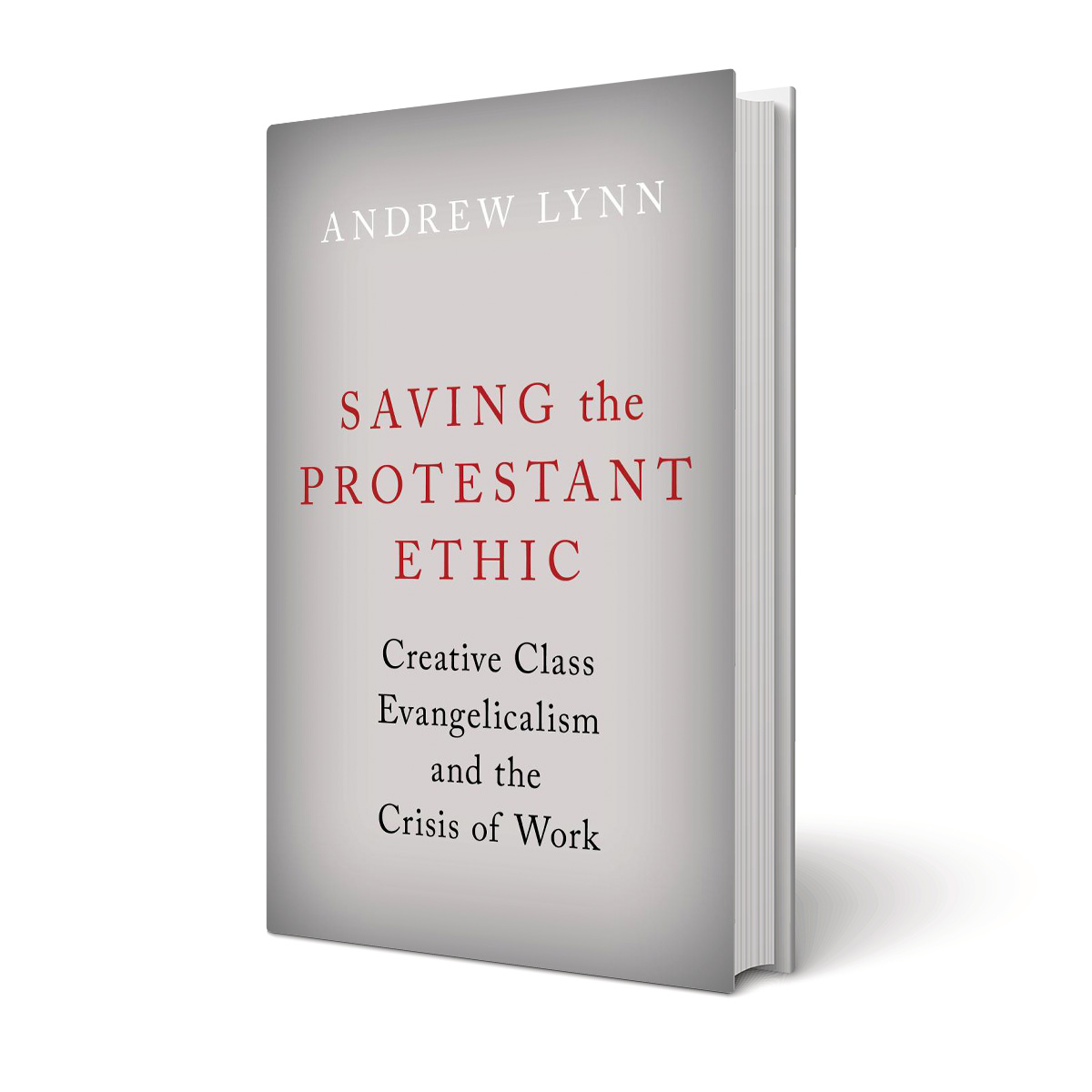
By Andrew Lynn
(Oxford University Press, 2023)
Saving the Protestant Ethic: Creative Class Evangelicalism and the Crisis of Work by sociologist Andrew Lynn is an illuminating study of this movement. But it is also a critique of same that gets tangled up in the obligatory left-wing economics of his profession.
As Lynn shows, from its very beginning Protestantism promoted a positive relationship between faith and work. Luther’s doctrine of vocation taught that God calls all Christians, not just members of religious orders, to productive labor and relationships through which God works to sustain His creation and in which Christians can live out their faith in love and service to their neighbors. Whereas Luther stressed the multiple vocations that Christians have, not just in the workplace but also in the family, the society, and the church, Calvin focused on economic callings. Calvin’s emphasis on the character-forming disciplines of hard work, thrift, and pursuit of the common good inspired generations of industrious, energetic Puritans whose “Protestant work ethic” would turn former peasants into prosperous members of the middle class and contribute to the rise of capitalism.
But what happened to the Reformation doctrine of vocation and the Protestant work ethic? In the late 19th and most of the 20th century, those topics largely disappeared from the sermons and writings of conservative American Protestants.
Here Lynn makes an important contribution by identifying what he calls the “Fundamentalist Work Ethic.” With the Second Great Awakening came Methodist perfectionism, the “deeper Christian life” of the U.K.’s Keswick theology, the dispensationalism of the Scofield Bible, and the premillennial conviction that Christ’s second coming is imminent. All these emphasized the inner spiritual life and explicitly played down the significance of our physical existence in “the world”—which would soon pass away. Lynn marshals evidence from the religious writings of the time that warn against the spiritual dangers of money-making, materialism, and “worldly” ambition.

The Fundamentalist Worth Ethic, though, took another turn that did affirm work, sort of. In these end times, the main priority of Christians must be evangelism. Ministers who preached the gospel full time were seen to have a higher calling, but the highest calling of all was that of the missionaries, who took the gospel to all the world.
This “new clericalism,” as Lynn calls it, influenced the way laypeople saw their work. In their ordinary jobs on the farm, the factory, and the office, laypeople could earn money by which they could support mission work, whether by their local congregations, individual missionaries, or large-scale mission organizations. In that way, ordinary work could help spread the gospel.
Then laypeople realized that their own workplaces were also mission fields! Secular employment was seen as a way to reach people who might never visit a church. Sharing the gospel on the job became paramount. In fact, the first half of the 20th century saw a number of businessmen’s organizations crop up—such as the Gideons and the Full Gospel Business Men’s Fellowship—with the purpose of evangelizing in the business world. A number of books by successful Christian businessmen made the case that God’s work could be carried out in the business world.
According to Lynn, much of 20th-century evangelicalism—including the “neo-evangelicalism” of Billy Graham and the parachurch ministries he inspired—approached work in terms of some version of the Fundamentalist Work Ethic, either saying little about it or valuing it for instrumental purposes, such as evangelism or carrying out other functions of the church.
Today’s Faith and Work Movement, however, emerged out of fresh Christian attempts to engage with culture, associated with American evangelicals’ discovery of the neo-Calvinism of Abraham Kuyper as popularized by Francis Schaeffer. This approach values work in itself as a participation in God’s creation. Lynn describes an “explosion” of books on this topic over the last two decades, averaging 185 every year since 2000. (Full disclosure: I have written three of them, on Luther’s doctrine of vocation and its applications. I honestly did not realize I was part of a movement.)
Saving the Protestant Ethic is itself evidence that sociology is still in thrall to critical theory.
It should be emphasized that Saving the Protestant Ethic is a work of sociology, not theology or history. When Max Weber wrote The Protestant Ethic and the Spirit of Capitalism in 1905, he did a good job of analyzing the origins of capitalism except when he drifted off into theological and psychological speculations. Weber believed that the reason Puritans worked so hard must have been to convince themselves that they were of God’s elect, thinking that success in business was a sign of God’s grace. To his credit, Lynn, citing modern scholarship, dismisses that motive, which lacks both evidence and coherence. (Calvinists believe they are saved by grace, not works, much less economic work.) But instead of accepting theological explanations or reasons given by the people he is studying, Lynn, like Weber, looks to the social sciences for hidden motives.
According to Lynn’s analysis, the fundamentalists who devalued work were largely from the less-educated working class, whose manual labor was deemed meaningless (either by themselves or the larger culture), so they channeled their search for meaning by going within. When businessmen played up their role in evangelism, they were competing for social status with ministers and missionaries. And so we find the real thesis of Lynn’s book: “A key part of the story for the emergence of the faith and work movement is white evangelicalism’s ascension into the realms of knowledge-economy work and creative-class capitalism.”
Lynn stresses that most of the participants in faith and work conferences are well-educated, affluent, successful professionals, as opposed to blue collar workers. Today evangelicals have risen socially, from their unsophisticated rural origins, so that they are now as well educated and affluent as other Americans. Many are in the “knowledge economy” (teachers, researchers, scientists, physicians, lawyers, consultants) and the “creative class” (journalists, engineers, programmers, entrepreneurs, managers, artists). As such, their work is already a source of satisfaction, meaning, and identity. So it is natural for Christians in those fields to want to merge their faith with their work.
In this way of thinking, “vocation” is nothing more than a rationalization for social mobility. But we could ask, how and why are evangelicals now going to universities and pursuing professions they used to dismiss as “worldly”? Maybe they are learning to attend to the talents God has given them and to see their lives in terms of vocation.
The first half of the 20th century saw a number of businessmen’s organizations crop up with the purpose of evangelizing in the business world.
Worth noting is that Saving the Protestant Ethic is itself evidence that sociology is still in thrall to critical theory. Throughout the book, concerns are raised that the Faith and Work Movement is predominantly white, male, and privileged. Worse is the book’s quasi-Marxist hostility to free market capitalism.
One section looks at some of the institutions that support the Faith and Work movement, particularly the Institute for Faith, Work, and Economics; the Kern Family Foundation; and (yes) the Acton Institute. Because these organizations are also committed to free market economics, Lynn classifies them as belonging to the “Corporate Right.” In his description, capitalists appreciate the Faith and Work Movement because it makes for compliant workers who are easier to oppress. Employees who believe their labor is serving God, Lynn argues, will work harder and be less likely to complain about low pay and bad working conditions.
Implicitly adopting Marx’s canard that religion is the opiate of the people, Lynn says that capitalist organizations like the Acton Institute have an interest in promoting a theology that forms workers with “greater docility.” (But I thought the Faith and Work Movement consisted of high-level affluent elites, not the oppressed proletariat!)
The inadequacy of this analysis is evident in one of Lynn’s own examples. He tells about going to a conference funded by the Kern Foundation. The speakers and nearly all the audience were black. (But I thought the Faith and Work Movement was white!) “Several speakers took the stage to speak to issues of inequality or under-resourced urban neighborhoods,” Lynn reports, “but promoted the creation of new businesses rather than structural changes.”
How could anyone in the audience create “structural changes” that would solve the admitted problems of inequality and poverty? Critical theorists insist that such problems are “structural” because they are grounded in America’s alleged “systemic racism.” This implies that, pending a revolution, individuals can do nothing about these problems. Critical theory seeks to raise consciousness, but in practice it dooms disadvantaged minorities to perpetual victimhood. But if these victims are given the tools to create new businesses, they have agency, can improve their economic condition, and can potentially dismantle the “structures” that keep them down.
The Kern Foundation conference included workshops on entrepreneurship, with sessions on making pitches to investors. Far from oppressing their participants, the lessons in free market economics were empowering, not disabling, despite what the critical theorists assume.
A theology with a providential view of economics—that God works through human labor—will naturally be more favorably inclined to free market economics, regulated by an “invisible hand,” than an economic system predicated on class conflict and conspiracies of exploitation. Later, in another context, Lynn quotes a historian on the dysfunctions of fundamentalism:
American fundamentalism had in the early twentieth century become essentially Manichean, perceiving a conflict between good and evil in all arenas. It embodied the “paranoid style” of politics that saw history itself as “a conspiracy, set in motion by demonic forces of almost transcendent power.”
That could also be said of critical theory, which perceives a good-and-evil conflict between the oppressed and oppressors in all arenas, and Marxist economics, which sees history itself as a conspiracy of evil forces with transcendent power! Critical theorists and Marxists evidently have a Fundamentalist Work Ethic.
Lynn appreciates the late Tim Keller’s approach in the Center for Faith and Work sponsored by Redeemer Presbyterian Church, addressing high-powered professionals in Manhattan.
Lynn does have some good things to say about the Faith and Work Movement, however. He recognizes that people do need to think their work is meaningful. He appreciates the late Tim Keller’s approach in the Center for Faith and Work sponsored by Redeemer Presbyterian Church, addressing high-powered professionals in Manhattan. He is intrigued by “Kuyperian Humanism.” He recognizes the importance of recovering “the value of the ordinary.” He is especially taken by the work of Amy L. Sherman, a popular speaker at the conferences, who teaches how Christians can exert a moral influence by promoting justice and shalom (wholeness, peace) in the workplace. As Lynn admits, overturning his own stereotype, she writes for the Acton Institute.
Some of Lynn’s critiques have validity, but they could be met by better theological reflection and delving into the movement’s own Protestant heritage. He calls for doing just that, thinking of the Puritans’ moral zeal, the 19th-century evangelical social reformers, and the economic populism of early evangelicals like William Jennings Bryan. The Faith and Work Movement would do well to go back even further, however, to do more with Martin Luther, the father of both Protestantism and the theology of vocation.
Though Lynn insists that the Faith and Work Movement lacks attention to ethics, Luther teaches not just vocational egalitarianism but that the purpose of all vocations—including employers and political rulers—is to love and serve the neighbors one encounters in each vocation. That imperative can address cases of mistreatment and exploitation and can give to every vocation an ethical, social direction.
Lynn says that the Faith and Work Movement speaks to professionals rather than to blue collar workers. Luther addresses his teaching specifically to peasant farmers, servants, and craftsmen. Lynn also insists that the Faith and Work Movement assumes a separation between the workplace and the home, saying little about unpaid work, tasks within a family, and the work demanded in a home. Luther, writing in a preindustrial age, classifies economic labor under the category of the household—how a family makes its living—and so offers a vocational model of an integrated life.
Thus, saving the true Protestant Ethic is what will finally save the Faith and Work Movement.
