


USA Today announced in April of 2025 that for “three decades, the percentage of Americans who identify as Christian has steadily declined, a trend confirmed by countless studies. For many believers, it has felt like an inevitable slide into cultural irrelevance.” But Zoomers, say the headlines, are headed back to church, and “in a season of overwhelmed news cycles, these religious shifts haven’t received the coverage they should, but they are significant, and they keep coming.” Younger Americans, particularly Gen Z, or Americans born between 1997 and 2012, “are more spiritually curious. Barna research group reports that most Gen Z teens are interested in learning more about Jesus, with younger cohorts leading the way in the growth of new commitments.”
Religion in America has seen its ups and downs throughout the country’s history. Recent statistics show that we’re experiencing a little bit of both now.
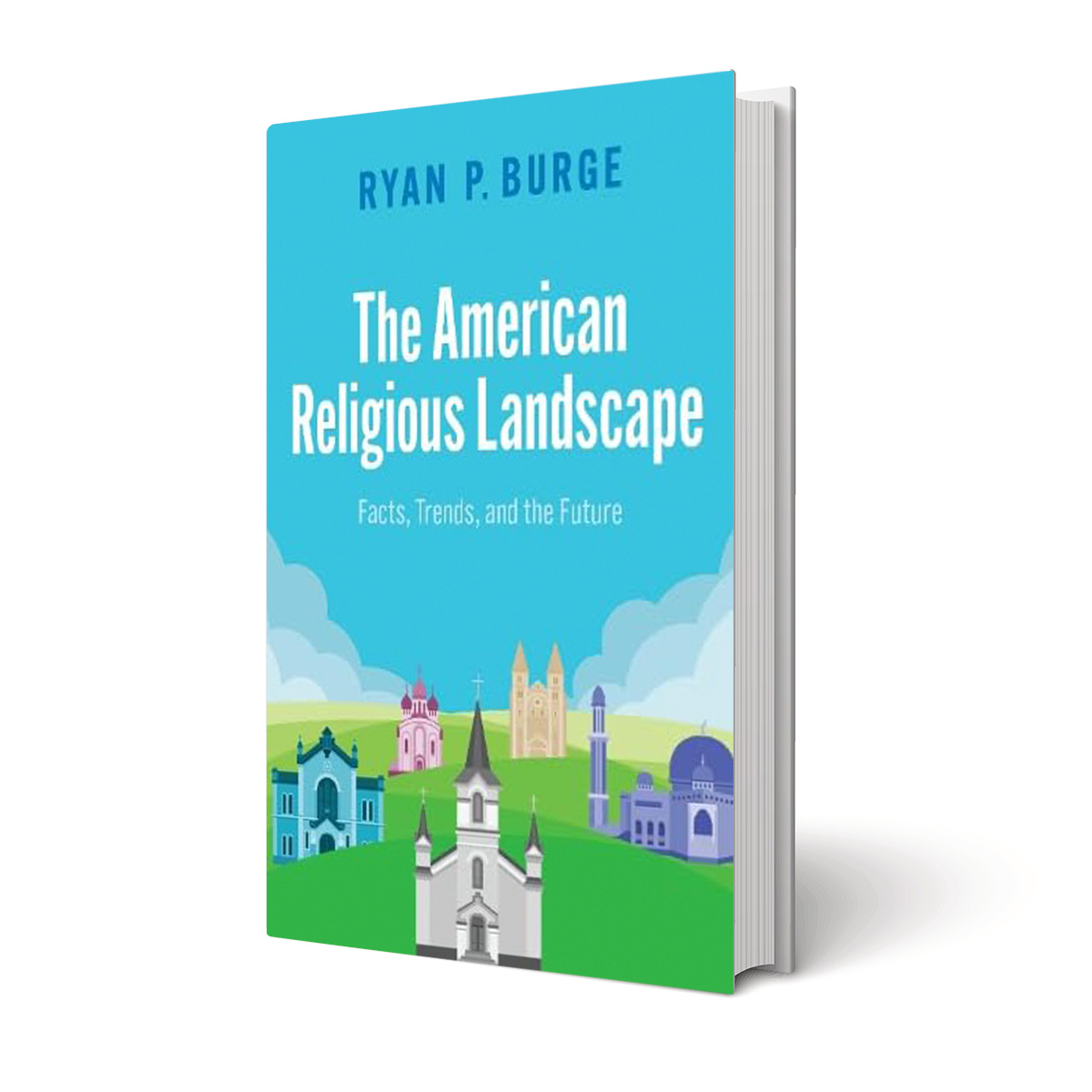
By Ryan P. Burge
(Oxford University Press, 2025)
In May, Axios proclaimed that “Christianity is starting to make a comeback in the U.S. and other western countries, led by young people.” Zoomers, “especially Gen Z men[,] are actually more likely to attend weekly religious services than millennials and even some younger Gen X-ers, Burge’s analysis shows.” Young men “were leading America’s religion resurgence.” Similar articles by Slate, the Barna Group, Vox, The New York Post, and The Guardian propose that a broad resurgence of religion is occurring in the Anglophone world. And almost all of them appeal to the research of Ryan Burge, an ordained Baptist minister and sociologist at Eastern Illinois University who specializes in the study of contemporary religion. Burge’s The American Religious Landscape: Facts, Trends, and the Future tries to give a glimpse of what is happening in the diverse and nearly impossible-to-quantify lives of religious Americans in various Christian denominations, Islam, Hinduism, Judaism, and even the surprisingly religious lives of nonreligious Americans. And what is in fact happening is far more complicated, and interesting, than the headlines would have us believe.
The American Religious Landscape is first and foremost a methodologically conventional work of sociology. It has graphs and charts, but these standard and quantifiable measures are not handicaps. Burge rightly sees them as helpful and trustworthy means to move the American religious experience out of sectarian anecdote. Because the “inherent problem with living in the modern world” tends to be that Americans inhabit a “bubble,” data can help Americans of various religions see outside their bubble. “The average American hardly ever ventures away from their small and trusted circle of family and friends. Many vacation to the same places every year, and if they do take an international trip, it is fairly rare.” Americans, and modern westerners in general, “tend to consume a specific type of media diet that likely confirms their priors, and if they choose to attend a house of worship, they are more often than not surrounded by people who look, believe, and think like they do.” Americans don’t have the ability, “through their own personal experiences, to even begin to understand the rich tapestry that is American life.”
Burge’s work is broken into 15 chapters, which focus on various religious groups in the United States. Evangelicals, mainline Protestants, black Protestants, Orthodox Christians, Roman Catholics, Jews, Latter-day Saints, Muslims, Buddhists, Hindus, atheists, and “nothing in particular” are all covered, in that order. But even the table of contents tells us we are in for more than your average work of sociology. By separating atheists/agnostics from nones, Burge tells us that he’s not letting atheists off the hook; they’re religious, too. It’s a subtle but important marker that Burge is willing to get creative about when exploring American religion, and his readers are all the better for it.
By separating atheists/agnostics from nones, Burge tells us he’s not letting atheists off the hook. They’re religious, too.
The fundamentally important claim that Burge makes in his introduction is that there is no country on the planet that has a religious landscape quite like that of the United States. It is by all measures an economically and socially advanced liberal democracy and among the wealthiest countries on the globe. But unlike other wealthy countries—Burge mentions by way of example Australia, Finland, and Spain—the United States is highly and even intensely religious. “Less than 20% of all Norwegians say that religion is very important to them, the same figure in the United States is 52%.” In fact, American religiosity
rivals countries like Paraguay and Armenia, with GDPs that are $6,153 and $7,018, respectively (2024 USD), while the United States GDP per capita was $76,330. It’s empirically accurate to say that the United States is, in almost every conceivable way, a religious outlier. It is both incredibly religious and incredibly prosperous.
From the outset, its clear that the United States is not a “normal” Western democracy when it comes to religion. Its history also is not “normal.” Burge’s evidence for this is an absolute treat for historians, largely because he cuts through tropes that hang around the internet, work watercoolers, and church donut hour. The American South, for example, was historically the least churched part of the United States until the blossoming of evangelical religion in the middle of the 19th century. Perhaps more important for modern historians and sociologists is data Burge uses to show that the United States only became a hyper-religious society at the beginning of the 20th century. Readers looking for a historical golden age of American religion, when a Christian and moral nation flourished untainted by outsiders, will find the reality presented by Burge’s work undoubtedly disappointing.
While many more traditional Christians seem interested in reclaiming an idealized Christian past, it is Burge’s work on evangelicals that no doubt will drive interest in this book. Burge to his credit is self-aware enough to recognize that interest in evangelicals is such that he put the chapter on them first in the book. “There may be no more discussed religious movement in the United States today than evangelical Christianity. It’s hard to discount the influence that evangelicals have had on every aspect of American culture, society, and politics.” Burge documents carefully the intense growth of evangelical churches in the last half of the 20th century. From a marginalized group of Fundamentalist-adjacent Protestant outliers, they became by 2000 arguably the most culturally, socially, and politically influential American religious demographic. The intensity of evangelical churches is matched by the movement’s inherent instability. From a high of nearly 30% of the U.S. population, the movement has lost 1/5 of its adherents in the first two decades of the 21st century.
Roman Catholics offer a picture of success and stability in the latter part of the 20th century compared to evangelicals, even if they never reached the same heights of influence. But the 21st century has been harder on Roman Catholics than on evangelicals. While the particular ecclesiology of the Roman Catholic Church makes their claim to 62 million U.S. members institutionally valid, the number of people attending Mass once a week in the United States has plummeted in the last half century, from nearly 50% of Catholics to 24%. “Simply stated,” says Burge, “a Catholic today is half as likely to attend weekly Mass compared to a Catholic in the 1970s.” Roman Catholic America is likewise plagued, or blessed, as it were, by the enduring phenomenon of cultural Catholicism that allows nonattending Catholics to admit the importance of Catholic social mores, even if they do not personally attend Mass. “If the Cultural Catholicism phenomenon is true, it’s reasonable to assume that there is a bigger share of never or seldom attending Catholics compared to Protestants.”
The American South was historically the least churched part of the United States until the blossoming of evangelical religion in the middle of the 19th century.
Other chapters in the book will undoubtedly interest social scientists, religious leaders, and educated laypeople. Burge’s data is important precisely because it cuts through the sensationalism of headlines, even ones that appeal to his work. There is, for example, and contra right-wing pastors and politicos, no Muslim takeover of the United States. The percentage of the United States that is Muslim is largely stable. What has happened is that Muslim Americans are more geographically diffuse than they were at the beginning of the century, largely because they now participate in sunbelt suburbanization. America Muslims have thus expanded their geographic footprint while simultaneously becoming more like suburban Americans. American Islam is small, stable, and increasingly American.
The darkest story in Burge’s work is the decline of mainline Protestantism. In 1950, the Protestant mainline firmly controlled almost every major cultural, social, and political institution. But in the 21st century, Burge notes, “the continued existence of mainline Protestant Christianity is very much in doubt. The denominations that provide the foundation for this faith tradition are shedding members at a rapid rate, and the number of young families in mainline churches is shrinking with each year that passes.” The only remaining “viable path forward relies on conversion rather than retention—a challenging pursuit in an American climate that is becoming increasingly secular with each year. For decades, the mainline has offered a theological and cultural counterbalance to the conservatism espoused by their evangelical cousins.” The scales of American Christianity, Burge argues, “are continuing to tip to the right as the membership of the mainline continues to vanish, while evangelicalism is holding steady.”
Readers might knock Burge for a reductionist liberal/conservative or right/left when it comes to the respective taxonomies of theology and politics, but he’s not writing a work of history or a theological treatise. He has written a work of sociology and delivered a small masterpiece. The only criticism that might be offered is that Burge never addresses that strange group of Protestants that are neither fully evangelical nor fully mainline. Conservative Anglicans, the Lutheran Church–Missouri Synod, Wisconsin Synod Lutherans, and the NAPARC Presbyterian denominations are not statistically large, but they nonetheless deserve some coverage. That said, Burge’s book is excellent, and without a doubt the best book on contemporary religion available to scholars, religious leaders, and laypeople. The charts and graphs interspersed throughout are easy to understand, and the author is a fantastic writer who makes numbers tell a story that is both interesting and important. One hopes for more from Ryan Burge in the coming years.
