


Helen Rhee has done a great service with her slim volume Wealth and Poverty in Early Christianity. This collection of primary sources from the Church Fathers’ teachings on money, lending, justice, mercy, and almsgiving contributes to a growing list of such handbooks. Anyone wanting to teach a course or simply educate oneself in the Fathers’ wisdom about stewarding the resources of creation has an abundant storehouse to draw from, even as more undoubtedly could be added in years to come.
Helping the poor means more than merely giving hand-outs. It also means making friends.
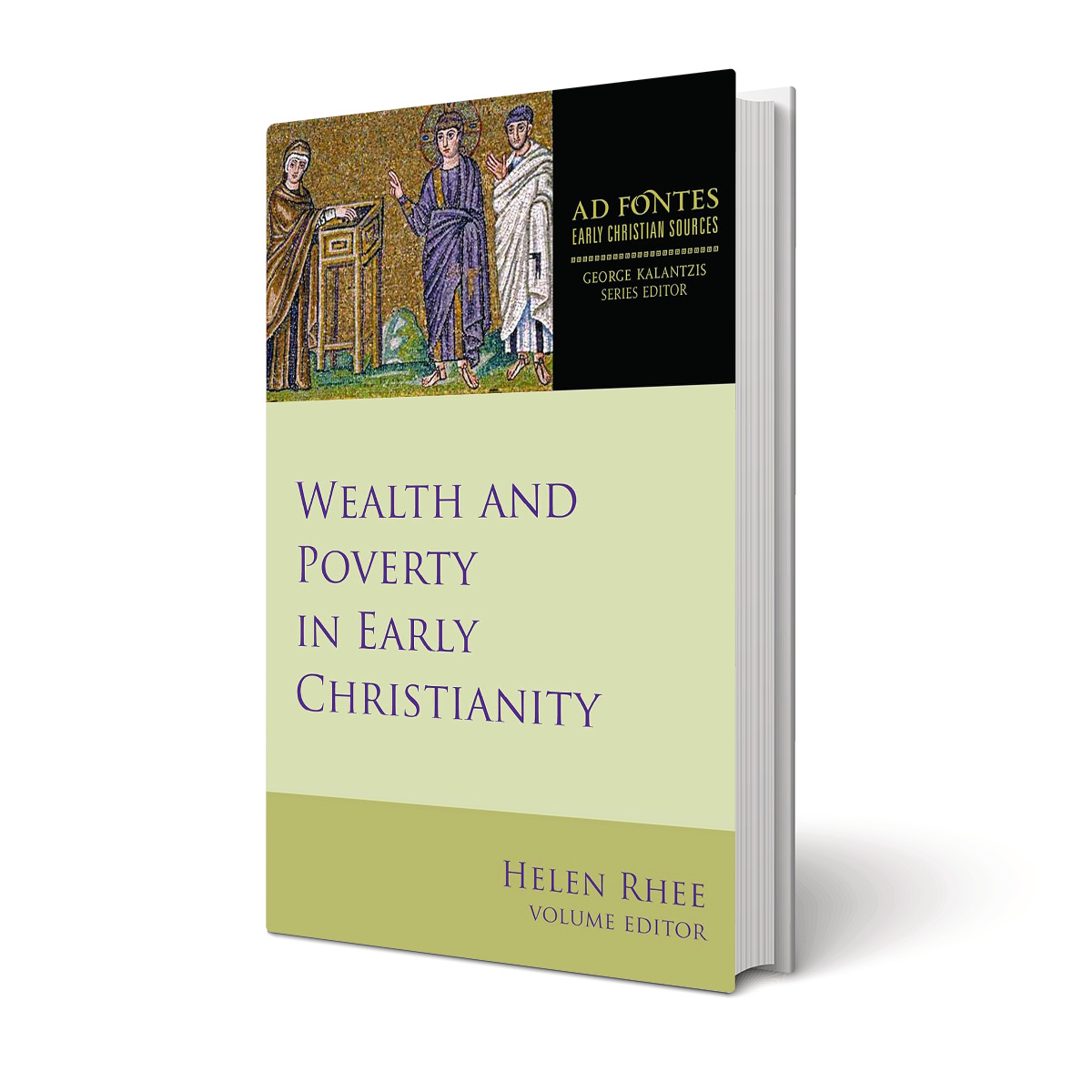
Edited by Helen Rhee
(Fortress Press, 2017)
Rhee corrects naïve readings of the Scriptures and the Fathers as “communist” immediately from her introduction: The common sharing of resources and distribution to the needy in Acts 2 and 4 “hardly suggests that these assemblies practiced ‘communism’ in an anachronistic, modern political-economic sense.” Indeed, Rhee contextualizes these primary sources with a summary of the economic conditions of the Roman Empire. In short:
The Roman socioeconomic hierarchy consisted of imperial and aristocratic elites (1–3 percent), a middle group with moderate surplus resources (7–15 percent), and the “poor,” who were either stable near subsistence (22–27 percent), at subsistence (30–40 percent), or below subsistence (25–28 percent).
Thus, the “rich” are most commonly men with large estates and inherited wealth in a society that heavily privileged such patresfamilias. The “middle group” would be closer to middle class businesspeople today. No doubt some exhortations of the Fathers also applied to them, but understanding this difference alone keeps us from “anachronistic” applications.
While many themes are woven through these texts dating from the second to fifth centuries, a sampling of three prominent touchpoints demonstrates the treasures—and challenges—such teachings offer us even today. In particular, Rhee’s collection draws readers to reflect on the true value of riches, the role of friendship, and the sin of usury. The world may be different in the 21st century, but these teachings retain their value like a pearl of great price hidden in a field, for which a man might sell all he has to obtain it.

According to Clement of Alexandria, “An instrument, used with skill, produces a work of art, but it is not the instrument’s fault if it is used wrongly. Wealth is such an instrument.” The Fathers consistently side with the Stoics in claiming that wealth is “neither good nor evil in itself.” Its good or evil depends on whether it is used for righteousness or sin.
Conversely, true riches are not found in material wealth. As Lactantius taught, “No one is poor in God’s sight except the one lacking justice; no one is rich except the one full of virtues.” Lactantius challenges his readers, furthermore, not to separate justice and mercy—for as a matter of piety, Christians at least owe a debt to God to give to those who otherwise could make no claim on their resources. Yet one must always remember that the Fathers were trained in rhetoric. Sometimes they speak in absolute terms to shock complacent hearers into action. Despite his strong rhetoric, Lactantius nevertheless concludes, “Do not think that you are being advised to reduce or exhaust your property now, but rather to convert to better uses what you would spend on excesses.”
So, too, St. Basil bitingly exhorts his hearers thus: “The bread in your board belongs to the hungry; the cloak in your wardrobe belongs to the naked; the shoes you let rot belong to the barefoot; the money in your vaults belongs to the destitute. All you might help and do not—to all these you are doing wrong.” Yet he, too, understood this with more nuance than is often portrayed, which, thanks to Rhee, one can see in this same volume: “The Lord’s command does not teach that we have to reject and flee from possessions as though they are bad, but that we should administer them.” Our modern world has not dispensed with the need for moderation or the shunning of luxury. Indeed, we need to hear these exhortations all the more, and more such challenging but balanced teachings can be found in this volume from St. Gregory Nazianzus, St. John Chrysostom, and many others.
The role of friendship may not be the most prominent theme in Rhee’s collection, but in a world plagued by what Pope Benedict XVI called a “market-plus-State” binary that “is corrosive of society,” renewed reflection on the social role of friendship and similar voluntary associations retains its relevance for us today.
Lending at interest was condemned as usury because it was used to 'trade on other persons' calamities.'
Commenting on Christ’s teaching to “make friends for yourselves by unrighteous mammon” (Luke 16:9), Clement of Alexandria helpfully reminds us, “The Lord did not say, ‘Give,’ ‘provide,’ ‘do good,’ or ‘help,’ but ‘make a friend.’” What does this mean? He continues: “But a friend is made not by a one-time gift, but by lasting relief and companionship.” No one becomes unwillingly homeless, for example, who has friends and family to fall back on. Indeed, one of the most common ways the Bible refers to the poor is “the foreigner, the fatherless, and the widow”—three groups of people defined by the privation of their social relations. The poor may need charity or jobs or justice, but they need good friends even more.
Moreover, St. Augustine, who is particularly nuanced in his treatment of wealth and poverty, writes to the widow Proba that “one’s personal safety and friendship are desired for their own sake, whereas a sufficiency of the necessities of life is usually sought—when it is properly sought—for the two reasons mentioned above, not for its own sake.” He continues this line of thought by reflecting on the importance of friendship: “Friendship is not confined by narrow limits; it includes all those to whom love and affection are due although it goes out more readily to some, more slowly to others; but it reaches even to our enemies, for whom we are commanded to pray.”
In illustration of this, Rhee’s excerpts from the Life of Mar Rabbula of Edessa note how the power of peer influence over friends endures after one’s death:
As soon as his friends hear the sweet name of Rabbula, love of him is inflamed in their hearts. Their compassion bubbles up and they give alms. The recipient rejoices, and the giver is helped, and God is praised as, in this way, the work of our father Rabbula towards his Lord is preserved.

When it comes to the morality of moneylending, one might expect that the Fathers have less to offer us today. After all, lending with interest has fueled the entrepreneurial revolution of the past 200 years that has reduced the proportion of people in the world living in extreme poverty from 80% to 8%. Yet the Fathers consistently condemn all lending at interest as the sin of usury … don’t they? While they may have been too harsh, at least two considerations, evident in Rhee’s collection, should give us pause before anachronistically misreading these texts.
First, St. Augustine asks, “What does ‘to exact usury’ mean? To give less and receive more.” While one might consider this an absolute ban on lending with interest—and it is likely St. Augustine did mean it that way—his definition should at least raise questions about how to apply this teaching in our modern economies, which commonly feature (hopefully low) year-over-year inflation. That is, to lend $100 and receive back $100 a year later is actually to “give more and receive less”—the opposite of usury, according to St. Augustine.
A second feature of the Fathers’ teaching does not get enough attention, however. In every case, lending at interest was condemned as usury because it was used to “trade on other persons’ calamities, draw profit from the distress of others, and demand wages for kindness,” as St. John Chrysostom put it. This should be contrasted with later, scholastic definitions of usury based on Aristotle, as the economist Joseph Schumpeter noted: This understanding “does not necessarily involve the exploitation of the needy: this element … was not a constituent of the scholastic concept of usury.”
The Fathers’ teaching, however, always makes reference to exploitation of the poor. Economic historian Marjorie Grice-Hutchinson correctly cautions that, “as a general rule, the fathers wrote with the indignation of moralists, not the objectivity of legislators.” She notes that the Church’s canon law, at least in the East, only forbade lending at interest by clergy, and Eastern Roman civil law simply capped the rate of interest rather than prohibiting it.

In our modern contexts, we have a system of credit scores to prevent lending at interest to those who cannot likely repay. Furthermore, bankruptcy limits the extent to which creditors can impoverish those unable to repay a loan. But that doesn’t mean usurious exploitation of the poor can’t be found—the housing crisis of 2008 can be traced to indiscriminate lending, enforced by the state, as can our current (and looming) student debt crisis. The Fathers’ condemnations of usury in their day still apply in these and other such cases, and we should heed their severe warnings.
We should also remember, however, as a complement to the Fathers’ teaching on friendship, how much greater it is simply to “lend, hoping for nothing in return” (Luke 6:35), or even better, to give alms—not as a one-time, impersonal tax write-off but as the start of a friendship in which both parties are enriched. The Fathers repeatedly teach that such almsgiving is lending to God, who will repay the giver with “holy usury,” as Pope St. Leo the Great puts it, giving superabundant spiritual riches to those who forego material luxury.
This “holy usury” is given, in part, through the recipients themselves. As the Shepherd of Hermas vividly describes in the image of the elm and the vine: “These two trees … are intended as a model for God’s servants.” How?
The elm does not seem to bear fruit, and … if a drought comes the elm, which has water, nourishes the vine, and the vine, having a constant supply of water, bears double the fruit, both for itself and for the elm. So also the poor, by appealing to the Lord on behalf of the rich, complement their wealth, and again, the rich, by providing for the needs of the poor, complement their souls. So, then, both become partners in the righteous work.
Through a sort of mutual patronage, material and spiritual riches are united, rich and poor become “partners”—or we might say, friends—and God repays with interest what is lent to him through those created in his image.
For those interested in better stewarding their wealth today, Helen Rhee has provided an excellent resource of timeless wisdom from the Fathers of the Church. These teachings do not all perfectly align—some are more nuanced than others—but with spiritual eyes opened wide by Christ our Great Physician, we can see in them a common compassion, challenging in its scope, merciful in its application, and no less needed in our own time than any other. Rather than write them off as irrelevant, Rhee helps us heed the words of Pope St. Leo the Great: “Let us show that the authority of the Fathers still lives among us and that their teaching abides in our obedience.” Indeed, “Let your light so shine before men, that they may see your good works and glorify your Father in heaven” (Matt. 5:16).