


What does it mean to be a human person? Are we, for example, just collections of molecules in motion, or are we souls that inhabit collections of molecules—or are we souls that organize and empower collections of molecules to be livingbodies? Are we, in other words, merely bodies, merely souls, or soul-body composites? Furthermore, is it even intelligible today to speak of the “soul,” or is such language simply a vestige of a bygone era long shattered by the imperious hammer of modern science?
What does it mean to be human? Despite innumerable attempts to reduce the “human” to a single attribute, we’re complicated, and more than the sum of our parts.
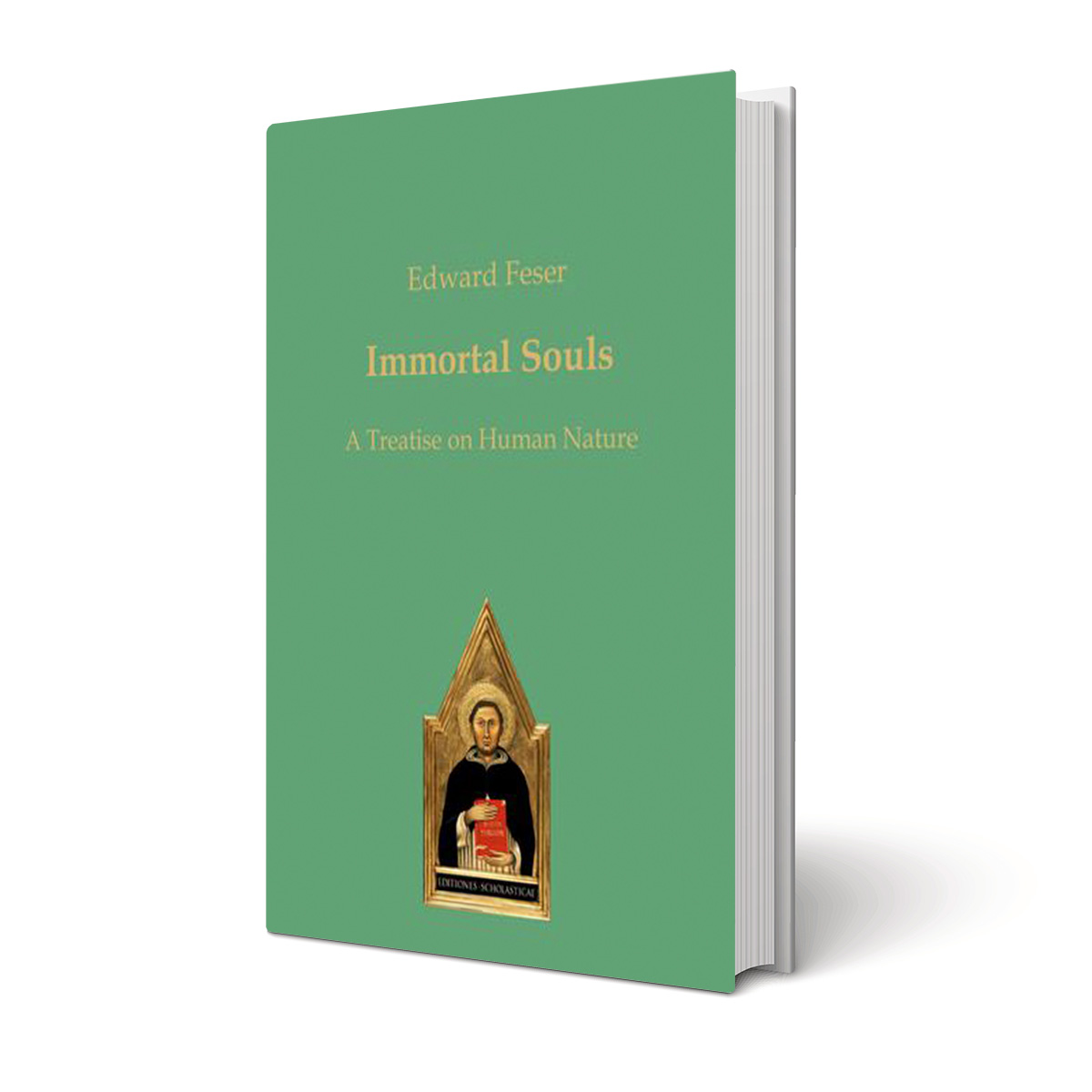
By Edward Feser
(Editiones Scholasticae, 2024)
In his new book, Immortal Souls: A Treatise on Human Nature, distinguished philosopher Edward Feser answers these questions and others by marshalling insights from Plato and Aristotle and bolstered by thinkers down the centuries, as well as considerations from modern physics, biology, anthropology, and neuroscience. In brief, he argues that these lines of thought reveal the person as a soul-body unity—or in classical Aristotelian terms, a “rational animal.”
To unpack this, Feser analyzes what it means to be both “rational” and “animal.” He begins by exploring the mind, or rationality. The nature of the mind, he observes, is a rather peculiar thing to investigate. For “in reflecting on its knowledge of its own existence, the mind comes to know that it knows this. It discovers that it is a knowing thing, a thing whose nature makes it capable of knowledge.” Thus, the mind is unlike ordinary objects of experience insofar as it not only knows things but knows that it knows things. It is, in a word, self-reflective. But that is not all. “When it reflects on the further circumstance that it loves the fact of its own existence and loves the fact that it has knowledge of its own existence, the mind thereby discovers that it is also a loving thing, a thing whose nature makes it capable of love.”
Moreover, while the mind is both a loving and knowing thing, it is not a thing we have. Rather, it is, in a very real sense, what we are. “To inquire into the nature of the mind,” writes Feser, “is at the same time to inquire into the nature of the self.” Of course, just because we discover the self through the mind does not mean that we are only a mind. We are, in fact, more than that.

One way Feser helps the reader see this is by examining the nature of cognition. For the mind to know anything, it requires input from the senses, for without sense experience the mind has no content to understand—no food for thought, as it were. For example, before I can think about what a flower is, I must either see, touch, or smell one (or do all three). Indeed, even our most basic beliefs, such as the law of noncontradiction or the axiom that “the whole is greater than the part,” are acquired through experience. It is by encountering objects in the world that we come to understand the meaning of “part” and “whole,” and through this understanding we recognize that parts can never be greater than the whole they comprise. The mind, then, is deeply dependent on, and indeed could not acquire knowledge without, the body.
In fact, though, the body plays an even more fundamental role than this. Much of what we know is implicit in our bodily actions—or as 20th-century philosopher Martin Heidegger put it, knowledge of this sort constitutes “knowing how” rather than “knowing that.” For example, when a carpenter drives a nail into a piece of wood, he does not consciously think, “I am going to hammer the nail this hard and at this precise angle, and I am going to keep my fingers in this position and my eyes focused on this spot.” Rather, the carpenter simply skillfully engages with the hammer, even as he may be thinking about something else entirely, such as what he is having for dinner that night. As Feser puts it: “The idea is that the explicit content of all our cognitive states presupposes a body of inexplicit knowledge, where this knowledge is fundamentally a matter of knowing how to interact with the world, rather than a matter of knowing that such-and-such propositions are true. It is knowledge essentially embedded in bodily capacities.” The body’s engagement with the world, then, is a critical aspect of cognition.
Even so, this does not mean that the mind is a physical thing (reducible to, say, the brain). As Feser argues, although the mind requires the body for knowledge acquisition, the act of thinking itself is a nonbodily, or “immaterial,” power. While he utilizes several arguments to demonstrate this, his central line of thought is dependent upon the late philosopher James Ross, though Feser presents it with genuine insights and panache of his own. To be sure, the argument is quite technical and abstract, but Feser combines its rigor with his talent for making difficult ideas digestible, and helps the reader along with more familiar everyday examples before examining its technical formulation by Ross. Briefly, the argument holds that thinking is exact in what it represents, whereas nothing material is exact in what it represents, ergo thinking cannot be material.
Meaning cannot be accounted for by purely physical or 'material' features of the world.
Consider, for example, a triangle drawn on a whiteboard. On its own, the triangle could represent an indefinite number of things: a pyramid, a slice of pizza, a dunce cap, triangularity in the abstract, a wizard’s hat, something else entirely, or even nothing at all. But how can we determine which of these possibilities it is? Consider that nothing about the physical facts of the triangle alone can determine what exactly it represents. We could study the thickness of the lines in which it is drawn, the chemistry of the ink, the physics of the drawing—even the neurophysiology of the person drawing it—and yet none of these would reveal what the triangle represents. Nor, for that matter, would a description affixed to the drawing, such as the sentence “This triangle represents a pyramid,” provide any help. After all, the letters by themselves are just meaningless squiggles. They have significance only inasmuch as they are conventions of the English language, and without these conventions the physical markings would be as devoid of meaning as is the triangle alone. Ergo, explains Feser: “The physical properties of any material representation are indeterminate or ambiguous with respect to its content. Whatever conceptual content it turns out to have will have to be determined by something outside these properties.”
In other words, discovering what the triangle means can only be determined by something over and above the physical facts of the situation—by the mind of the person who drew it. Meaning, therefore, cannot be accounted for by purely physical or “material” features of the world.
Of course, this compressed version of the argument is laid out in much greater detail in the book, which includes both responses to objections and refutations of alternative conceptions of the mind. In fact, an admirable feature of Feser’s treatise is how thoroughly he engages opposing positions to reveal their shortcomings, not only on matters of the mind, but also on free will, the role of the body, the immortality of the soul, and even the nature of the self.
For example, while Feser defends the traditional notion of the self as a substance with various powers and capacities, he carefully demonstrates why accounts that reduce the self to either some single feature of the human being, such as “consciousness” or memory, or to “bundles of features,” such as a mere collection of thoughts, feelings, experiences, etc., or to mental constructs or illusions (as in many strands of Buddhism), are ultimately self-defeating.
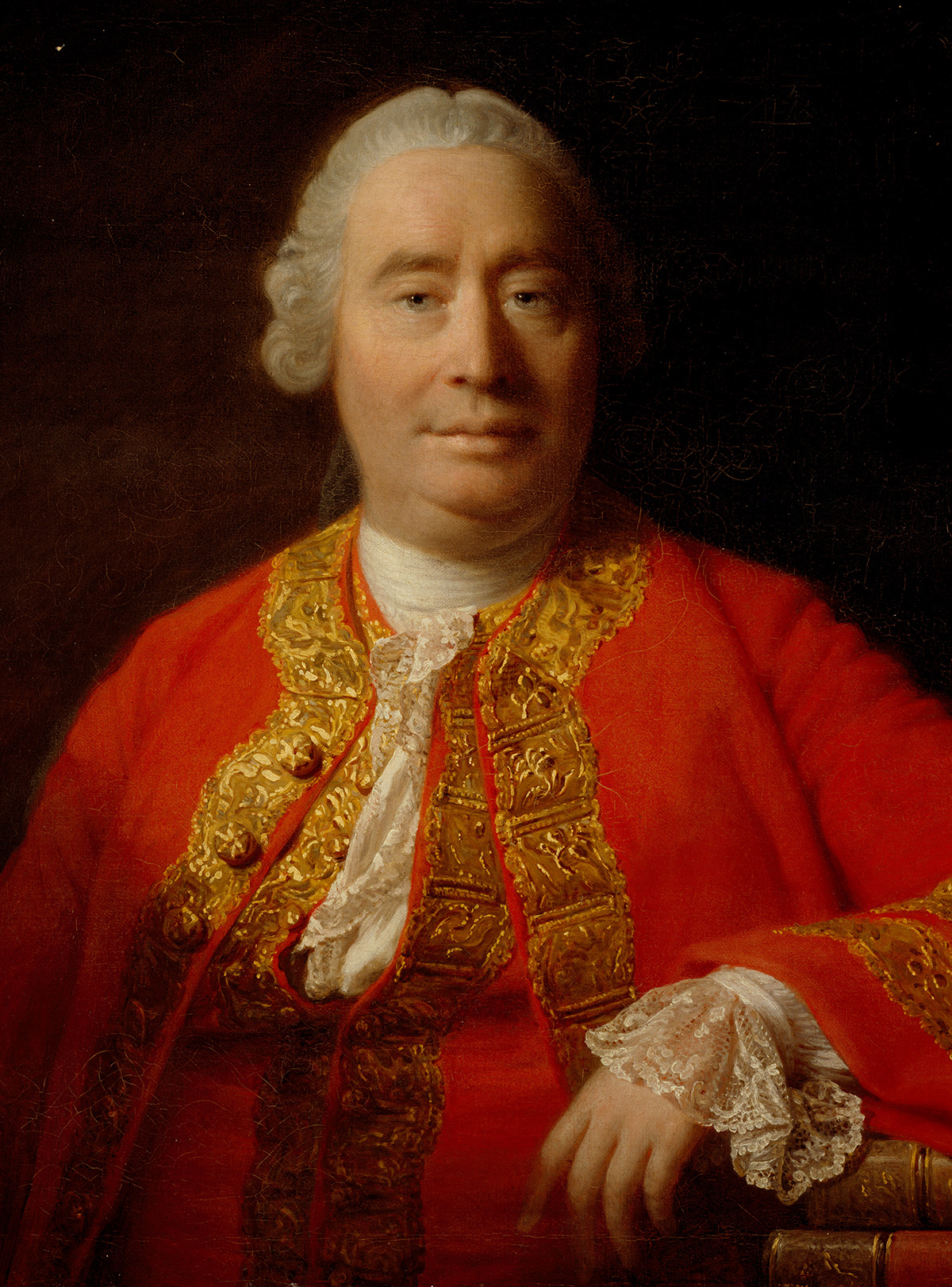
Consider, for instance, the notion that we are simply bundles of thoughts, feelings, and experiences. This idea, famously associated with early modern philosopher David Hume, persists in various expressions today. But one popular version holds that “bundles”—selves—are constituted of nothing more than the resemblances of ideas they contain. As Feser points out, this idea not only cannot account for the self but it presupposes the very self it seeks to explain. To see why, consider the following scenario.
The self is the ground and source of our thoughts, feelings, and experiences.
Imagine that some person, Dan, has (A) the memory of drinking a cup of coffee that morning, (B) the feeling of an itch on his leg, and (C) the thought of taking a vacation. Now imagine that another person, Beth, has (D) the memory of her alarm going off at 6 a.m., (E) the sensation of scratching her leg, and (F) the thought of being on a beach in Hawaii. Now, according to bundle theory, the collection of ideas (A), (B), and (C) constitutes the identity of Dan, while the collection of ideas (D), (E), and (F) constitutes the identity of Beth. But why should this be? After all, the six ideas plainly resemble one another—(A) and (D), for example, are both memories of the morning, (B) and (E) are both sensations, and (C) and (F) are both thoughts about destinations. So why is it that these six ideas make up just two discrete bundles? Why, for example, is (E) a part of Beth’s bundle and not a part of Dan’s? For that matter, why is (C) a part of Dan’s bundle and not a part of Beth’s?
Clearly, something besides resemblance is needed to account for the fact that one bundle belongs to Dan while the other belongs to Beth. And that something invariably ends up being the selves—Dan and Beth—that bundle theory was meant to explain in the first place. (For similar reasons, appeals to causal relations fare no better in explaining why there are discrete bundles, but one must read the book to find out why.) In other words, the bundle of (A), (B), and (C) cannot explain the identity of Dan, because Dan explains why (A), (B), and (C) count as one discrete bundle, and so on for Beth. In short, then, the self cannot be cashed out as a mere collection of thoughts, feelings, and experiences. Instead, the self is the ground and source of our thoughts, feelings, and experiences. As Feser puts it: “There simply is no coherent way to reduce substances to collections of attributes, whether the attributes in question are thoughts, experiences, and the like, or are of some other type. Just as we cannot coherently doubt the reality of the self, neither can we coherently doubt that the self is a substance.”
But even though we cannot doubt the existence of the self, understanding the nature of who we are remains a difficult task. For those willing to make the effort, however, reading Immortal Souls is an investment whose dividends pay well.
