


Tracey Rowland once quipped that, while natural law is proposed “as a kind of lingua franca for dialogue with non-believers,” given that most liberal theorists ignore it and many Protestants reject it, we have “a situation in which Catholics talk to other Catholics in an idiom which was devised for dialogue with unbelievers.” If that is the case, natural law has failed to deliver on its promises.
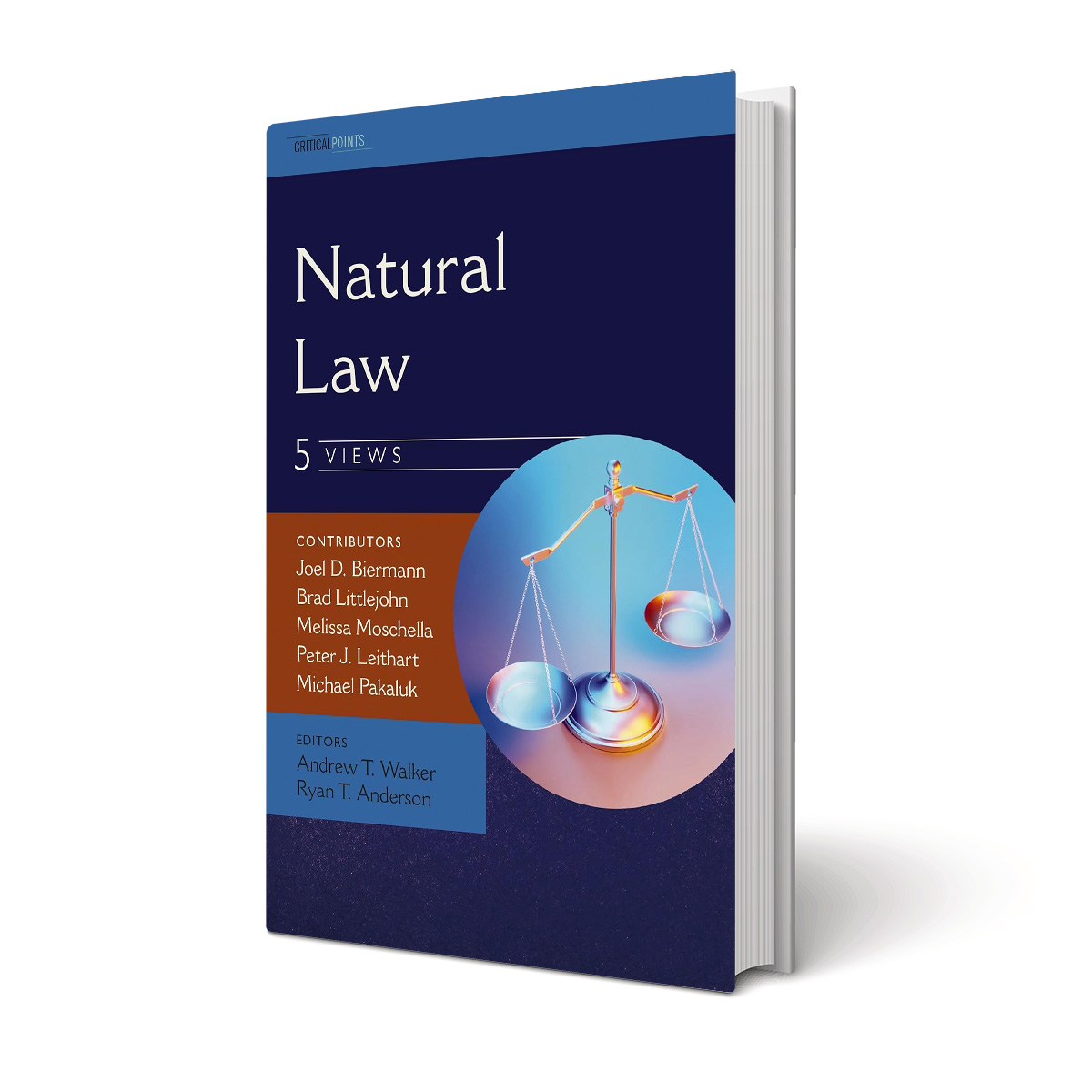
Edited by Ryan T. Anderson and Andrew T. Walker
(Zondervan Academic, 2025)
Is there a law inherent in our nature as humans made in the image of a good God? Or does it exist only outside ourselves, thus requiring a preacher? Is that law good? Or is it arbitrary? Depends on whom you ask.
Natural lawyers might respond that Rowland has conflated natural law theory with the natural law itself. If natural law is the way humans participate in the eternal law by virtue of our rational nature, it follows that humans always operate, and cannot but operate, according to natural law whenever engaging in practical and moral reasoning. Natural law is the operating system, so to speak, whether or not we recognize and affirm this. A theory about natural law is a second-order reflection about the operating system, and a theory that denies the underlying system is either irrelevant or a performative contradiction. It’s irrelevant insofar as a second-order theory can’t nullify a first-order system, however much it tries. And it’s a performative contradiction since the theorist uses the very reality denied in the construction of the theory.
I admit, I have long thought the distinction between natural law and theorizing about the natural law settled objections against the natural law itself, although certainly disputes about the content of the theory remain entirely valid and ongoing. In Natural Law: 5 Views, edited by Ryan T. Anderson and Andrew T. Walker, we see that debates about theory remain, but so too do objections against the function of natural law itself.
The editors have gathered five scholars in argument. Michael Pakaluk defends the “classical understanding,” Joel D. Biermann a Lutheran view, Brad Littlejohn “Reformed Natural Law,” Melissa Moschella the so-called new natural theory, while Peter J. Leithart remains steadfastly “anti–natural law.”
Each of these scholars presents his or her case, in the order listed, in sections of approximately 25 to 30 pages, with shorter responses of roughly five pages from each of the others, again in the same order, followed by a short rejoinder from the first, resulting in a book of 30 chapters, as well as the editors’ introduction and concluding remarks. While complicated, the book delivers a coherent, robustly informative, and thoughtful series of exchanges and developed debates. As expected with the format, there is some throat-clearing and obligatory statements of gratitude to the others for their insightful comments, but the editors kept the book fairly tight, on point, and with minimal repetition.
Just as the Decalogue should not be viewed as an analogue to the Universal Declaration of Human Rights, neither should natural law.
According to Michael Pakaluk, the classical understanding of the natural law is not a lingua franca accessible to all reasonable people of goodwill—that more liberal assumption better describes new natural law. Natural law, rather, is a development of the classical framework, with the monotheistic traditions appropriating and winnowing from the metaphysics and epistemology of classical thought, with Thomas Aquinas the master of the approach. Just as the Decalogue should not be viewed as an analogue to the Universal Declaration of Human Rights, neither should natural law. Instead, natural law articulates important truths about human nature, human society, and the natural world itself, and knowing these truths, while natural to our reason, depends also on good education, sound institutions, and well-formed people. Appealing merely to the principles of (supposedly) self-evident reason is not an option, even though the basic precepts are open to reason as articulable and specifiable.
Of course, in the classical framework, law was not free-floating but related to ideas of teleology, flourishing, and rendering what was due. Given that we are creatures of a certain sort—humans, rational animals—we have certain goods proper to us and certain claims of right or justice owed to us, all of which are caught up into what it is to flourish and thrive given our nature. Natural law is enmeshed in the particular claims of the classical framework that are not universal and culturally transcendent principles. Of course, the obvious objection to all this is that natural law becomes just another theory among theories and, even if true, not especially persuasive outside the classical framework.
Joel D. Biermann’s “Lutheran Understanding” begins with an account of Melanchthon and Luther, leading to the conclusion that, for the Lutheran, natural law “does absolutely exist.” The world has been created by God and is governed by his will such that the laws of physics are not markedly different in kind from moral laws governing sexual conduct or the civil laws of Moses for Israel or of Saxony in the 16th century. All law comes from God and so “efforts to distinguish meticulously between various sorts of laws” is somewhat blunted, in part because all people are duty-bound to obey the laws of their people and place. When such laws conflict, negotiation is needed so they conform to “God’s revealed will,” but people are “rightly living as God intended” when they obey the laws of their place, since this is how God governs the world according to what he “arbitrarily chooses.” God does what he does for no reason other than that God “chose it.”
Natural law, however, is objective since God commands it, but given sin the “natural law provides no functional foundation or concrete guidance when attempting to establish or adjudicate moral questions in the public arena.” Of course, the obvious objection is that the Lutheran account lacks anything natural or lawful. Whatever else law is, it is an ordinance of reason, and if God does not command according to reason, the command is arbitrary and tyrannical. Biermann’s rejoinder boils down to one word—submit. With respect, no.
Littlejohn departs starkly from the Lutherans, for God has a nature, on which his commands are based.
As Brad Littlejohn’s articulation of the Reformed view notes, his tradition is freeing itself from Karl Barth and others focused on “exclusively biblical premises” through which to know reality and morality. Things have changed, and the Reformed might be emerging from their self-imposed captivity. As Littlejohn puts it, humans are created such that some acts are natural to them, allowing them to thrive, but there are also reasons for this: There are moral and immoral ways of seeking those goods to which we naturally incline. By nature, I want dessert, and yet it might be irrational to seek it in this way and this time because it would impede my thriving.
Here Littlejohn departs starkly from the Lutherans, for God has a nature, on which his commands are based, just as humans have a nature, by which human laws can be made reasonable. At the same time, sin interferes with our knowledge of what is natural as it does also our inclinations, but God is good enough to provide common grace in addition to civil authority and divine law. I’ll admit, I’ve never understood why the category of common grace needed to be invented since the idea of natural law already contained it, but I’m not Reformed and so never found nature inadequate.
Melissa Moschella’s account of the “new natural law” is an excellent primer. She notes the important distinction between the four orders of reason, including the vital distinction between theoretical and practical reason. Too often natural law has been treated as if it were some sort of practical application of the theoretical. On that view, we do a theoretical anthropology, and once knowing what the human is, we can then derive the human good as proportionate to being. But the principles of practical reason are nonderived, since they are first principles, and as nonderived cannot be derived from metaphysics or anthropology. Instead, practical reason grasps basic human goods among the data of nature, biology, metaphysics, and our inclinations, but these goods are not derived.
Peter Leithart opposes any theory of natural law that brackets “revealed Christian theology.” Such attempts are “villainous.” We cannot exist or know the human condition without revelation, and it is in the events of revelation, rather than static nature, that we access ethical reality. Thus the Decalogue is not a version of the natural law. Moreover, natural moral law is too thin to be useful anyway, and so it is to Scripture that we must turn. And to grace. Since the main concern is salvation, any account ignoring or bracketing Scripture is not just weak or thin but a villain to be resisted.
Natural law is objective since God commands it.
I have my own judgments in all this, of course. The essays of Moschella and Littlejohn are far more coherent and persuasive than the others. Biermann’s essay is quite weak, Pakaluk’s less strong than others he’s written, and while I disagree with Leithart, he represents a live tradition. But for a book like this, the very point is to introduce arguments and counterarguments for the reader’s own consideration, so my own judgments are not especially relevant. Although I do note that theories don’t matter much if natural law is the underlying performance of practical reason, in which case you can be as anti–natural law theory as you like and it doesn’t change reality one iota. If you’d like to inform your own judgments, however, Natural Law: 5 Views is an excellent resource and worth the effort. Highly recommended.