


If the well-examined life is worth living, then C.S. Lewis’s must have been extraordinarily worth living, because few lives have been quite so well and thoroughly examined. Even in the midst of a century full of remarkable (and remarkably well-documented) lives, Lewis’s has attracted particular attention, enough to make me a bit skeptical whenever I hear of yet another Lewis biography. Surely all the material has been hashed over by now!
So it was with surprise and a little relief that I found that Simon Horobin’s C.S. Lewis’s Oxford not only gives a fresh perspective on Lewis’s life and a reminder of just how unusual that life was, but also offers, however subtly, a vision for our own moral and imaginative flourishing.
If you thought every aspect of Lewis’s life had already been covered, think again. What about his commute home from work?
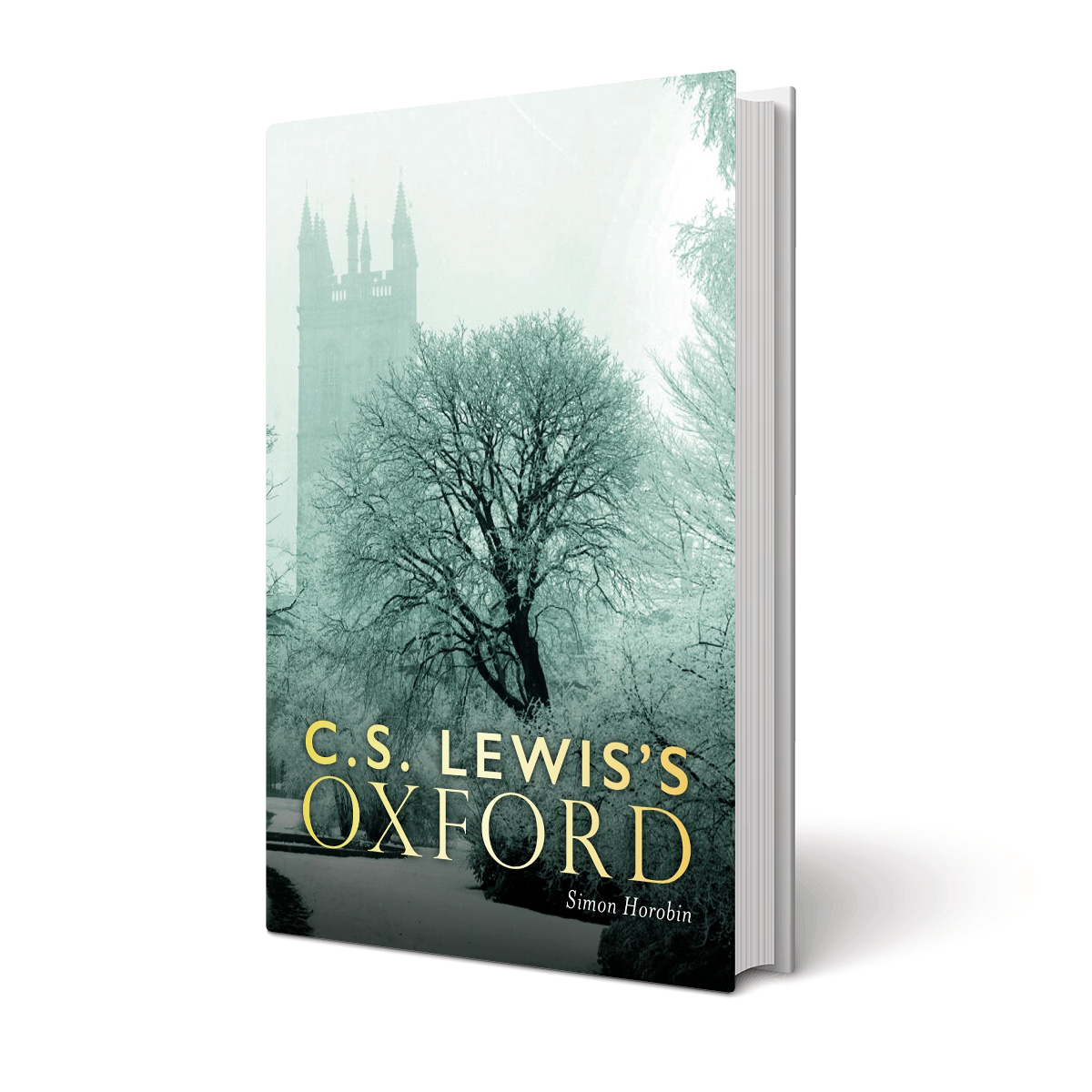
By Simon Horobin
(University of Oxford, 2024)
Like 2023’s noteworthy Metaphysical Animals (a group biography of four Oxford women whose work continues to shape inquiry today), C.S. Lewis’s Oxford traces its hero’s philosophical, theological, and literary development, not just to certain thinkers, but to specific times and places. We visit gardens, particular houses, walks, quotidian little spots that might strike us as separate from, or even antithetical to, the intellectual life Lewis lived and the fame he achieved. Yet Horobin shows us that this apparent duality is a false one. In the process, he reminds us why Lewis’s accomplishments matter to so many people around the world, even decades after his death: because Lewis did not succumb to the false distinction between “ordinary” and “extraordinary.” Lewis’s famous dictum that the world was “bigger on the inside than on the outside” was not merely a theory, but a conviction grounded in his own experience of real places and moments.
The elements of Lewis’s life are so well-known that it is tempting to mythologize them: the towering spires of Oxford set against explosive world wars; the brilliant atheist who became the leading public apologist of his time; the friendships with J.R.R. Tolkien, Charles Williams, Owen Barfield (a.k.a. the Inklings), and others that gave birth to an entirely new literary genre. It is easy to forget that Lewis was a man who lived.
Horobin’s intention is to remind us of this. C.S. Lewis’s Oxford is organized not chronologically but situationally. The chapters lead us from place to place, from famous spots like Magdalen College (chapter 2) and the Eagle and Child pub (chapter 4) to the less well-known Eastgate Hotel (chapter 5) and St. Mary’s Passage (chapter 7). Within each chapter, Horobin explores Lewis’s life in that place. For example, in the chapter on Magdalen College, he describes the rather dire conditions of Lewis’s rooms in the New Building: “Lewis regularly woke to find his bedside water had frozen over [and] he was regularly visited by mice.” In the chapter on Headington (the location of The Kilns), Horobin describes the landscape surrounding the Lewis home and walks us through Lewis’s commute between Headington and Oxford, undertaken “by bus or on foot.”
As a pedestrian he would take a brisk walk down Cuckoo Lane and across the bridges and islands of the Cherwell, which were completely deserted first thing in the morning. This would bring him to Magdalen at the little gate leading into the Fellows’ Garden, which joins Addison’s Walk at Bat Willow Meadow.

Horobin’s own prose is so clear that it is a pleasure simply to read these descriptions, but he offers us more than just a sense of where Lewis lived. Rather, he reveals how these locations and the little ways in which Lewis lived in them affected his subject’s intellectual development. For example, in the next paragraph, Horobin writes:
The bus home would take him gradually up the steep Headington Hill from the roundabout near Magdalen College, known as The Plain. It was on one of those slow ascents that Lewis found himself confronted by the need to make a firm commitment to either belief or atheism.
By locating this key moment in Lewis’s spiritual life in a very specific time and place—a slow commute home after a long day of work—Horobin demystifies the great thinker’s life. Lewis, it turns out, was a person very like other people! He walked to work and took buses home. His thoughts wandered about and he wrestled with significant life decisions while on his commute.
C.S. Lewis’s Oxford does not ignore the somewhat magical elements of Lewis’s existence, however. Lewis lived in one of the most beautiful cities on earth, and he had secure employment for much of his life. His job was to inquire into great literature, both on his own and in the company of other brilliant minds. When I, an artist and intellectual whose life is very far from those “dreaming spires,” read descriptions of Lewis’s life, it is easy to feel a little despair—of course Lewis did great things! He didn’t have to do his own cooking and laundry, and someone was paying him to think!
Despite the reality that Lewis’s circumstances were quite rare, Horobin’s account disrupts this line of thought. By dwelling in specific places alongside Lewis and watching him at his day-to-day activities, Horobin reveals that what made Lewis so special was not merely the circumstances of his life but his response to those circumstances.
Lewis made space in his daily life for contemplation, which made him ready for the intellectual and imaginative triumphs we see in his writings.
Consider the passages I quoted above: Lewis, on his commute home after a long day of tutorials and assessing essays, did not allow his eyes to glaze over at the sight of the familiar landscape going by. Rather, he allowed that “slow ascent” to bring before him, inescapably, the question of whether to accept the existence of God or to deny it. This is just one example of the ways that Lewis made space in his daily life for contemplation, which made him ready for the intellectual and imaginative triumphs we see in his writings.
One of my favorite passages in the book is the section about “Addison’s Walk,” a rambling little circular trail on the grounds of Magdalen College that Lewis strolled every morning before 8:00 a.m. service at the chapel. Horobin describes how Lewis walked this path with such influential figures as Hugo Dyson and J.R.R. Tolkien, talking easily and enjoying the sights and sounds of nature. This little routine could easily have become monotonous, but instead of becoming numb to its charms, Lewis chose to persist in loving it. He would pause in his intellectual discussions with peers to look at a particular flower nudging up from the soil. He refused to let Addison’s Walk become overly familiar but instead continued to look for magic on the way—and because he was looking, he found it.
C.S. Lewis’s Oxford shows us a Lewis of small, regular habits, a man in harmony with the rhythms of his place. It is a lovely portrait; rarely does a person’s natural inclination align so perfectly with his setting and career. The book gives us a snapshot of a man for whom day-to-day existence was coherent and whose physical setting seemed to be a manifestation of his spiritual and intellectual pursuits.
For most of us, this kind of unity between the inner and the external life seems like a fantasy. Obviously Lewis had his struggles; there was a period during his life at The Kilns when his routine was marked by profound anxiety as the aging Janie Moore, who lived there with him and his brother, Warnie, experienced ongoing health crises and mood swings. It should also be remembered that he had endured both world wars, and, going all the way back to his childhood, the loss of his mother left an indelible psychic mark. But for all this, Lewis’s life had a fullness and a centeredness that many of us desire.

This is the real pleasure of Horobin’s work: Rather than simply rehashing Lewis’s ideas, he has located those ideas within a time and place. Horobin’s book is a reminder for our abstracted and ideological age that we don’t live in a world of ideas; we live in a world of people and homes and sidewalks and parks and garages and little cafés and churches and offices and schools. We live in a real, physical world, and our relationship with our real physical surroundings has an inescapable influence on our ideas.
Lewis’s surroundings were remarkably beautiful, certainly. But what is more important is that he paid attention to them.He sank deeply into his life. He embraced the sodden weather of England; he persisted in visiting Addison’s Walk in the dreary days of winter, and that sharpened him for the delight of the first spring flowers. He filled his evenings with social events, even when the schedule became punishing. Horobin reminds us that Lewis would participate in student reading groups frequently, sometimes two nights a week, on top of his standing meetings with the Inklings, and that he often stayed until the wee hours of the morning in heated discussion with his students. This was wearying, but Lewis believed it to be a vital part of his vocation and kept up this schedule as long as he could. In Horobin’s careful research, we find not a pampered academic dreaming in his study but a vibrant, active man embracing the details of his daily life and allowing himself to be moved, shaped, stretched, and even punished by the place and time in which he lived.
As Chesterton says in Orthodoxy, the greatness of a place is not inherent to it. Rather, a place becomes great because humans love it greatly.
If there arose a man who loved Pimlico, then Pimlico would rise into ivory towers and golden pinnacles.… If men loved Pimlico as mothers love children, arbitrarily, because it is theirs, Pimlico in a year or two might be fairer than Florence. Some readers will say that this is mere fantasy. I answer that this is the actual history of mankind. This, as a fact, is how cities did grow great. … Men did not love Rome because she was great. She was great because they had loved her.
The same could be said of Oxford: No one loved Oxford because she was beautiful. Rather, she—and the life she offers—is beautiful because people have loved her and have given their lives to her. Could not the same happen for any place?
This is the sentiment that pervades C.S. Lewis’s Oxford. Horobin does what I did not think could be done: It offers us a fresh and revelatory look at one of the most examined lives of the 20th century while also calling us gently to live our own lives, wherever they are, more fully and attentively.