



In Hopeful Realism: Evangelical Natural Law and Democratic Politics, Jesse Covington, Bryan T. McGraw, and Micah Watson, all professors of political science, argue that evangelicals have been profoundly shaped by the political winds roiling society. Evangelicals have frequently contributed to this polarization, leading to a public witness marked by “moral inconsistency and incoherence.” Contemporary research shows that churches have become increasingly politicized and partisan, with ideological debates often eclipsing theological and biblical principles. These divisions have deepened in recent years, intensified by dramatic and entrenched cultural shifts. This polarization not only destabilizes liberal democracy but also jeopardizes the role of evangelical moral commitments within a liberal democratic framework.
Can evangelicals enjoy wiser political engagement by embracing natural law principles? If so, it will require a solidarity that is sorely lacking in their circles.
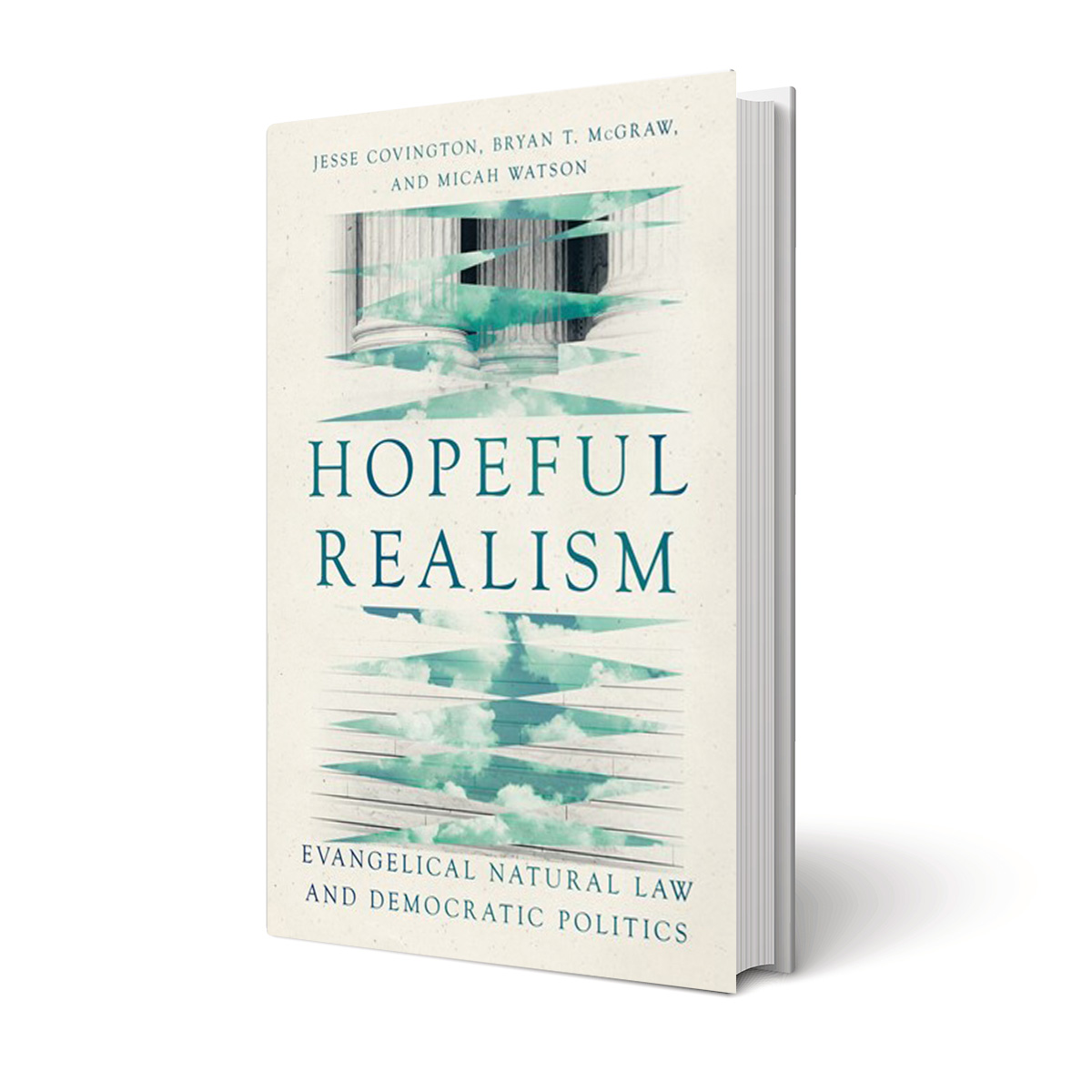
By Jesse Covington, Bryan T. McGraw, Micah Watson
(IVP Academic, 2025)
The authors propose a better path forward for evangelicals to engage in moral reasoning within the public square. This approach involves navigating the cultural moment with healthier political participation rooted in the natural law tradition, which they term “hopeful realism.” The theological virtue of hope reminds Christians that meaningful cultural engagement is possible in this life and that their efforts can make a difference in the public sphere. At the same time, realism acknowledges the brokenness of the world and the pervasive presence of sin in all human endeavors.
This natural law reasoning may be unfamiliar to some evangelicals, particularly those influenced by a biblicism that downplays general revelation and often upholds a sacred-secular divide, leading to limited interest in political issues. Evangelicals nevertheless have access to the natural law tradition, and by embracing it they can cultivate a political witness rooted in Christian conviction. This witness would allow them to engage faithfully and thoughtfully within a pluralistic and liberal democratic order.
Hopeful Realism is divided into two parts, with the first providing a theoretical framework grounded in the natural law tradition as a foundation for political engagement. Drawing from the Christian intellectual tradition, Covington, McGraw, and Watson define natural law as “a set of stable, morally obliging norms for human action, grounded in a common human nature.” These norms are intelligible through reason and conscience, though they are imperfectly grasped owing to the effects of original sin. What distinguishes this vision of natural law as distinctly evangelical is its emphasis on Scripture, which corrects and enriches the understanding of natural law. The authors affirm that the Bible, as the sacred Word of God, is given to Christians to guide all aspects of life, including politics. They highlight three key passages of Scripture as foundational to framing a natural law theory: Genesis 1–4, Matthew 22:15–21, and Romans 13:1–7.
The theological virtue of hope reminds Christians that meaningful cultural engagement is possible in this life.
Genesis 1–4 outlines the general features of the natural framework, emphasizing the imago Dei, the call to live in community, and the anticipation of salvation through Christ. Earthly politics, as part of the creation mandate, serves to restrain evil and promote creational goods. Matthew 22:15–21 and Romans 13:1–7 delineate the separate spheres of church and state, with each having distinct authorities and responsibilities. The authors argue that government has a legitimate role in human life, existing to serve human beings rather than the reverse. Their interpretation of Romans 13 also broadens the application of the principles of a Christian magistrate to all believers. In a liberal democracy, where elected officials emerge from among the people, these leaders function as “public servants.” This arrangement, they argue, calls all individuals to wield political authority through active participation in the political process. The authors acknowledge that Scripture does not provide explicit answers to every political issue—for instance, it does not specify a tax code—but it does offer a robust paradigm for thinking through any issue in light of God’s moral order.
Hopeful Realism leans not only on Scripture but also on Augustine and Aquinas. From Augustine, it argues that the natural law is “transcribed upon the rational soul” to preserve God’s semblances in this earthly life. Moral norms are part of the created order and intelligible to humans, a concept known as moral realism. The authors draw from Aquinas a definition of natural law as simply “good should be done and pursued and evil avoided.” The “good” that should be “done and pursued” include the intelligible creational goods: physical goods, i.e., the promotion of physical well-being, reproduction, and bodily integrity; volitional goods, the preservation and protection of responsibility and agency of individuals and groups; rational goods, the promotion of education, contemplation, and attainment of wisdom; and relational goods, the preservation of social and religious life, including institutions, families, organizations, and other relationships that foster flourishing.
The book rightly cautions the reader that the ultimate manifestation of these goods is found only in the life to come. Until then, we live in the saeculum, to cite Augustine’s term, the life inside of time before the coming kingdom, and so Christians should be about the work of seeking creational goods within cultural spaces that are a mixture of Christians and non-Christians. Political communities, or what Augustine calls “commonwealths,” are always composed of citizens of both the City of God and the city of man. All those who exist in the same commonwealth may not share a common conception of justice or other theological convictions, but they can seek earthly peace that is grounded in the goodness of the created order, common rational truths, and a common moral order.
In addition to the lineaments of their “hopeful realism” framework, the authors provide a few general principles that should guide political reflection within a liberal democracy. For one, Christians should seek the common good and civic friendship in ways that promote peace and flourishing. They should also maintain a confessional pluralism and defend religious liberty, while promoting limited government powers and deference to liberty as a default. Finally, the principle of subsidiarity ought to guide their reflections, stressing that the “thicker” decisions should be left to smaller, local communities.

The second part of the book focuses on applying the theory of hopeful realism to specific issues such as economics; marriage, sex, and family; and coercion, violence, and war. The authors outline a three-step process for political reasoning:
- Identify the goods involved in any political issue (physical, volitional, rational, and relational) and their relation to human flourishing.
- Discern and choose among options that best secure these goods.
- Apply prudence to implement the chosen option within specific social and political contexts.
As one example, the authors apply this schema to religious liberty. They argue that religious liberty is tied to relational and volitional goods. Relational goods signify that religious life is a worthy pursuit, as it seeks the preservation of families, churches, and other social institutions, while religion also entails a volitional good that allows individuals and groups to follow their conscience and live in accordance with their beliefs.
Given an evangelical natural law framework, the best way to preserve these goods is neither a state church with no free exercise of religion nor an established secularism with no protections for free exercise. Between these extremes, the authors propose other options, including a “weak establishment” of a state church or no establishment at all with protections for free exercise, or an established secularism with protections for free exercise. These are the general options that help preserve the general goods among religious organizations and that should guide evangelical reflections about religious liberty.
The authors also cite examples of civil rights laws that have challenged religious liberty in recent years. To what extent should religious organizations be exempted from civil rights laws that would otherwise constrain their hiring and firing decisions? The authors reason through various options, arguing that securing civil rights promotes volitional and physical goods, but in cases where the goods relate to religious liberty, the government must “understand, evaluate, and weigh citizens’ religious commitments over and against state interests.” The scope of power should be most constrained at the higher levels of government, where agreement about shared goods is thinner and more limited, leaving the lower levels of society to work out the specific application in common life. Ultimately, Covington, McGraw, and Watson argue that “hopeful realism” promotes a view of religious liberty that “highlights the benefits of categorical exemptions at the national level and more fine-grained balancing treatments at lower levels of government.”
The chapters on economics, family, and coercion follow similar lines, illustrating how hopeful realism can address diverse moral issues. Rather than endorsing specific policy positions, the authors offer a method for making prudential judgments rooted in evangelical principles, providing a stable moral foundation for engagement in an ever-changing political landscape.
To what extent should religious organizations be exempted from civil rights laws that would otherwise constrain their hiring and firing decisions?
As I closed Hopeful Realism, several thoughts came to mind. First, this work is a valuable gift to the church and deserves a wide readership. It calls evangelicals to draw from Scripture and the rich history of Christian moral reflection, challenging believers to embrace a spiritual life fully integrated with their social and political context.
In this secular age, a book like this is crucial for helping evangelicals develop a more holistic doctrine of the spiritual life. The political jockeying of recent years and the transformation of cultural institutions have highlighted the difficulties evangelicals face in living holy lives within the public square. This book underscores the need for evangelicals to return to Scripture, recognizing how it frames every aspect of the Christian life and offers guidance for living out its truths in ways that will effect tangible, positive change. One of the book’s most significant contributions is its call for Christians to reflect on their vision of citizenship and to foster solidarity. The authors encourage congregations to collaborate and address real-world issues that impact people’s lives.
But the authors acknowledge the limitations of the natural law tradition, describing it as neither “a magical algorithm that acts as an infallible political guide” nor an entirely novel approach. This description signals the kinds of challenges that lay on the other side of embracing this type of moral reasoning. How can evangelicals—who often disagree on the application of political principles at the local level, in addition to their confessional differences—maintain unity in their political engagement? Answering this question represents perhaps the book’s greatest challenge, especially in our polarized and contentious times, where fostering cooperation and mutual understanding is increasingly difficult. Are evangelicals prepared to embrace a diverse range of views on political engagement, even among conservatives? Addressing this difficulty is essential for advancing the book’s vision of a more thoughtful and cooperative evangelical political witness.
Another challenge along these lines is determining who has the authority or vision to guide specific communities in their political reasoning. What role should pastors or other Christian leaders play? Moreover, who will the people of God follow when authoritative voices conflict over the specific application of moral principles? Applying the framework of Hopeful Realism will require careful deliberation and the cultivation of prudence, especially among leaders who can model for their congregations the kind of moral reasoning the authors envision, even as they work toward solidarity among their communities.
Hopeful Realism offers an important call for Christians to connect Scripture with their moral actions in the political sphere. It challenges evangelicals to engage thoughtfully and faithfully, drawing on the resources of Scripture and natural law to navigate cultural complexities. While political winds may swirl around us, the authors provide a guide to help Christians envision a renewed political witness—one grounded in an honest assessment of the world as it is and animated by the hope that ultimately leads them home.
