


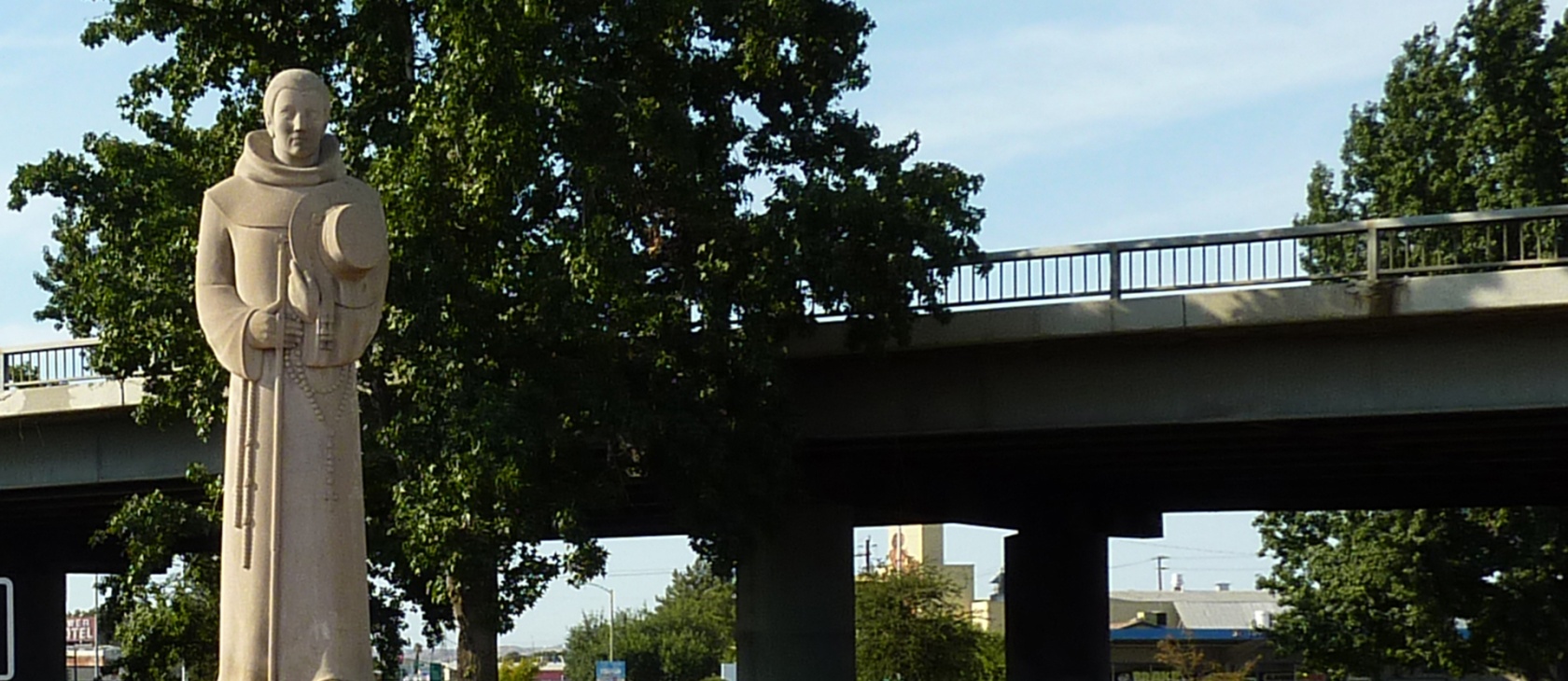
The grandest monument to the Spanish Franciscan friar, missionary, and explorer Francisco Garcés is the Garces Memorial Traffic Circle in Bakersfield, California. There, at the intersection of Chester Avenue, Golden State Avenue, and 30th Street, within the circle, stands a sculpture of the martyr, behind which, bisecting the circle, looms an overpass.
Among the many stories of Spanish missionaries in the American Southwest, one in particular stands out: that of a Franciscan friar who showed a new way—not only through treacherous terrain, but through to the hearts of indigenous peoples.
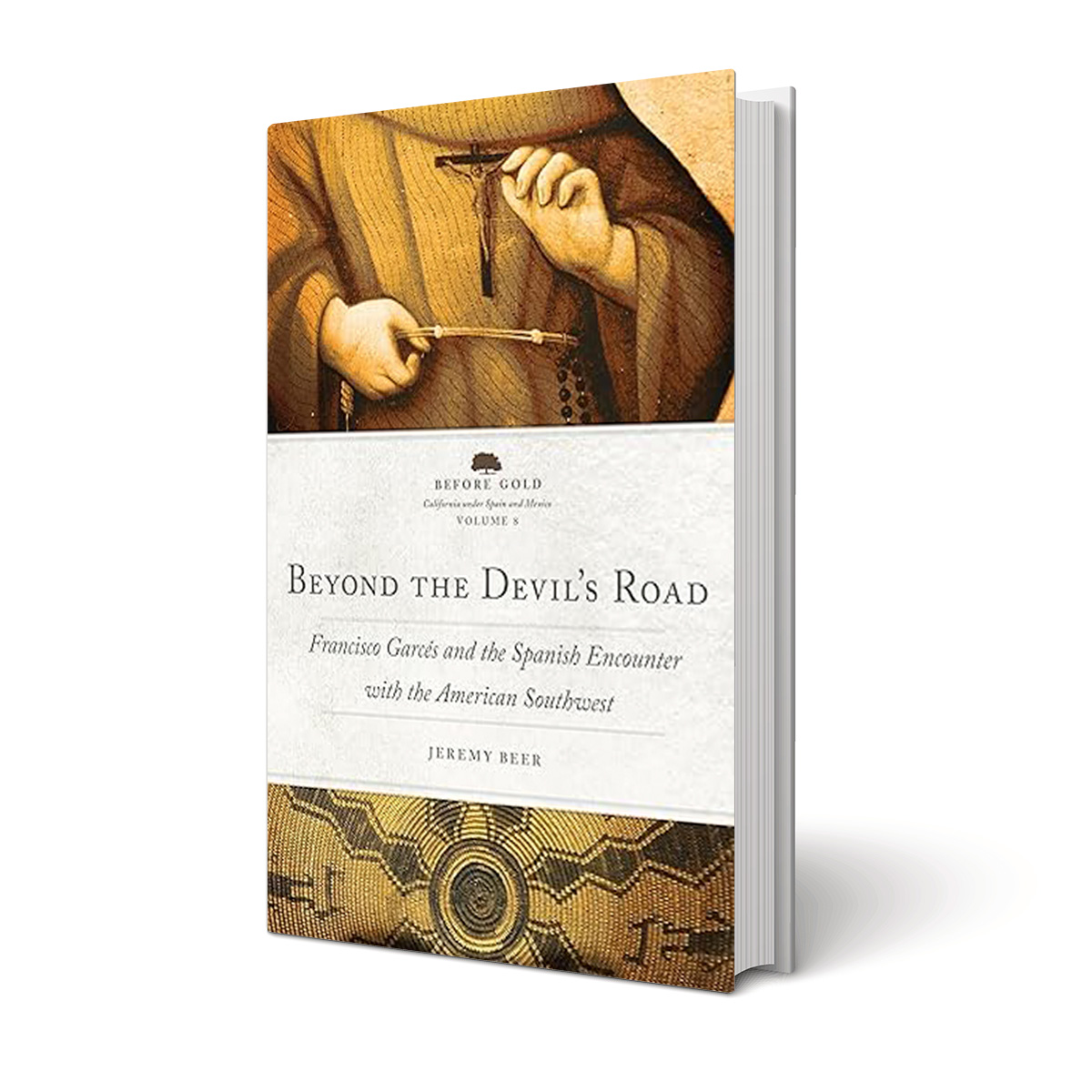
By Jeremy Beer
(University of Oklahoma Press, 2024)
The circle marks the site of Father Garcés’ visit to what was then a small American Indian settlement in 1776, one of his many journeys across what is now northwestern Mexico and the American Southwest. His odyssey through inhospitable mountains and deserts would take him farther overland than all but the expeditions of Jolliet and Marquette in the century before, and Lewis and Clark at the beginning of the century next. His motivation was gospel witness to indigenous peoples with little or no previous contact with missionaries or the Christian faith. He made considerable contributions to anthropology and the ethnography of indigenous peoples in his journals and letters as he went. He also influenced the geopolitics of the New World, providing evidence of overland routes to California, which proved instrumental to its settlement by the viceroyalty of New Spain.
All and more is accessibly told by Jeremy Beer, independent historian and co-founder and CEO of the nonprofit AmPhil, in the new biography Beyond the Devil’s Road: Francisco Garcés and the Spanish Encounter with the American Southwest. Father Garcés, at the center of so much of the Southwest’s history, has, Beer’s argues, been neglected by historians as merely “a tantalizingly fascinating supporting actor. That, until now, no full biography has appeared indicates the low esteem colonial-era missionaries and the enterprise they represented generally command in scholarly circles.”
Beer does an excellent job throughout presenting, sympathetically but with warts and all, the nature of that missionary enterprise in its 18th-century Spanish, Catholic, and Franciscan context. Garcés, a second son, christened Francisco Tomás Hermenegildo by a Franciscan priest, was early on “inclined to sacred things.” In his rural, peasant community, “Existence had a simple, integrated, highly parochial pattern in which state, the aristocracy, and the church each had its God-ordained place.” Beer draws on then-popular mystical literature of the period to explain what may have drawn Garcés to a vocation as a missionary in the Franciscan order. Most vivid is the tale of a levitating Franciscan nun who claimed to have somehow physically visited the New World while cloistered: “They were stirred not just by her stories of the New World but by her report that St. Francis himself had told her the Indians of the New World would be converted merely by seeing a friar.”
The priestly formation of Father Garcés was unremarkable. He struggled in academic subjects but demonstrated a powerful personal charisma that would help him make friendships throughout his life and ministry. After ordination, he was recruited into the Colegio de Santa Cruz de Querétaro, “located about 125 miles north of Mexico City in New Spain … one of twenty-one such Franciscan institutions in the New World.” These colegios were designed expressly to train priests to evangelize the unreached and unbaptized indigenous.
‘To [Father Garcés], as to every Spaniard he knew, crown and cross were but two sides of the same coin.’
After several bureaucratic delays, Father Garcés made a harrowing journey to the New World. Beer repeatedly returns to the bureaucratic difficulties and pathologies of the Spanish state and its colonial administration. This lack of state capacity hampered colonial and missionary efforts. It also paradoxically empowered priests and religious orders to exercise both spiritual and political authority in remote and indigenous mission fields.
Beer chronicles a wide variance in governance in many mission areas, as well as widespread abuse of indigenous people by unscrupulous priests whose rights over mission property and mission residents were legally, if not always in practice, absolute. Agricultural production was often collectivized, labor compelled, and residents of missions prohibited from leaving. Even priests such as Father Garcés, who had a benevolent disposition toward indigenous peoples, saw themselves as possessing legitimate political authority over the indigenous residents of the missions. “In his travels he had unceasingly preached the Christian gospel of peace and salvation. He had just as unceasingly sought to serve the interests of the Spanish sovereign. To him, as to every Spaniard he knew, crown and cross were but two sides of the same coin.”
What all Spaniards knew in theory didn’t always work out in practice. A vivid example of this periodic failure is illustrated by the expulsion of the Jesuit order from all Spanish territories in 1767, which was the occasion for Franciscan Father Garcés’ being put in charge of the former Jesuit mission of San Xavier the next year. San Xavier was south of modern Tucson, Arizona, but then the northernmost mission in Sonora, New Spain.
Garcés welcomed the challenge. He reported that the residents of San Xavier showed “no sign of knowing Christian teachings—even in their own language.” Beer points out that Father Garcés promised that, “unlike his Jesuit predecessors, not to mention other Spaniards, he would not—indeed according to the new regulations, could not—ask them to work for him in the fields.” By the summer of 1768, “his comparatively gentle methods helped win the affection, or at least the respect, of the San Xavier Indians. Soon some of them, especially the children and younger, unmarried persons, began to attend religious instruction at the mission.”
Father Garcés, having established San Xavier on a firm foundation, began to journey northwest of the mission to tell the people there about the two majesties he served: “God and the Spanish king.”
In whatever rancheria Garcés found himself in the evening, he would say Mass and then summon the elderly Indians for a talk around the fire, which conversation would last from nightfall until around two o’clock in the morning. The missionary spoke to them “of divine mysteries” and of Charles III—the traditional Franciscan approach.
These early missionary journeys were for the purpose of sharing the Good News and gauging interest in the establishment of new missions. A mission would usually provide a priest, and with him religious instruction and access to the sacramental life of the church. It would also provide Spanish troops to provide defense, open trade, and grant access to technology, particularly agricultural technology. Father Garcés would spend the rest of his life requesting new missions be established near his own, as he believed Spanish troops were necessary to protect against regular Apache raids. Among the surrounding indigenous communities, he found much interest. The Spanish bureaucracy moved slowly, however, if at all.
Father Garcés made considerable contributions to anthropology and the ethnography of indigenous peoples in his journals and letters.
Much of Beyond the Devil’s Road recounts the increasingly lengthy treks of Father Garcés into the often treacherous and hostile landscape of the American Southwest. These sections are fascinating, filled with episodes of immense courage, stark landscapes, and details of the life of the Indian nations that inhabited them. Beer, however, is never content simply to serve up adventure to the reader; instead, he delivers deeply researched accounts of the theological and geopolitical motive forces driving these harrowing journeys. He also deftly explores just how tightly those theological and geopolitical motivations are intertwined in Father Garcés’ world.
While Spanish efforts in colonization were aided by Father Garcés’ part in the discovery of overland routes to California, his geopolitical dream of a Spanish Southwest was never realized. The indigenous peoples he ministered to would not convert to Christianity in large numbers for another century. He was ultimately martyred, along with Father Juan Barreneche, after peace between the Spanish and the Quechan—which he fought hard to extend—collapsed. Beer recounts a moving story of the martyrdom from one of their fellow captives who survived:
The Indians tell the story that at the first attack of the executioners, Father Garcés disappeared from sight, and they were clubbing the air. Word spread among the Yuma nation that he was more powerful than their own witch-doctors. Time and again I heard that many of the Yumas did not want to see the Fathers killed. Nevertheless, their blood was spilled.
It should be noted that, throughout the book, Beer maintains a historian’s objectivity without dismissing a deeper religious meaning in the life and ministry of Father Garcés. His moving epilogue, “Blood of the Martyrs,” recounts the historical failure of the early Franciscan missionary efforts in the Southwest but then turns to Garcés’ spiritual legacy. Long after the departure of the last Spanish missionaries from the region in 1843, the indigenous O’odham
themselves kept the friars’ faith alive. They built chapels in many of their villages in which they practiced a kind of folk Catholicism they call santo himdag—the saint way. They kept in memory the prayers taught to them by the long-gone friars. They even kept in safekeeping many of their sacred vessels.
The Franciscans would return in1895, however, and their ministry would bear fruit in a new context. “All of this was accomplished without soldiers, without ‘reductions,’ without terror, threats, or violence—in other words, in a highly Garcésian manner.” Jeremy Beer has done Father Garcés and fellow historians a great service in presenting not only a comprehensive historical biography but also an enduring spiritual legacy.