


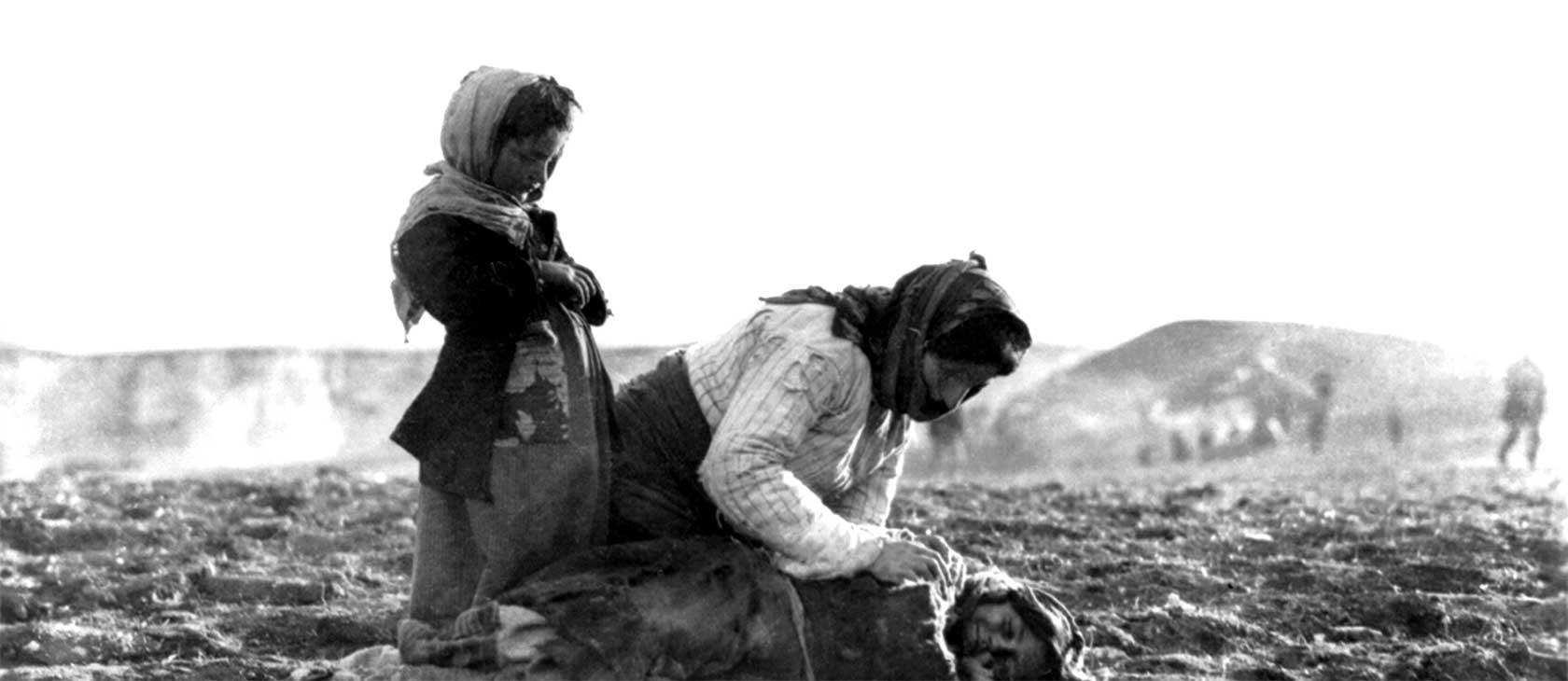
A Christian missionary working in Turkey, J.K. Marsden, described the roundup of Armenians in the town of Merzifon in the summer of 1915:
They were in groups of four with their arms tied behind their backs and their deportation began with perhaps one-hundred or two-hundred in a batch. As we afterward learned, they were taken about twelve miles across the plains to the foothills, stripped of their clothing and in front of a ditch previously prepared, were compelled to kneel down while a group of villagers with knives and axes quickly disposed of them. For a week, every night, this was repeated until twelve hundred and thirty of the leading Armenian men had been disposed of.
Exposing a buried crime
In The Thirty-Year Genocide: Turkey’s Destruction of its Christian Minorities 1894-1924 (Harvard University Press, 2019), historians Benny Morris and Dror Ze’evi have produced a new “documentary” history of the Armenian genocide that resulted from sifting through thousands of reports, letters, and diary entries from Western observers, including diplomats, military officers, Christian missionaries working in Turkey, businessmen, and other travelers. In this way, Morris and Ze’evi did an end-around the official scrubbing of the archives, or the sealing off of crucial information, that the Turkish government, they say, has engaged in systematically for decades to obliterate Turkey’s role in genocide. Yet, traces remain. The historians made use of postwar trials of war criminals in Constantinople, today’s Istanbul, and interviews published in the Turkish press. Their conclusion is damning.
“The destruction of the Christian communities was the result of deliberate government policy ...”
“The destruction of the Christian communities was the result of deliberate government policy and the will of the country’s Muslim inhabitants,” Morris and Ze’evi write. “The murders, expulsions, and conversions were ordered by officials and carried out by other officials, soldiers, gendarmes, policemen and, often, tribesmen and civilian inhabitants of towns and villages. All this occurred with the active participation of Muslim clerics and the encouragement of the Turkish press.”
The definitive “tell” of an official, coordinated Turkish program to cleanse the country of Christians, Morris and Ze’evi contend, was the slaughter and deportation of Assyrian Christians during 1914-24. Dispersed and small in numbers, shunning terrorism or military conquest, the Assyrians were without any designs on their own nation-state in Anatolia. Nevertheless, “they were murdered and expelled en masse.”
While much of what has been written about the Armenian genocide focuses on the period during World War I, Morris and Ze’evi contend that the destruction of Turkey’s Christian minorities – “a giant and continuous crime against humanity” – began much earlier, with the massacres of 1894-96. During this 30-year stretch there were periods of relative peace for Armenians, Greeks, and Assyrians. But the inevitable outbreaks of mass murder, mass rape of girls and women (“absolute sexual permissiveness vis-à-vis Christians”), the kidnapping of children, extensive plunder, and conversion to Islam at the point of a bayonet were never far away. Prosperous Armenian villages that had for centuries enjoyed peaceful relations with Muslim neighbors and Ottoman rulers were subjected to planned raids of Turks, Kurds, and others – and destroyed by the score.
Over 30 years, the authors say, the “the process of ethnic-religious cleansing was characterized by rounds of large-scale massacre, alongside systematic expulsions, forced conversions, and cultural annihilation that amounted to genocide.” Christians accounted for 20 percent of the population of Asia Minor at the close of the nineteenth century. By 1924, that proportion had fallen to two percent.
How big a role did Islam play in the genocide?
On the question of Islam’s contribution to the genocide, Morris and Ze’evi begin by observing that the religion holds to humanistic and moderate traditions, and that individual Muslims have differing views of practice, scriptural interpretation, and moral behavior. Still, the historians assert that there is “compelling evidence” that Islam was a forceful driver of the genocide of Anatolia’s Christians. “Perpetrators cited jihad and Muslim law more generally to explain and justify their actions, even to argue that their actions were obligatory,” they write. Indeed, even Mustafa Kemal Ataturk, the father of the secular, Westernized Turkish state, justified the destruction of Armenian, Greek, and Assyrian Christians as rooted in Islamic doctrine. In 1919, Western diplomats cited captured Turkish documents that pointed to Kemal and proved “beyond all doubt his responsibility for [the] disorder … by inciting to holy war.”
What of the charge by pro-Turkish writers and historians that the Armenians were a subversive element working to destabilize the nation, a fifth column that would pave the way for foreign intervention in the wake of a massively destructive and destabilizing world war? Indeed, the threat of postwar intervention by Britain, France, and Russia – and the occupations and military clashes – was an ongoing concern, as was the potential for a dismemberment of Turkey, particularly in the heavily Armenian eastern provinces. Destroying the Ottoman Christians was also seen as “payback” for the territorial losses and humiliations “meted out to the empire and the Turks since the 1820s by the Christian powers and rebellious Christian minorities, from the Balkans to the Caucasus,” Morris and Ze’evi write. Ottoman leaders and the Muslim population at large shared “a deeply ingrained feeling that the natural order had somehow been overthrown and that matters had to be put right.”
The political and military context
The European Christian powers had other things on their mind following World War I. Carving up the remnants of the crumbling Ottoman Empire was their chief concern. The French, exhausted by the Great War, had occupied Cilicia in 1919 but quickly lost any stomach for battle when faced by Kemal and his Nationalist movement. France’s chief interest was to hold onto Syria. Churchill, commenting on the peril of being drawn into a conflict of “indefinite scale” against the Nationalists for the benefit solely of “alien and predatory races [Greeks and Italians]” was worried how such a war would affect Britain’s garrisons in Egypt, Palestine, and Mesopotamia. Morris and Ze’evi observed that Kemal shrewdly played the powers off of each other. And “he never stopped telling Muslims that Turkey’s existence was imperiled by Christians abroad and at home, the great powers and the subversives who constantly invited their intervention.”
The Greco-Turkish War (1919-22) didn’t do anything to allay those fears. Greek military forces landed at Smyrna in 1919, encouraged by victorious Western allies who encouraged the Greeks. The war eventually ground into a stalemate and then a defeat, as retreating Greek forces and irregulars, the historians write, “deported Turkish villagers and townspeople, looted and torched villages, and occasionally murdered and raped.”
Indeed, Armenian revolutionary bands has been forming since the 1870s, at a time when Armenians, including the patriarch of the Armenian Orthodox Church in Etchmadzin, made appeals to the Russians for protection. One of these revolutionary bands was the Hunchaks, inspired by violent anti-tsarist ideologies in Russia. They attacked Ottoman military bases and gendarmerie posts and Kurdish bands from bases in the Caucasus and northern Iran. A chief aim, Morris and Ze’evi write, was to “provoke the authorities to take harsh countermeasures that would trigger European intervention.”
any Armenian resistance to the ongoing plunder, rape and murder ... was met with ferocious reprisals.
In practice, any Armenian resistance to the ongoing plunder, rape and murder, along with constant tribute to local Ottoman officials or Kurdish tribesmen, was met with ferocious reprisals. In Sason, during the 1894-96 massacres and after a long famine, the Armenians mounted counter raids on Muslim villagers. This was met with an overwhelming government crackdown, which began with the arrest and torture of Armenian leaders, who were also charged with sedition. One witness reported that the Turks hung one notable “by the feet from the ceiling … and literally covered his body, face, forehead and tongue with cruciform scars made with a red-hot iron.” This was just one of the “countless acts of individual sadism” the historians point to during the Thirty-Year genocide. The Turkish massacre of the Christians, they say, was “far more sadistic” than the Nazi murder of the Jews, which was in large part impersonal and organized on a highly organized industrial scale.
Amid the slaughter, there were times when the light of compassion did shine through. Muslims, at great risk to themselves, did go out of their way to protect Christians. In Ankara, in 1896, a local official refused to massacre Christians – or see them massacred – and ordered local troops to arrest marauding Turks. During World War I, a Christian missionary witnessed a heroic Turkish doctor who “sent away all his sick soldiers” from a Red Crescent hospital – and rented other buildings – so he could care for sick and wounded Armenians.
Morris and Ze’evi also described how the annihilation and deportation of Christian minorities deprived the Ottoman state of some of its most prosperous and capable citizens. This, too, was perceived as a threat to the Muslim majority. Armenians had long been dominant in the merchant class and in banking and had networks into Western Europe. At home, 20 of the 21 metalworking factories in the empire were owned by Christians; 33 raw silk production shops were owned by Christians but only six by Muslims. The “neighborly” plunder of Christian property following deportation wiped out vast private assets invested in lands and houses, household possessions, farm animals and money.
Whitewashing a bloodstained floor: Modern Turkish denial
In response to the April 2019 commemoration of the Armenian Genocide, Turkish President Recep Tayyip Erdogan – who has flatly rejected charges of a Christian genocide in his country – declared that “the relocation of the Armenian gangs and their supporters, who massacred the Muslim people, including women and children, in eastern Anatolia, was the most reasonable action that could be taken in such a period. The doors of our archives are wide open to all seeking the truth.” These would be the same archives that Morris and Ze’evi say have been scrubbed by Erdogan’s government.
As for the “reasonable” relocation of Armenians, Greeks and Assyrians, anyone reading the record assembled in Thirty-Year Genocide has to marvel at the stupendous lie that Erdogan is mouthing. The “relocation” was in fact a death march into the plains and deserts of Anatolia, by turns parched with heat or freezing cold, and where thousands perished – intentionally and far from the sight of Western observers.
Morris and Ze’evi concede that the death toll cannot be accurately fixed and that the number is in dispute. Part of the problem is that there are not agreed census figures for Armenians in the Ottoman Empire in 1914. But the authors contend that it is probable, aside from those who left voluntarily, that more than 1 million Armenians perished over the 30-year scope of their work.
The problem, as Turkey’s Erdogan shows, is that “successive Turkish governments and the Turkish people have never owned up to what happened or to their guilt,” the authors write. “They continue to play the game of denial and to blame the victims.”