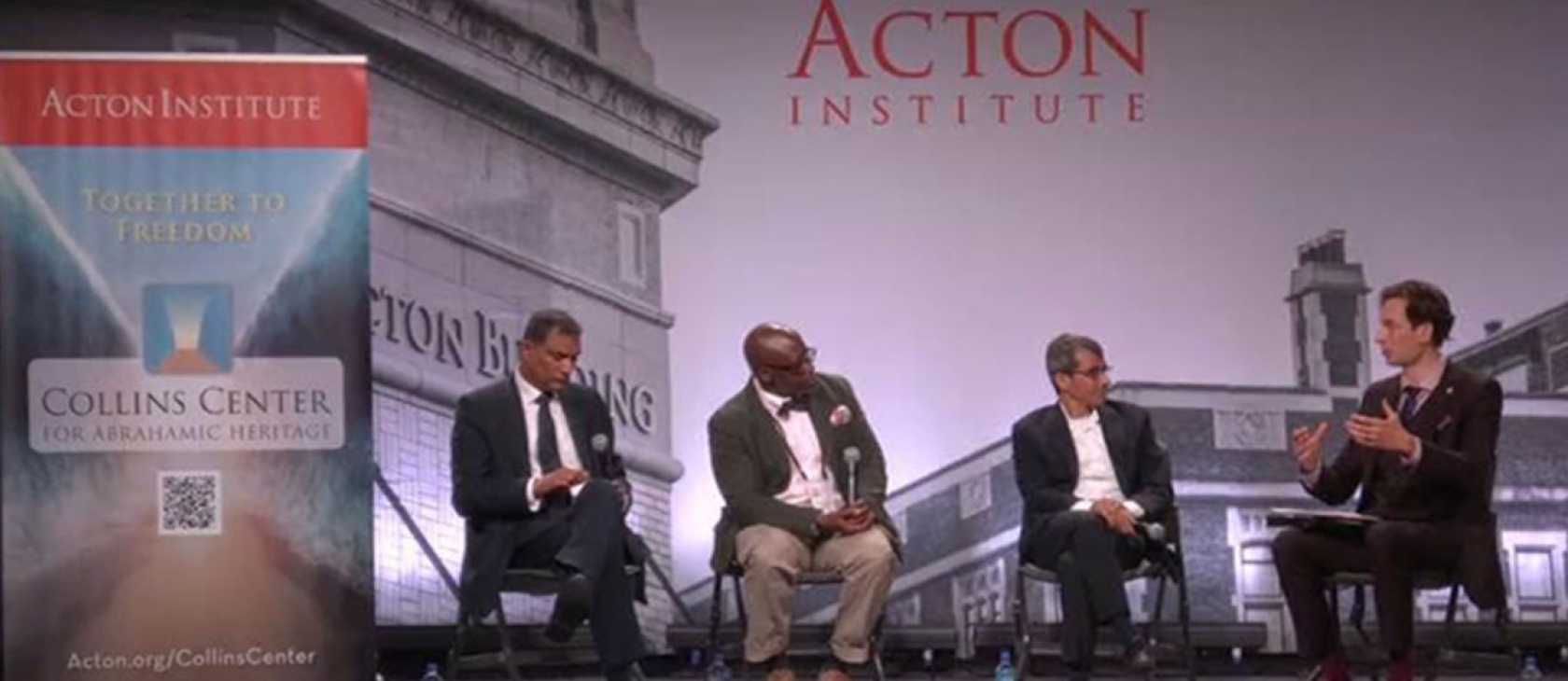
College campuses have faced contentious debates around the free expression of students and faculty and the need to ensure a safe and open public square for all. In this rare panel discussion, Jewish, Christian, and Muslim leaders engage in much-needed civil dialogue on these issues, drawing from their experience and respective religious traditions.
Panelists Include:
- Lee Dranikoff
- Dr. Anthony Bradley
- Lord Syed Kamall
- Nathan Mech (moderator)
Today, and throughout history, Judaism, Christianity, and Islam have sometimes been misused to threaten human dignity and the common good. Rather than decrying the role of religion in society, the Collins Center explores the roots of these problems and sees great opportunity to find solutions to better the world from within these religious traditions.
Judaism, Christianity, and Islam have produced many of the greatest thinkers in world history, and these rich intellectual traditions contain insights that maintain great relevance and value to addressing current challenges. Acknowledging both the commonalities and differences between religions, the Collins Center encourages genuine, robust dialogue between scholars and leaders of different faiths.
Founded in 2022 thanks to the generosity of Gilbert I. Collins and family, the Collins Center’s world-class educational programs include creating global networks of religious scholars, international conferences, book publications, and other resources. An initiative of the Acton Institute, the Collins Center diversifies Acton’s audiences and brings principles of a free and virtuous society to thousands of Jewish, Christian, and Muslim leaders worldwide.
The Acton Institute is a think-tank whose mission is to promote a free and virtuous society characterized by individual liberty and sustained by religious principles. This direction recognizes the benefits of a limited government, but also the beneficent consequences of a free market. It embraces an objective framework of moral values, but also recognizes and appreciates the subjective nature of economic value. It views justice as a duty of all to give the one his due but, more importantly, as an individual obligation to serve the common good and not just his own needs and wants. In order to promote a more profound understanding of the coming together of faith and liberty, Acton involves members of religious, business, and academic spheres in its various seminars, publications, and academic activities. It is our hope that by demonstrating the compatibility of faith, liberty, and free economic activity, religious leaders and entrepreneurs can contribute by helping to shape a society that is secure, free, and virtuous.