Research Fellow, Producer of Poverty, Inc.

mmiller@acton.org

Michael Matheson Miller is Research Fellow and Director of Acton Media at the Acton Institute. With some ten years of international experience, Miller has lived and traveled in Europe, Asia, Africa, and Latin America. He lectures internationally on such themes as moral philosophy, economic development, and social theory, and entrepreneurship. He is a frequent guest on radio and has been published in the Washington Times, The Detroit News, The LA Daily News, and Real Clear Politics.  He is the Director and Host of the PovertyCure DVD Series and has appeared in various video curricula including Doing the Right Thing, Effective Stewardship, and the Birth of Freedom.

Much of his current work at the Acton Institute involves leading PovertyCure, promoting entrepreneurial solutions to poverty in the developing world.  Before coming to Acton, he spent three years at Ave Maria College of the Americas in Nicaragua where he taught philosophy and political science and was the chair of the philosophy and theology department.

Miller received his bachelor’s degree from the University of Notre Dame, an M.A. from Nagoya University’s Graduate School of International Development (Japan), an M.A. in philosophy from Franciscan University, and an M.B.A. in International Management from Thunderbird Graduate School of Global Business. He serves on the President’s Advisory Council of Aquinas College in Nashville, the board of the Dietrich von Hildebrand Legacy Project, and the board of trustees for Angelico Press

Recent Articles by Michael Matheson Miller

  • Following the crowd: Rene Girard on the denial of Peter

    This week, June 29, was the solemn feast of Saints Peter and Paul. The Apostle Peter is remembered for many things: his declaration of Jesus as the Messiah; his boasting of fidelity, followed by his threefold denial of Christ; and his subsequent repentance and heroic martyrdom

    The late French anthropologist and former Stanford professor Rene Girard has an insightful discussion about the denial of Peter and the problem of scapegoating and contagion. He sees in it an archetype of the whole human race.

    Girard argues that this scene is one of the most powerful stories in the Gospels, and in all literature. He says that “Peter is all man—and men cannot resist mimetic contagion. When you are in a crowd, you become literally possessed by the crowd.”

    Girard warns that we should not simply think of this as Peter’s personal psychology and fear. Peter is not a “special case” or “weak individual.” He is representative of contagion and a willingness to go along with the crowd. Girard also observes that Peter’s denial of Jesus was not spurred on by a violent mob, or even first by a group. It begins with a servant girl, a young lady. This seemingly insignificant...

  • Economics and the social nature of the person

    At the center of the economy are human persons.

    Economics must first be a human discipline before it can be a technical one.  One of the essential characteristics of the human person is that we are social beings.

    While each of us is a subject and a unique and unrepeatable person, we achieve human flourishing and moral perfection in relationship with others. We cannot do this alone. We are neither radical individuals, nor are we indistinct parts of a collective.  We are social beings.

    We are individual substances, yet we are also in relationship with and dependent upon others right from the beginning or our existence.  We are born into a family and into a society, and a culture.  But we don’t exist solely for the family or the society.  We are as the late Jesuit philosopher, Norris Clarke describes in his book Person and Being, “substance-in-relationship”

    This is complex and requires thoughtful reflection.  Because we like things simple, we tend to stress one side or the other. At the social extreme we see the person as merely part of a collective who exists for the good of society or the state.  We can see this in ancient civilizations...

  • Nisbet and Dalrymple on community, authority, function, and tattoos

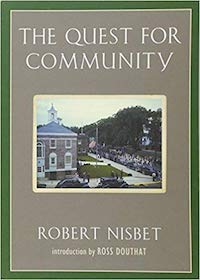
    In his must-read book, The Quest for Community, Robert Nisbet discusses the relationship of community and authority.

    Communities provide human connection and sense of belonging, but they also come with limitations. They make demands up us to do certain things, to hold fast to certain beliefs. You can’t simply do whatever you want and still remain part of a community.
 Community without authority is not real community.

    'The Quest for Community' by Robert NisbetThis is of course one of the tensions of contemporary life.  We all want community, but we don’t want any limitations.  We want friendship, meaning, and deep relationships without the moral demands of family, religion, or tradition. This the false promise of modern liberation: all the freedom you want apart from any tradition and all at the low price of no cost.

    But there is a cost and it includes among other things anxiety, isolation, loneliness, broken families, and social disorder. (You may have noticed that many of the elites who peddle this liberation don’t actually practice what they preach.)

    The loss of community doesn’t simply affect our personal lives. It has political import. When people lack authentic community and authority from traditional sources like the family, civil associations, and religion, they go looking...

  • Here I come to save the World Bank

    Recently, Professor Jeffrey Sachs made a public application to be the next president of the World Bank with an op-ed in The Washington Post titled